European Commission adopts 19th package of sanctions on Russia
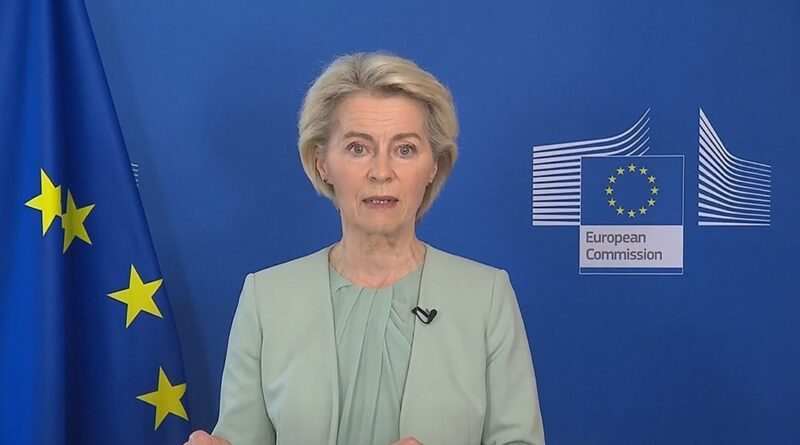
The European Commission (EC) adopted on September 19 the 19th package of sanctions on Russia, EC President Ursula von der Leyen announced, calling on EU member states to quickly endorse the sanctions.
As adopted by the EC, the sanctions include a ban on imports of Russian LNG into European markets, a targeting of financial loopholes Russia uses to evade sanctions, sanctioning more vessels in Russia’s shadow fleet, and new direct export restrictions for items and technologies used on the battlefield.
In a video address, Von der Leyen said unfortunately, over the past month, Russia has shown the full extent of its contempt for diplomacy and international law.
“It has launched some of the largest-scale drone and missile attacks against Ukraine since the beginning of the war, striking government buildings and civilian homes alike, hitting our EU office in Kyiv, the representation of our Union. The threats to our Union are also rising,” Von der Leyen said.
She said that in the past two weeks, Russian Shahed drones had violated the European Union’s airspace in both Poland and Romania.
“These are not the actions of someone who wants peace. Again and again, President Putin has escalated. And in response, Europe is increasing its pressure.”
First, on energy. Russia’s war economy is sustained by revenues from fossil fuels, Von der Leyen said.
“We want to cut these revenues. So we are banning imports of Russian LNG into European markets. It is time to turn off the tap,” she said.
“We are prepared for this. We have been saving energy, diversifying supplies and investing in low-carbon sources of energy like never before.”
Today, these efforts pay off, Von der Leyen said.
“Then, we have just lowered the crude oil price cap to 47.6 USD,” she said.
“To strengthen enforcement, we are now sanctioning 118 additional vessels from the shadow fleet. In total, more than 560 vessels are now listed under EU sanctions.”
Major energy trading companies Rosneft and Gazpromneft will now be on a full transaction ban, she said.
:And other companies will also come under asset freeze. We are now going after those who fuel Russia’s war by purchasing oil in breach of the sanctions.
“We target refineries, oil traders, petrochemical companies in third countries, including China. In three years, Russia’s oil revenues in Europe have gone down by 90 per cent. We are now turning that page for good.”
On the targeting of the financial loopholes which Russia uses to evade sanctions,” Von der Leyen said: “We are putting a transaction ban on additional banks in Russia and on banks in third countries”.
“We are stepping up our crackdown on circumvention. As evasion tactics grow more sophisticated, our sanctions will adapt to stay ahead.
“Therefore, for the first time, our restrictive measures will hit crypto platforms. and prohibit transactions in crypto currencies. We are listing foreign banks connected to Russian alternative payment service systems. And we are restricting transactions with entities in special economic zones.”
Von der Leyen said that the sanctions add new direct export restrictions for items and technologies used on the battlefield.
“We also list 45 companies in Russia and third countries. These companies have been providing direct or indirect support to the Russian military industrial complex. In a war driven by innovation, cutting off Russia’s access to key technologies is crucial. Above all when it comes to drones.”
She said that the EC’s economic analysis is clear: “Our sanctions are severely affecting Russia’s economy.
“The interest rate is at 17 per cent. Inflation is persistently high. Russian access to financing and revenues are consistently decreasing.
“And Russia’s overheated war economy is coming to its limits,” Von der Leyen said.
“Even more interesting is that when speaking directly with partners that speak to Russia, they say that among the first Russian requests is, sanctions relief. We know that our sanctions are an effective tool of economic pressure. And we will keep using them until Russia comes to the negotiation table with Ukraine for a just and lasting peace.”
She said that, as she had announced last week, “we are working on a new solution to finance Ukraine’s defence efforts based on the immobilised Russian assets”.
“We must be very clear: This is Russia’s war, and the perpetrator must pay for it. With the cash balances associated to these Russian assets, we can provide Ukraine with a Reparations Loan. The assets themselves will not be touched. And the risk will have to be carried collectively. Ukraine will only pay back the loan once Russia pays reparations. We will come forward with a proposal soon.”
She said that the EC was aligning the sanctions with the G7 partners, under the steer of the Canadian presidency.
“And to support Ukraine in its fight for freedom, we are also working in lockstep with the Coalition of the Willing.
“Europe has been by Ukraine’s side from the very beginning. Faced with Russia’s escalation, Europe stepped up to the challenge,” Von der Leyen said.
“We will continue to use all the tools at our disposal to bring this brutal war to an end. I now call on the member states to quickly endorse these new sanctions. We want Russia to leave the battlefield and come to the negotiating table. This is the way to give peace a real chance.”
(Screenshot via the EC Audiovisual Service broadcast of Von der Leyen’s announcement)