
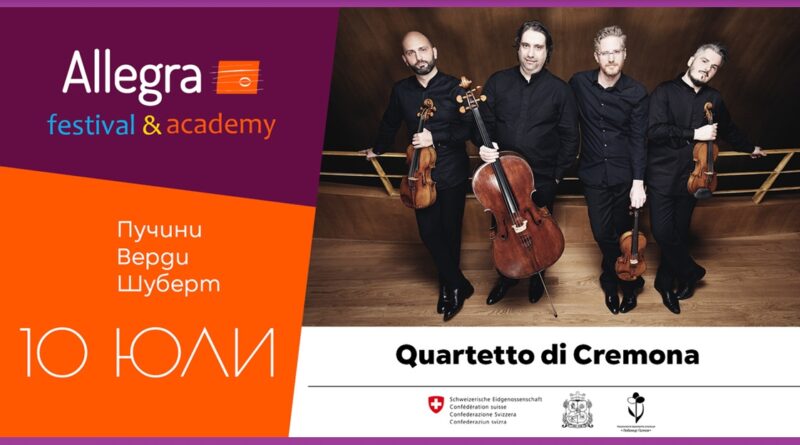
Simone Gramaglia: Allegra Festival is a small miracle of culture and beauty
The Allegra Festival is a small miracle of culture and beauty, of passion and hope for our profession.
These are the words Simone Gramaglia uses to describe the festival, which he will inaugurate together with Quartetto di Cremona on July 10 at the Military Club in Sofia.
You are celebrating 25 years on stage. What is the secret to this artistic longevity?
It comes down to two things: an endless love for what we do, and a great stroke of luck. The luck of having found three people with whom you can share a life on stage for so long. In the end, it is simply love and luck.
Quartetto di Cremona is a world-known ambassador of talent and the power of music to inspire. What inspires you?
We are inspired by the beauty of what we imagine and pursue. String quartet music stands among the highest forms of expression for string players, and even after 25 years, every time we revisit a piece or discover something new, it reveals an inexhaustible source of inspiration. Quartet music is like a fountain of youth—endless, beautiful, eternal.
Simone, this is your second return to the Bulgarian stage, and you and your colleagues will give a masterclass to young musicians. Do you remember your first encounter with a master teacher?
First of all, it is a great joy to return to such a vibrant festival, full of energy, wonderful artists, and a passionate, inspiring team. Working with young musicians in this setting is a privilege. I remember my teacher Luigi Brusini with great affection. I started relatively late—I was 16 when I began playing a string instrument, and I met the viola immediately. He guided me, believed in me, and gave me the confidence that eventually led me to the teacher who changed my musical and technical life: Michael Kugel. I still remember meeting him in Chioggia at 19. With him, I learned everything I know today.
What is the best piece of musical advice another artist has given you?
From Piero Farulli: when you truly believe in something, go forward—no matter what.
Do you have any rituals or routines before going on stage?
Not really. We are quite natural. But if anything, we like to exchange a few ridiculous jokes before walking on stage.
How has your relationship with your instrument evolved over the years?
It has been a long love story. Over time, I learned how to make these few pieces of wood speak with their unique magic. I began with modern instruments, which I loved and which taught me everything I needed, before moving to older ones. I discovered that it is not about force, but about elegance, lightness, and the right gesture. I have been fortunate: in 25 years I have played at least four Stradivari violas, a magnificent 1584 Andrea Amati in Taiwan, an extraordinary Torazzi, and now the unique Maggini “Joyce,” thanks to the Pro Canale Foundation in Milan. The search for sound through these instruments is endless—it keeps teaching me.
What is the biggest misconception people have about being a classical music artist?
There are two major clichés. The first is the idea of the “genius and madness” artist—the belief that to be great you must be disorganized, chaotic, somehow detached from reality. It is simply not true. Musicians, especially those with serious careers, must be highly organized and capable of managing far more than just music. Just read Beethoven’s letters, or Toscanini’s—what discipline and control they required.
The second misconception is that musicians are always on holiday, doing what they love without effort. We are partly to blame—we often share images of dinners and celebrations. But behind every performance there is immense work: joy, yes, but also struggle.
Looking back, what is one thing you know now that you wish you knew when you started your career?
I wish I had known that most things that seem terribly difficult are not so difficult—and that most of what we fear will happen, simply does not. One could approach a career with much greater calm.
You have already been a guest at Allegra twice. What are your impressions of the festival? What are your colleagues expecting from their first visit to Bulgaria?
The Allegra Festival is a small miracle of culture and beauty, of passion and hope for our profession. The team is extraordinary, attentive to every detail. For me, it is a joy to return for the third time to work in Sofia—a beautiful city with a warm and attentive audience. I have shared all this with my colleagues, who are eager to come. We are all looking forward to playing and bringing the music of the Quartetto di Cremona to you.
Detailed information about the festival program, the soloists, and tickets for the concerts can be found at https://allegrafestival.com/bg/concerts/2026-summer/.
The Allegra Festival and Academy is held under the patronage of the Embassy of Switzerland, with the financial support of the Ministry of Culture and the Sofia Municipality through the Cultural Events Calendar and the Sofia Culture Programme. The Sofia Globe is a media partner of the festival.


