
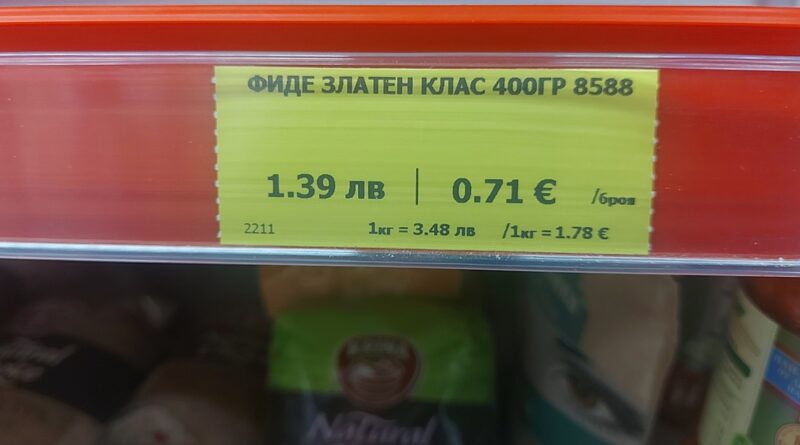
Bulgaria and the euro: Dual price display ends on August 8 2026
The one-year period of mandatory dual display of prices in leva and euro in Bulgaria ends on August 8 2026, the government’s official evroto.bg website said.
Dual display of prices in leva and euro was a temporary measure aimed at helping consumers get used to the euro currency more easily and preventing unfair price increases by traders, the website said.
From August 9 2026, merchants shall announce the selling and payable prices of the goods and services they offer in euro.
At their discretion, merchants may continue to indicate the lev equivalent of the prices for informational purposes only.
When the trader voluntarily continues to indicate the lev equivalent, it must be clearly evident that the price in euro is the only selling and payable price, and the value in leva is for reference only. Prices in euro and leva must be displayed clearly and correctly, in a manner that does not mislead consumers.
When comparing prices, keep in mind that currency conversion must be carried out at the official fixed rate: 1 euro = 1.95583 leva, as fixed in Article 12 of the Euro Adoption Act.
After currency conversion, amounts in euro are rounded according to the legally defined rules, which include mathematical rounding to the second decimal place (Article 13 of the Euro Adoption Act) and a prohibition on causing harm to consumers (Article 7 of the Euro Adoption Act).
The Euro Adoption Act does not provide for a special transitional period regarding the use of menus, price lists, catalogues, brochures and other printed materials with dual prices after the expiry of the dual price period.
However, this does not mean that all such materials must be destroyed or completely reissued as of August 9 2026. They may continue to be used when the price in euro is the current payable price, and the lev value remains reference and non-payable.
Even after the expiry of the dual price indication period, consumers continue to be protected against incorrect currency conversion and unfair commercial practices, the website said.
In cases where a trader has increased the prices of the goods or services offered without objective economic justification, as well as in cases of violations related to receipts, invoices or other payment documents, reports are submitted to the National Revenue Agency. In cases of violations committed by banks, including in relation to currency exchange, fees or customer service, reports are submitted to the Bulgarian National Bank.
Since the beginning of the introduction of the euro in the country, 1550 fines and about 700 penal decrees have been issued under the Euro Introduction Act, totaling 1.8 million euro, according to official data from the National Revenue Agency.
It is important for the public to know that the end of mandatory dual denomination does not change their rights and does not mean that the possibility of exchanging leva has ended, the website said. Lev banknotes and coins can continue to be exchanged for euro under the conditions provided for by law.
Commercial banks in Bulgaria will continue to exchange leva into euro until December 31 2026, with some banks keeping the service free of charge, while others have introduced fees after the initial free period expires on June 30 2026.
For the exchange of cash amounts more than 30 000 leva, a prior request is required, as provided for in the Euro Adoption Act. The purpose of the requirement is to guarantee the necessary availability.
Bulgarian National Bank will exchange leva into euro without a fee, without a limit on the amount and without a deadline.
When exchanging leva into euro at Bulgarian Posts for amounts up to 1000 leva, the fee is six euro, from 1000.01 to 3000 leva – 7.20 euro, from 3000.01 to 6000 leva – 8.80 euro, and from 6000.01 to 10 000 – 10 euro.
Public awareness remains key to the successful adaptation to the euro, the website said. Therefore, the Ministry of Finance and partner institutions will continue to provide up-to-date information and clarifications on all issues related to the use of the single European currency.
(Archive photo: Clive Leviev-Sawyer)