
VDL spells out measures to respond to Middle East crisis’s enormous impact on EU economy
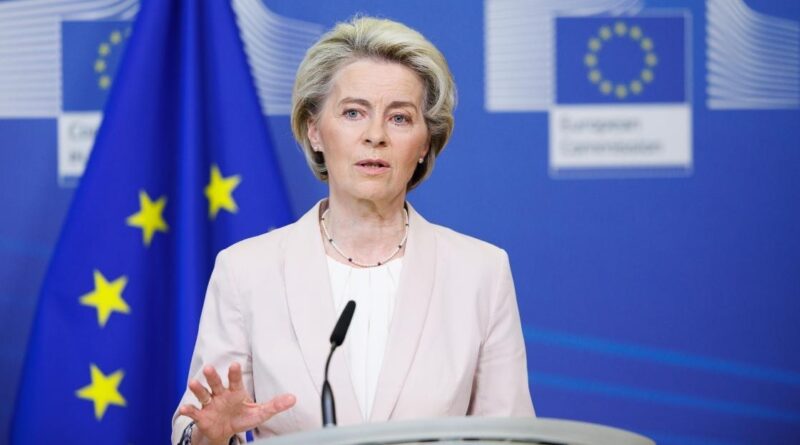
European Commission President Ursula von der Leyen, in a statement on April 13, spelt out measures discussed at a coordination council meeting to respond to what she described as the enormous impact from the Middle East crisis on the European Union’s economy.
“Since the beginning of the conflict – 44 days ago –, our bill for fossil fuel imports has increased by over 22 billion euro,” Von der Leyen said.
“Forty-four days, 22 billion euro – not a single molecule of energy in addition. This shows the enormous impact this crisis has on our economy,” she said.
Von der Leyen said that even if hostilities ceased immediately, the disruptions to energy supplies from the Gulf will persist for some time to come.
“Therefore, we also discussed a series of measures that we will present to leaders at the next informal European Council in Cyprus next week,” she said.
“First and foremost, it is important that we have a robust coordination among the Member States,” Von der Leyen said.
“We have demonstrated this in the 2022 energy crisis with the EU Energy Platform,” she said.
“We are also looking into EU-wide coordination of Member States’ gas storage filling, to avoid that many Member States go to the market at the same time, so they are competing against each other.
“We will also coordinate oil stock releases, to achieve the largest possible effect of these releases. And we will ensure that Member States’ emergency measures will not impact the Single Market. That is the ‘coordination’ part.”
Von der Leyen said that the second element discussed was how to approach the different measures that Member States might apply to better protect vulnerable households and sectors from high energy prices.
“The measures should be targeted to vulnerable groups, timely – they have to be fast, not in a year but immediately – and temporary – so for a short amount of time you can apply them, but if they are cast in law, you have to make sure that you get out of the measures in a timely manner,” she said.
“We will discuss with the Member States and show some typical best practices – how to design income support schemes.
“And already this week, we will consult Member States on more flexible State aid rules – that is an important tool too –, to give Member States more space for temporary State aid support in the most exposed sectors.”
Von der Leyen said that her goal wass that this temporary State aid framework should be adopted still this month.
The third element is “how can we reduce the demand., more can be done to reduce demand”.
“At the same time, we also need more structural measures, to bring down energy prices and give relief to citizens and businesses,” she said.
“We already had constructive discussions in the last European Council on the four cost components for the energy bill.”
There are two other cost components: electricity taxes and grids charges, Von der Leyen said.
“Work is advancing on legislative proposals with which we will come. Today’s discussion confirmed that we will present these legislative proposals in May,” she said.
“Finally, we discussed the biggest chunk of the energy bill: the energy source itself. Let me recall and widen the picture for a moment: The Strait of Hormuz is essentially closed, and immediately citizens feel the impact at the gas station, in the supermarket and on the household bills.
“What we are seeing in the Middle East is not some distant crisis. But in a world in which everything is connected, the effects are direct and immediate.”
This is the second fossil fuel crisis in just a few years, Von der Leyen said.
“There is one thing that all these events are making clear: we are paying a very high price for our overdependency on fossil fuels. And the grim reality for our continent is: fossil fuel energy will remain the most expensive option in the years to come.”
But on the other hand, Europe also has assets, she said: “That is electricity produced in Europe from renewables and nuclear.
“And therefore, our strategy to decarbonise has not only been confirmed in the last years but is growing in importance day by day,” she said.
“And our objective is clear: we need to scale up the homegrown, affordable, reliable energy. That is the wide range of renewables we have, but it is also the nuclear energy of course. Because they give us independence, predictability and energy security.
“The only lasting way out of the fossil dependency is to modernise by shifting electricity generation to renewables and nuclear, and by electrifying the economy as rapidly as possible.”
She said that the EU also needs to accelerate “the electrification of our economy; of our industrial operations, of how we heat our homes, of our mobility”.
“In other words: electrifying Europe means making Europe more independent.”
Von der Leyen said that the Commission would present its electrification strategy before the summer as well.
“This will include an ambitious new target on electrification. Only what gets measured gets done. To achieve this, we have to remove any remaining regulatory obstacles and to mobilise investments.”
Von der Leyen said that regarding public money, she would again encourage the Member States to make better use of the EU funding we have, for example the Cohesion Funds.
“The money is there, you can invest it – in grids, in storage, in batteries,” she said.
“Please use that money now, because we need to improve our energy system. But public money is not enough – so we also need much more private capital. We will therefore convene an Investment Conference to mobilise private investments in these areas.”
(Photo: EC Audiovisual Service)


