
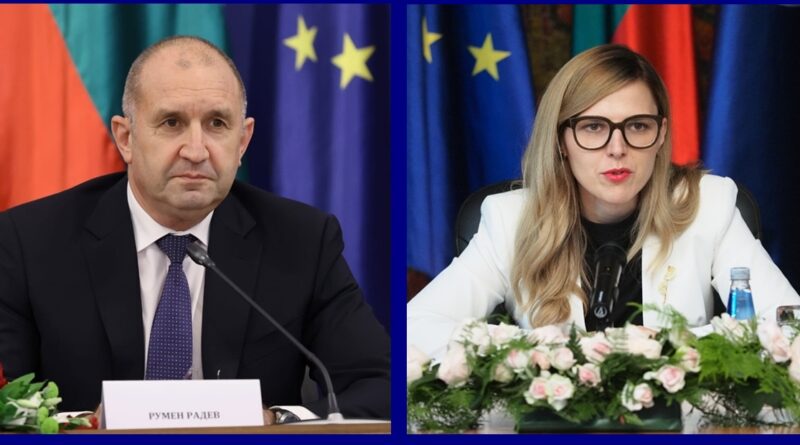
Statements by Bulgaria’s PM and Foreign Minister on Ukraine further fuel controversy
From denial of a contradiction in government policy on Ukraine, to alarmist talk of nuclear weaponry and a “storm in a teacup”, statements by Prime Minister Roumen Radev and Foreign Minister Velislava Petrova on July 17 further fuelled controversy over this week’s Kyiv Declaration.
This week saw the publication of a declaration on the official website of the President of Ukraine following the July 15 Ukraine – Southeast Europe summit, listing Bulgarian Foreign Minister Velislava Petrova’s name and including several points diametrically different from stances taken publicly by Radev.
These include backing for the Coalition of the Willing, from which Radev has withdrawn Bulgaria, a call for tightening of sanctions on Russia, which Radev opposes, financial and military aid for Ukraine, which Radev also opposes, and a special tribunal for Russian ruler Vladimir Putin, which, in turn, Radev opposes.
Petrova and Radev faced questions from reporters in the corridors of Parliament on July 17, a day after opposition parties slammed the government over the apparent duality of its policy on Ukraine.
It was put to Petrova that it was not clear which side Bulgaria is on – Russia’s or Ukraine’s – and she was asked who should win the war.
“I think that attempts to get into one position or another… The war should end with a peace agreement that would be lasting, that would provide guarantees for the security of Ukraine. And Europe should have a key role there,” Petrova said.
Asked if Bulgaria was neutral, Petrova said no.
Asked who started the war, she replied: “Of course…we all know who started this war” and when pressed, said: “Russia… I think that attempts to introduce a dialogue that could divide society are very unproductive, even dangerous.
“And I advise each of us to focus on what Bulgaria can do right now, so that it can protect its national interest and at the same time be useful, so that the European Union as a whole can be an active participant in these peace negotiations and that they can happen,” Petrova said.
Asked again whether Bulgaria was neutral in the war between Russia and Ukraine, Petrova said “Thank you!” and walked away.
Radev, asked what was in Bulgaria’s interest – whether Russia wins or does not win the war against Ukraine, said: “I stated the Bulgarian position very clearly in Brussels to our partners, in Ankara, and in Paris. Bulgaria is part of the common European decisions, but Bulgaria will not and does not provide weapons and financial resources. This is clear…”
Asked if Bulgaria has an interest in Russia not winning the war, Radev said: “At the same time, we continue – where we consider it appropriate – to develop our relations with Ukraine”.
Radev, to the question whether he still thought that Russia could not lose the war against Ukraine – a reference to an opinion he expressed in 2022 when president – said: “I don’t see a winner in this war. And that’s the most worrying thing for me, because every day this war – I said it years ago – the war begins to expand its spatial scope.
“Has it happened? It has happened. We already have strikes at a depth of 2500 km. All of Ukraine is under attack in depth. Russia will soon be as far as… it’s already in Siberia… waiting in Siberia. What do you think – doesn’t this expansion of the spatial scope cause concern,” Radev said.
When it was put to him that if Ukraine is not helped, it would be crushed, he said: “Doesn’t this escalation cause concern, because I also told our Western partners: Chernobyl was news for many countries far to the west, but for us – the younger ones don’t know – but for us Chernobyl was reality”.
“And it affected the health of thousands of people. We see how there is news about attacks on nuclear power stations every day, we see how the escalation is growing and we could become witnesses – I don’t want it and it really shouldn’t happen – of a tactical nuclear strike. Then you answer the question of what this leads to,” Radev said.
Radev insisted that Bulgaria had not signed by Kyiv Declaration, while Petrova said that such documents were not signed.
“Such type of declarations are not signed. Declarations of this type are constantly accepted in different formats,” Petrova said.
Unlike Radev, she did not question why Ukraine named her in the document. She simply believes that it does not commit her to anything.
“These points do not commit us in any way. We give the other countries the opportunity to support (Ukraine) as they see fit. Since this is not committing, it is not a problem for us. If it committed us, we would express (objections),” Petrova said.
Did Bulgaria have any objections to the text of the declaration?
She said no – even though the document had been provided in advance as a “ready-made text”.
According to Petrova, “there is already established language from previous such meetings, in which previous Bulgarian governments participated.”
“There was no discussion of this declaration during the forum. The focus was on ways to help Ukraine. Different countries can do it in different ways, we can in the energy sector,” she said.
Serbian President Aleksandar Vucic, who also participated in this forum, did not support the declaration and – as can be seen in its content – his name is not mentioned. Unlike the name of Petrova.
She tried to make a distinction along the lines of Serbia not being a member of the EU – but the declaration also includes other non-EU countries such as North Macedonia, Moldova and Montenegro.
However, it became clear that Petrova has an explanation for the reasons for the controversy, which she said she considers a “storm in a teacup.”
“On Monday, we clearly showed that Bulgaria can defend its national interest and still not be isolated, that our reservations can come out of the sanctions package and yet we can support it.” This was a reference to Russian Patriarch Kirill, Lukoil owner Vagit Alekperov, and the chairman of the association that supplies Sofia metro locomotives with spare parts, Iskandir Makhmudov, being removed from the EU’s proposed 21st sanctions package against Russia at the request of Bulgaria.
“The truth is that for the first time Bulgaria is fighting for its national interest, and not blindly following instructions from other embassies,” she said.
Ivailo Mirchev, an MP for opposition Democratic Bulgaria, said on July 17: “We call on President Yotova to convene a Consultative Council on National Security as soon as possible, given the geopolitical risks facing our country, unprofitable energy projects and talk of tactical nuclear strikes”.
Mirchev said that Bulgaria has de facto supported the Kiev Declaration in support of Ukraine and with a commitment to increased participation in the Coalition of the Willing.
“First we heard the categorical position of Prime Minister Radev that Bulgaria will not remain in the Coalition of the Willing. Then, however, the Foreign Minister went to Kyiv and agreed to the content of the declaration,” Mirchev said.
“We see that many people expect to see ink and a signature on the international protocol. There is no such practice,” he said.
“Always at such meetings, when the parties have unanimity between them, there is informed consent. If any of the parties does not agree with the declaration, this is stated explicitly. This is the case with Serbian President Vučić, who did not join and is not on the list of parties. In other words, Bulgaria has joined the entire declaration and is on the same page with Ukraine and all its allies,” Mirchev said.
He said that the Radev Cabinet’s divergent foreign policy signals are weakening Bulgaria’s position – especially in relations with its international partners.
“They expect security and predictability on Nato’s Eastern flank from Bulgaria, and today they are getting exactly the opposite,” Mirchev said.
He described Radev’s warning today about a possible tactical nuclear strike by Russia as a frivolous statement used mainly by Russian propaganda.
GERB-UDF MP Daniel Mitov, a former foreign minister, said on July 17: “Why the name of our foreign minister is included in the dispositive as part of this declaration on Ukraine must now be answered by the diplomatic service and the foreign minister”.
“I don’t know how it is possible for President [sic] Radev to come out and say: she did not sign the declaration. Since her name is there, it means she signed it,” Mitov said.
“It should become clear from their own actions to clarify the case how this happened. But this is not a good signal at all – neither to partners, nor to allies, nor to Ukraine. The fact is that they clearly do not know what they are doing. Do they have any concept at all of what position Bulgaria supports on certain geopolitical topics?” he said.
Georg Georgiev, a GERB-UDF and former foreign minister, said: “We are not just present in the declaration, but we are constituted as co-authors of the declaration.
“It is very well written, understandable and it is clear that those who are listed take on the relevant messages and express them,” Georgiev said.
This is either a huge political blunder or a clear and deliberate move that serves the strategy of “one thing at home, another abroad”, he said.
(Photos: Bulgaria’s Foreign Ministry and government.bg)


