
PM Radev: ‘No contradiction’ in Bulgarian government’s position on the war in Ukraine
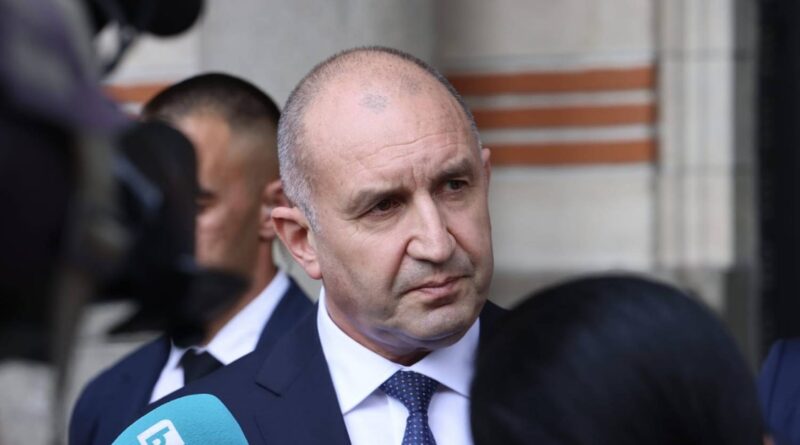
There is no contradiction in the government’s position regarding the war in Ukraine, Bulgarian Prime Minister Roumen Radev told reporters in Parliament on July 17.
This follows the publication of a declaration on the official website of the President of Ukraine following the July 15 Ukraine – Southeast Europe summit, listing Bulgarian Foreign Minister Velislava Petrova’s name and including several points diametrically different from stances taken publicly by Radev.
These include backing for the Coalition of the Willing, from which Radev has withdrawn Bulgaria, a call for tightening of sanctions on Russia, which Radev opposes, financial and military aid for Ukraine, which Radev also opposes, and a special tribunal for Russian ruler Vladimir Putin, which, in turn, Radev opposes.
Radev told reporters that Petrova had not signed such a document despite the official announcement on the Ukrainian Presidency’s website, which included her name, as well as a photo that appeared from the signing.
“Did you see a signature? There is no signature and you will not see one, so I am surprised with what confidence you are spreading the opposite information,” Radev said.
Asked why Petrova’s name appeared on the official announcement of the signing on the Ukrainian Presidency website, Radev laconically replied, “ask the hosts.”
“Minister Petrova went there [to Kyiv] to continue the talks I had with President Zelenskyy. Within a month, we held three meetings requested by him during various international events,” Radev said.
Radev categorically rejected the rumours that have emerged about a misunderstanding in the Cabinet regarding the war in Ukraine.
He said the discussions in which Petrova participated were about energy and the economy.
“These were important talks about mutually beneficial cooperation in energy and the economy. Mrs. Petrova continued this dialogue. There were also talks with Naftogaz, in which we see serious potential and prospects,” Radev said.
“Bulgaria is part of the common European solutions, but Bulgaria will not and does not provide weapons and financial resources. We continue where we consider it appropriate to develop our relations with Ukraine,” he said
Petrova told reporters on July 17 that Bulgaria has not signed the Kyiv Declaration and had not made any commitments to participate in the Coalition of the Willing.
She said that artificial tension is being created around the document, although such declarations are not subject to signing.
“No one has signed any declaration. This type of declaration is not signed. They are accepted in various international formats all the time,” Petrova said.
“It is high time to stop the speculation. It is interesting that such a storm in a teacup is developing exactly this week . It is good to think about why exactly this is happening , because on Monday we clearly showed that Bulgaria can defend its national interest and still not be isolated, but on the contrary – that our reservations should be taken into account,” she said.
This week Russian Patriarch Kirill, Lukoil owner Vagit Alekperov, and the chairman of the association that supplies Sofia metro locomotives with spare parts, Iskandir Makhmudov, were removed from the EU’s proposed 21st sanctions package against Russia at the request of Bulgaria.
According to Petrova, the main topic of the July 15 meeting in Kyiv was not the discussion of the text of the declaration, but the specific ways to assist Ukraine .
She said that the text of the declaration was provided to the participants in advance and uses established wording from previous similar meetings.
Petrova said that the individual points in the declaration do not create specific obligations for the countries.
“These points do not commit us in any way. We give the opportunity to other countries to support in the way they see fit,” she said.
According to her, Bulgaria has participated in previous similar international formats, and the presence of a foreign minister, instead of a head of state or government, is a common diplomatic practice.
Petrova rejected claims that Bulgaria is isolated within the European Union because of its positions: “There is no fear of isolation. On the contrary, for the first time in a very long time, the Bulgarian position is being generated in Bulgaria.”
According to Petrova, the truth is that for a long time now, ” Bulgaria has been fighting for its national interest, not blindly following instructions from other embassies . And it is high time we accepted that this will be the case from now on,” she said.


