
Opposition slams Bulgarian Foreign Minister over handling of Iran issue
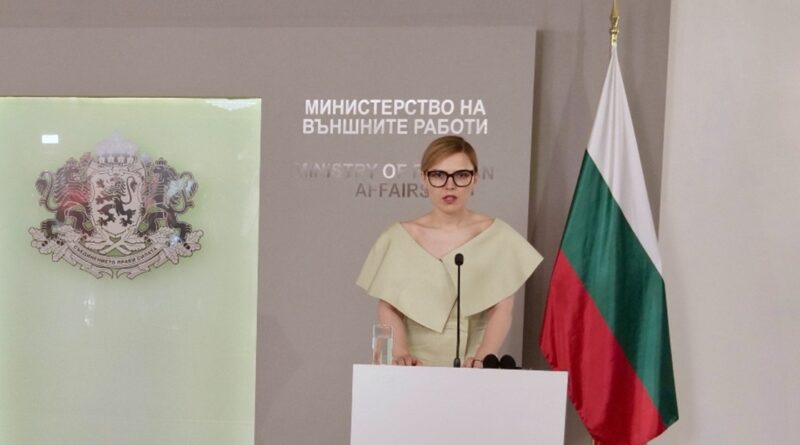
Opposition parties slammed Bulgarian Foreign Minister Velislava Petrova on July 31 over her handling of relations with Iran.
A July 30 statement by Bulgaria’s Foreign Ministry said that Petrova had spoken by phone to her Iranian counterpart Abbas Araghch, with the statement emphasising “good relations” and quoting Petrova as reassuring Araghch that US aircraft hosted in Bulgaria would not be used against Iran.
The Foreign Ministry statement reflected nothing of what Araghch said, with it emerging hours later that he told Petrova that “The Bulgarian government’s approval of a US request to deploy military aircraft at Bezmer Air Base in support of military operations is, in our view, condemnable, unacceptable and inconsistent with the traditionally friendly relations between the two countries”.
He reportedly urged Sofia to “urgently reconsider” the decision.
Araghch cited a 1974 United Nations General Assembly resolution that he said could be interpeted to define Bulgaria as an aggressor.
This is the third time that Iran has sharply criticised Bulgaria for agreeing to host the US aircraft, which the US embassy in Sofia has said are in support of operations in the Middle East.
Opposition GERB-UDF MP and former foreign minister Daniel Mitov, in a declaration in the National Assembly on July 31, said that Bulgaria should have first made an official diplomatic demarche and requested an explanation from the Iranian ambassador as to whether Tehran’s words posed a threat to the country, its citizens, or its infrastructure.
Mitov said that, instead, the foreign minister had a telephone conversation with her Iranian counterpart, which, according to official information, began with assurances of “good relations”, mutual trust and the lack of intention to carry out direct military actions from Bulgarian territory.
“Bulgaria finds itself in the position of having to explain its own decisions, while the other side continues to publicly insist that the National Assembly reconsider them,” Mitov said.
“This is not the signal that a member state of Nato and the European Union should send. The correct diplomatic sequence would be the opposite – first, an official protest against any ambiguous suggestion of retaliatory actions against Bulgaria,” he said.
“Second, insisting that Iran explicitly state that it does not consider Bulgarian citizens, Bulgarian institutions, Bulgarian infrastructure as a possible target and only then a political conversation between foreign ministers aimed at limiting tension and clearly presenting the Bulgarian position,” Mitov said.
“This would not mean escalation, but means that Bulgaria is talking calmly, but from the position of a country that does not allow doubt about its sovereignty,” he said.
On July 31, opposition Democratic Bulgaria co-leaders Bozhidar Bozhanov and Ivaylo Mirchev told reporters in Parliament that Prime Minister Roumen Radev spread fear in every way on the topic of Iran, both as when president and as a candidate for Parliament, which is why he fell into his own trap.
“The mess with Iran is due to Roumen Radev’s long-term positions and the fear he has instilled in society. Both in relation to American planes and Iran, and in relation to Russian aggression against Ukraine and Bulgarian support for the attacked country,” Bozhanov said.
Bozhanov cited the unfortunate linking of the stay of American planes in the country to the condition that the visas that the US requires from Bulgarian citizens be abolished.
“It turned out that all this is a pipe dream. In the end, what do we have? We have visas, we have planes, and the worst thing is that we have fear, instilled in Bulgarian society precisely by those in power,” Bozhanov said.
Democratic Bulgaria once again called on President Iliyana Yotova to convene a Consultative Council on National Security, which has not been held since February 2025. By law, the council must convene at least once every three months.
Opposition party Vuzrazhdane called for Petova’s resignation.
Petova had been due to answer questions in Parliament on July 31 about Bulgaria and its stance on the EU’s 21st package of sanctions on Russia over the war on Ukraine. But she absented herself, with Deputy Speaker Atanas Atanassov telling the House that Petrova had “urgent business”.


