
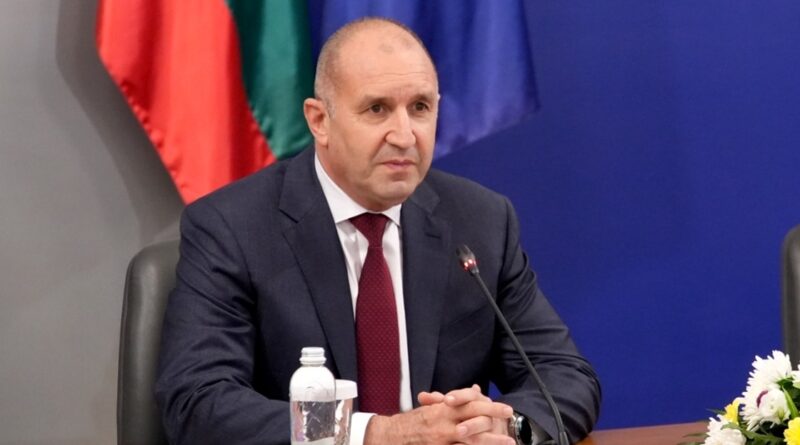
PM Radev takes Bulgaria out of the Coalition of the Willing
Prime Minister Roumen Radev was invited by French President Emmanuel Macron to participate in the July 13 Paris meeting of the Coalition of the Willing, but Radev declined because “Bulgaria’s place is not there”.
“We do not participate in a coalition that insists on continuing financial and military aid to Ukraine,” Radev told reporters on July 14 in Paris, where he is to attend the Bastille Day parade.
“We do not provide such assistance because I believe that the solution to this conflict is not in prolonging it by military means, but in a strong diplomatic mission that will finally put an end to the escalation,” he said.
Radev took office as Prime Minister on May 8 and his government has said that Bulgaria would no longer provide military equipment to Ukraine. He said that Bulgaria would participate in Nato financial assistance to Ukraine according to Bulgaria’s “capabilities”, later saying that there was no money to do so.
On July 14, Radev also distanced himself from the announcement of a new alliance of countries in Europe for common defence against possible ballistic missile attacks.
The group includes Ukraine, France, Germany, Denmark, Italy, the Netherlands, Spain, Sweden and two non-EU countries – the United Kingdom and Norway.
“All decisions that concern our collective security are made in a different format and in a different place. And proposals, ideas – we have seen a lot so far. But decisions are made in a different format and Bulgaria actively participates in all these formats where decisions are made,” Radev said.
“These things are decided within the EU, within Nato, where Bulgaria has its weight,” he said.
Radev also announced that his threat to block the new sanctions package against Russia was a manifestation of “an open declaration of his national interest.”
“We have insisted on the removal of an individual from the sanctions list against Russia, which is related to the Sofia metro. I want to say it clearly. Bulgaria openly stated its reservations and its readiness to veto the entire package if they are not removed from the list,” Radev said.
“You saw that they were removed from the list. For the first time, Bulgaria is openly declaring its national interest and we see that there is nothing terrible in a country defending its national interest. This behaviour is respected by all other partners,” he said.
Bulgaria’s absence from the Coalition of the Willing talks was conspicuous, given the countries that participated in the meeting in the French capital.
Those who attended included Ukrainian President Volodymyr Zelenskyy, the presidents of Moldova, Finland and Romania, the prime ministers of Albania, Croatia, Spain, Denmark, Norway, Sweden, Greece, Luxembourg, Poland, the United Kingdom, Estonia, Belgium, Austria, Germany, Czechia, the Netherlands, Slovenia and Latvia.
Representatives of other members of the coalition were also present, including North Macedonia, Italy, Türkiye , Portugal, Lithuania, Slovakia, Australia, Iceland, Montenegro, Japan, New Zealand, Canada, Ireland and Cyprus.
The EU and Nato institutions were represented by the presidents of the European Council and the European Commission, as well as the Nato Secretary General.
Radev also commented that the effectiveness of European sanctions against Russia must be assessed.
“When we impose the 21st package of sanctions, we must ask ourselves why we are getting to this point and what is happening with the previous 20 packages of sanctions. They clearly do not achieve the goal. Sanctions must be structured so that, above all, they do not harm the countries that impose them,” he said.
Bulgaria joined the Coalition of the Willing in 2025, when the Rossen Zhelyazkov government confirmed the country’s participation in the format.
Cabinet decisions from that time set the framework within which Bulgaria can participate in international initiatives related to support for Ukraine, explicitly emphasising that the country cannot send military personnel to the conflict zone.
Participation is limited to non-combat activities, including logistical and infrastructure support, as well as commitments in the field of maritime safety through the provision of minelayers and support vessels.
On March 30 2026, the Andre Gyurov Cabinet of the time also approved the signing of the bilateral security agreement between Bulgaria and Ukraine.
The document has a 10-year term and provides for cooperation in the field of defence, the production of military equipment, including drones, as well as Bulgaria’s participation in Nato’s Prioritised Ukraine Requirements List (PURL) funding and procurement mechanism.
The agreement formalises the country’s political and strategic commitments to Kyiv, while reiterating that all actions must be within the framework of the mandate given by the National Assembly.
These Cabinet decisions clearly outline that Bulgaria has been part of the Coalition of the Willing since its creation and has made specific legal commitments, albeit limited to non-combat activities.


