
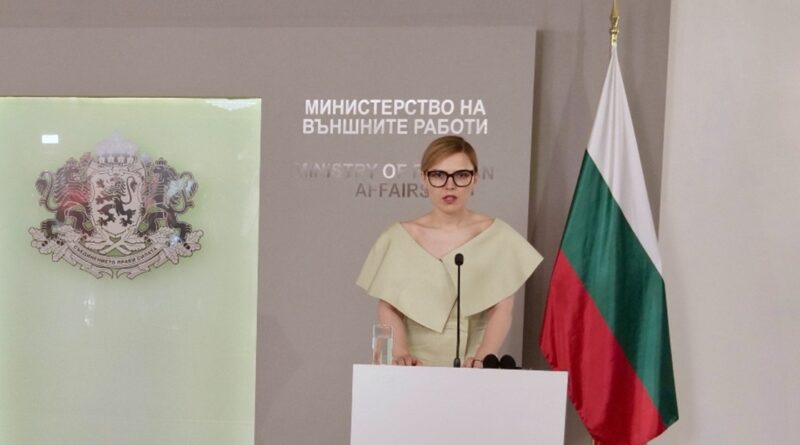
Bulgarian Foreign Minister signs declaration endorsing Coalition of the Willing, contradicting Radev’s rejection
A day after Bulgarian Prime Minister Roumen Radev said that his country has no place in the Coalition of the Willing, Foreign Minister Velislava Petrova signed an international declaration acknowledging the important work of the coalition and expressing readiness “to enhance our participation in its work”.
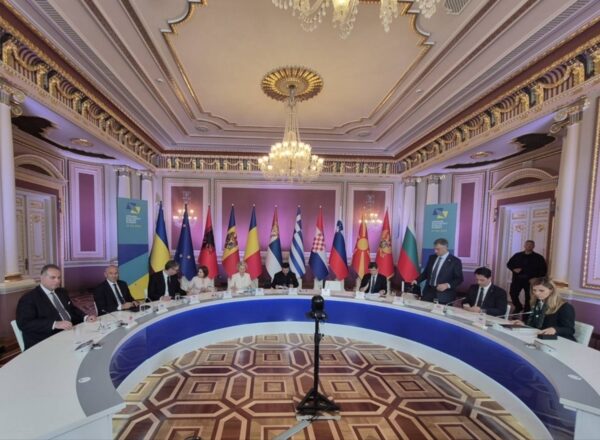
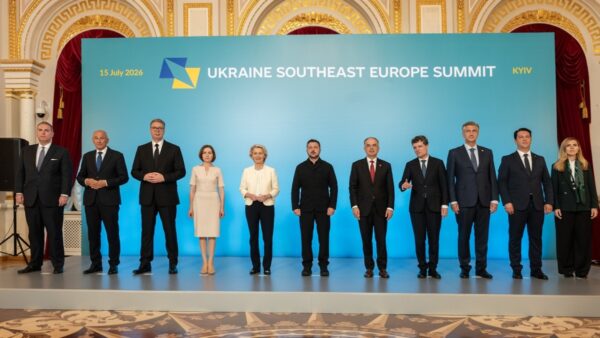
Petrova was in Kyiv on July 15, participating in the Ukraine-Southeast Europe summit.
She signed a joint declaration with European Commission President Ursula von der Leyen, Ukrainian President Volodymyr Zelenskky and other European leaders, “committing to continuing political, military, financial and security-related support for Ukraine, increasing pressure on Russia, and assisting in the reconstruction of the war-torn country.”
Point 7 of the declaration signed by the Foreign Minister says: “We acknowledge the important work of the Coalition of the Willing as an effective mechanism for supporting Ukraine, including in terms of providing Ukraine with robust and legally binding security guarantees, and express the readiness to enhance our participation in its work”.
While Radev opposes sanctions on Russia, the declaration Petrova signed says: We call for further strengthening of sanctions pressure on the Russian Federation and its war economy, ensuring their effective implementation, countering Russia’s shadow fleet and strengthening international cooperation against sanctions evasion, cyber threats and other hybrid activities that undermine European security.”
“We reiterate our condemnation of Russia’s illegal, unprovoked, and unjustified armed aggression against Ukraine and urge Russia to end the war immediately. This gross violation of international law, including the UN Charter, poses a serious threat to peace and stability in Europe. We strongly condemn any political, military, technical, financial, or other support to the Russian Federation’s war efforts provided by third states, and call for its immediate cessation,” the declaration says.
“We reaffirm our support for Ukraine’s Euro-Atlantic aspirations on its irreversible path towards future NATO membership, once the Allies agree and conditions are met, as well as its sovereign right to choose its own security arrangements and determine its own future. We recognize that Ukraine’s defence capabilities strengthen Euro-Atlantic security and underscore the importance of expanding defence cooperation to support Ukraine’s long-term security and resilience.”
The declaration also states that strengthening Ukraine’s air defence is a priority, especially “by providing appropriate systems and interceptors capable of countering ballistic missiles.” It explicitly states that the signatories also support the mobilization of the necessary financial resources for this purpose.
At the meeting in Kyiv, Bulgaria was alone in being represented at the level of foreign minister. The other countries were represented by presidents, prime ministers and deputy prime ministers.
In addition to Bulgaria, the declaration was supported by Albania, Greece, Moldova, Romania, Croatia, Slovenia, North Macedonia and Montenegro. The only country that refused to sign it was Serbia, despite President Aleksandar Vučić attending the forum.
The official statement from Bulgarian Foreign Ministry after the visit to Kyiv does not mention a single word about the signing of the declaration and the political commitments made with it.
Instead, the ministry focused on Petrova’s bilateral meeting with Ukrainian Foreign Minister Andrii Sybiha, as well as on talks on energy cooperation, increasing natural gas supply capacity, and future infrastructure projects.
On July 16, opposition GERB-UDF MP and former foreign minister Georg Georgiev said: “We wonder which role of Roumen Radev we should believe”.
“Whether it’s the Eurosceptic who said he would veto the sanctions , who removed us from the Coalition of the Willing and said that Bulgaria has no place in it because it does not support the philosophy and policies of this coalition, or Rumen Radev and his pro-European government, which, with the Kyiv Declaration, calls for increased sanctions and pressure, recognizes the role of the coalition as an instrument that can achieve lasting peace, and condemns Russian aggression,” Georgiev said.
Georgiev said that this” severe political schizophrenia , which has grown into an international one” is already threatening the foundations of Bulgarian authority abroad.
Opposition Democratic Bulgaria MP Ivailo Mirchev said on July 16: “While in Paris Roumen Radev explains that Bulgaria will not participate in the Coalition of the Willing, in Kyiv our Foreign Minister Velislava Petrova signs a declaration stating exactly the opposite. This is being done with one sole purpose – to exploit the Russophile vote for the presidential elections”.
Mirchev said that the Radev Cabinet’s behaviour was detrimental to the national interest and security of the country.
“At a time when Europe is threatened by Russia, and in Bulgaria the air defence is weak and we have no radars, our country is not participating in the common European defence, is not participating in the initiatives, but is explaining that Ukraine should not be assisted in any way and that we will not participate in the Coalition of the Willing,” Mirchev said.
Opposition We Continue the Change MP and former prime minister Nikolai Denkov said on July 16: “We are witnessing yet another case of political schizophrenia”.
“Prime Minister Roumen Radev surprised Europe by saying that our country would not participate in the Coalition of the Willing. Now we see that the Foreign Minister has signed a declaration to expand the coalition of the willing,” Denkov said.
Denkov gave more examples of the discrepancy between the words and deeds of the new government. Regarding the Budget, he recalled that Radev’s Progressive Bulgaria came to power saying that it would care for the people, but social payments have been frozen. It also talked about transparency, but the Budget lacks transparency.
“There is no such country in which the prime minister says one thing and the foreign minister does another,” Denkov said.
Earlier on July 16, speaking to Bulgarian National Television, Denkov said: “On the one hand, Roumen Radev says that he does not want to participate in the Coalition of the Willing, on the other hand, the foreign minister signs an official declaration in Kyiv, in which it says that efforts to support Ukraine through the Coalition of the Willing will be strengthened. So Bulgaria seems completely torn between two different worlds”.
Denkov said that this was not normal. Radev should come out and explain why this happened, or fire the foreign minister if she signed the declaration without his consent.
Radev cannot say one thing and the foreign minister do exactly the opposite on the same day, Denkov said.
He said that the prime minister’s positions currently place Bulgaria outside the common European positions.
Progressive Bulgaria parliamentary leader Petar Vitanov said on July 16 that “Bulgarian foreign policy is multi-layered”.
“Bulgaria will not deter pan-European decisions, will not block them, but will review its commitments individually and practical commitments individually,” Vitanov said.
Vitanov said that Petrova was in Kyiv “to strengthen bilateral cooperation in energy”.
The declaration that Petrova signed “has no binding character,” he said.
(Photos: Office of the President of Ukraine, and Bulgaria’s Foreign Ministry)


