
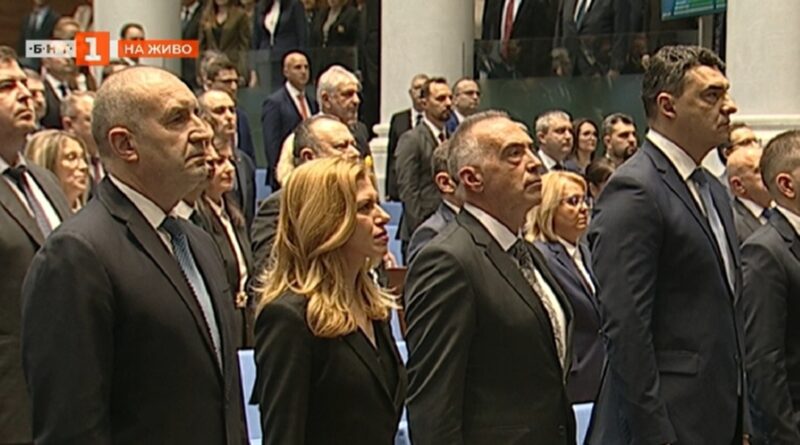
Bulgaria’s newly-elected National Assembly holds first sitting
Bulgaria’s 52nd National Assembly, elected on April 19, held its first sitting on April 30, accomplishing all the tasks on its Order Paper including the election of a Speaker.
Parliament concluded its business smoothly in two hours and 40 minutes, in sharp contrast to its predecessors in recent years that spent days deadlocked over electing a Speaker, a vital step for the National Assembly to transact business.
Roumen Radev, whose Progressive Bulgaria won a decisive victory in the April elections, confirmed on arrival for the sitting that it was highly probable that he would be Prime Minister.
Progressive Bulgaria on its own has more than enough MPs to elect a government.
Radev, who stepped down as Bulgaria’s president in January to enter parliamentary politics, told reporters that whether he would be Prime Minister would be decided by his parliamentary group.
He said that his party’s priorities were the state budget, which, he said, was in a catastrophic state, the laws on the Recovery and Resilience Plan and the election of a new Supreme Judicial Council.
Radev said that he hoped that the structure and line-up of the government would be ready by May 15.
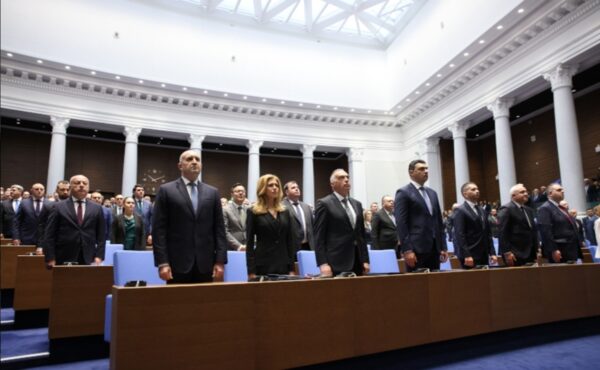
Head of state President Iliyana Yotova, addressing the first sitting, said that the April elections were the first won with an absolute majority in the 21st century.
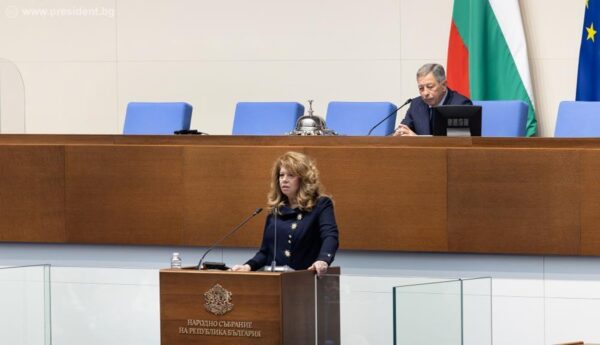
“Bulgarian citizens gave a categorical mandate to a political force – to Progressive Bulgaria, with the expectation of stable governance, an orderly state, and a true separation of powers,” Yotova said.
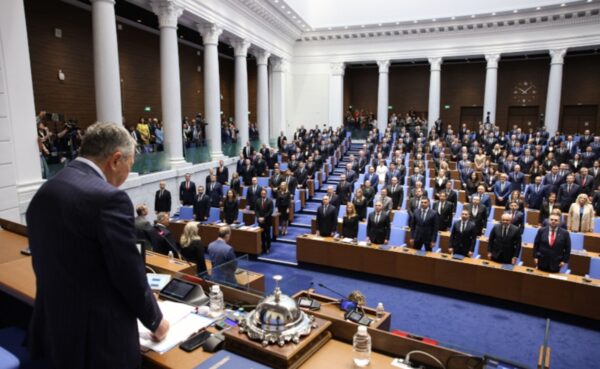
Pending the election of the Speaker, the sitting was presided over by the oldest MP, Roumen Milanov of Progressive Bulgaria. Photo: parliament.bg
The traditional succession of declarations by parties represented in Parliament saw former socialist MEP Petar Vitanov, and not Radev, speaking for Progressive Bulgaria.
Vitanov criticised We Continue the Change – Democratic Bulgaria for its role in 2023 amendments to the constitution and criticised the Andrei Gyurov caretaker government for signing the 10-year security agreement with Ukraine.
According to Vitanov, “the oligarchs suffered a defeat” in the elections, but a tough clash with the “conquered state” was ahead.
He urged the other parties to support the election of a new Supreme Judicial Council and Prosecutor-General, warning them not to resort to sabotage and blackmail.
“We must not allow Bulgaria to be used in global conflicts and the interests of the Bulgarian people must be taken into account,” Vitanov said.
Toma Bikov of Boiko Borissov’s GERB-UDF, this Parliament’s second-largest group, said that the elections showed that most citizens rejected the previous fragmented coalition politics and had given full confidence to Progressive Bulgaria.
Many had voted personally for Radev, who will have all the instruments of the state at his disposal, without considering coalition governments, Bikov said.
Bikov said this is a “mandate for broad, structural reforms” of numerous institutions and public relations, not only of the judicial system
GERB-UDF will act as a right-wing, constructive opposition that will exercise systematic parliamentary control and support what corresponds to its own programme, Bikov said.
Nadezhda Yordanova spoke in the slot for We Continue the Change – Democratic Bulgaria, which won the third-largest share of seats in the elections but which will, it was announced on the eve of the first sitting, be two separate parliamentary groups in the 52nd National Assembly.
Yordanova said that Progressive Bulgaria had been given a mandate with “one super task – dismantling the Borissov – Peevski model” and she warned that there should be no replacement of some oligarchs with other oligarchs, nor a truce between the previously warring camps.
DB and WCC will support for any measure that strengthens the rule of law, safeguards Bulgaria’s European direction, and increases the well-being of citizens, Yordanova said. But they will oppose replacing the reform or casting a “geopolitical fog” over the country’s foreign policy, she said.
Ayten Sabri, speaking for Delyan Peevski’s Movement for Rights and Freedoms, said that it would be a “constructive opposition”.
The sitting also was addressed by Kostadin Kostadinov, the leader of Parliament’s smallest group, Vuzrazhdane.
Progressive Bulgaria nominated lawyer and holder of a doctorate in administrative law Mihaela Dotsova as Speaker.
Dotsova was elected by a large majority, 188 in favour out of the 237 who voted, with her candidacy being backed by Progressive Bulgaria, GERB-UDF and the MRF. In this vote, WCC, DB and Vuzrazhdane abstained.
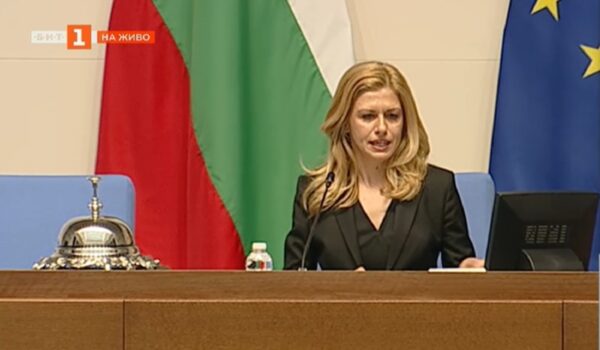
A rival candidacy of Vuzrazhdane’s Petar Petrov was overwhelmingly defeated.
The sitting saw the announcement of the six parliamentary group leaders: Vitanov of Progressive Bulgaria, Borissov of GERB-UDF, Peevski of the MRF, Yordanova of Democratic Bulgaria, Nikolai Denkov of We Continue the Change and Kostadinov of Vuzrazhdane.
With parliamentary groups having been formed, President Yotova may now, as the constitution prescribes, offer a mandate to the largest group – Radev’s Progressive Bulgaria – to seek to get a government elected.


