
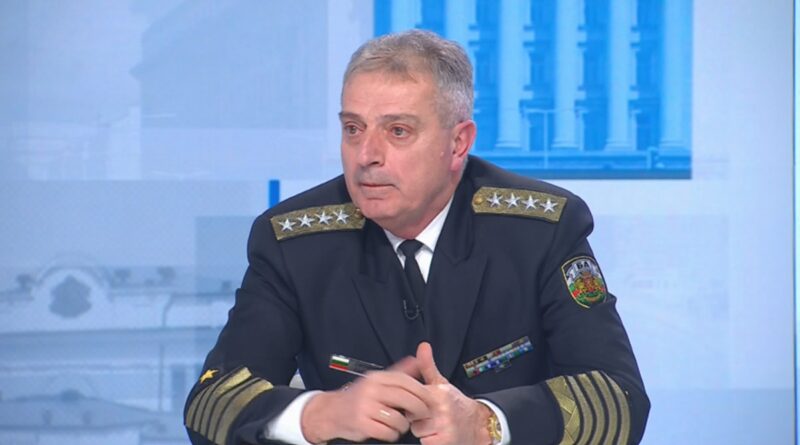
Defence Chief: Drone explosion was not a deliberate action against Bulgaria
The August 8 incident in which a drone fell and exploded near Kardam was not a deliberate action against Bulgaria, Defence Chief Admiral Emil Eftimov told Nova Televizia.
According to Eftimov, the drone was a Maya type decoy.
Eftimov said that he believed the drone was diverted by electronic warfare systems and headed out of radar range.
He said drones of this type can carry up to five kilograms of explosives.
Eftimov said that he had been at the scene of the incident and said that there was no damage.
The question was whether this was a Shahed drone or not, and it became clear that it was not, he said.
This was not the first such incident in recent years, Evtimov said.
There had been such incidents in the Baltic republics, in Türkiye and in Romania.
“This is a consequence of conducting combat operations nearby and we are adjusting, adapting, accumulating capabilities,” Eftimov said.
He said that at the end of July, as a result of the increased interceptions of Shahed drones on the Romanian-Ukrainian border, air defence forces and assets were re-based in Bulgaria, surveillance was intensified, and aviation was also re-based.
But the fight against drones is very difficult and specific and requires complex measures, he said.
He said that even the very identification of the devices is very difficult, because there was a large diversity of them.
Eftimov said that several Bulgarian companies are working on the issue of combating drones, and there have already been some successes. A project for anti-drone systems has been launched under the SAFE mechanism.
The problem is that these devices are difficult to detect, conventional radars, no matter how modern they are, are not effective for such small targets, Efimovsaid.
Bulgarian media, quoting a Foreign Ministry statement, said that in connection with the incursion of a drone into Bulgarian airspace, Foreign Minister Velislava Petrova had summoned Ukraine’s ambassador to Bulgaria Olesya Ilashchuk for a meeting at the Foreign Ministry.
Ukraine gave an assurance that it had not deliberately directed unmanned aerial vehicles towards Bulgaria and promised to conduct an investigation after a drone similar to those used by the Ukrainian army crashed near a gas pipeline in Bulgaria, Agence France-Presse reported.
Former defence minister Todor Tagarev told Nova Televizia on August 9 that the Defence Ministry and the government are fully focused on the version of a Ukrainian drone that was the subject of electronic warfare – jamming, GPS signal manipulation, most likely. And this is indeed the most likely version, Tagarev said.
However, there is another version, he said.
Just two days ago, the Lithuanian Defence Ministry again warned that Russia is preparing false flag operations using grounded Ukrainian drones or parts of them, which will subsequently be used against objects of the critical infrastructure of the Baltic countries.
This version is less likely, but at the moment we should not rule it out, Tagarev said.
“This drone with a warhead, albeit a small one, falls and explodes very close to compressor stations on the gas pipeline, which is critically important for the gas supply not only to EU countries, but also to Ukraine during winter conditions,” he said.
“The explanations currently coming from the Prime Minister, the Minister of Defence and the Chief of Defence are focused on the actions that are possible with the available means and capabilities that we have.
“However, here we need to think a little more broadly. For example, (former caretaker prime minister) Andrey Gyurov yesterday in his publication on the topic explained that our capabilities to act with the available forces are limited, but we need to think about policies.
“What worries me is that we heard absolutely nothing regarding the policy for developing the relevant capabilities – neither from the Prime Minister, nor from the Minister of Defence, nor from anyone who joined in with statements on this topic,” Tagarev said.
“First, the Minister of Defence said that after the three cases about two weeks ago with Russian drones in Romania, we have strengthened our anti-drone defence capabilities by deploying additional means of airspace surveillance, anti-aircraft missile systems, and aviation.
“However, we were unable to react in any way, which shows that the fact that we rely entirely on Soviet equipment in Bulgaria, especially on these radars, does us no good against modern threats to our security, such as threats from drones. We do not have additional means, because technically it is completely possible to determine whether we currently have manipulation of the GPS signal ,” Tagarev said.
He said that most likely Bulgaria had not invested in such systems and could not react at the moment.
Tagarev said that Bulgaria relied on old Soviet equipment or even newer equipment, which, however, is not specialized.
“About a year ago, I said that it was only a matter of time before a drone entered our airspace, so we will certainly have further cases as the war continues,” Tagarev said.
“This government has isolated us. We did not participate in the industrial forum in Ankara during the Nato summit, where such formats were announced. We did not participate in the Coalition of the Willing, we do not participate in other formats in which several countries come together to build more effective defence. It is not clear to me what (Prime Minister Roumen) Radev is counting on. He held talks with Zelenskyy, requesting drone protection technologies, while at the same time saying: ‘We will not help you’,” Tagarev said.


