
Alpha Research poll: Radev’s coalition 32.6%, GERB-UDF 19.7%
Were Bulgaria to hold parliamentary elections now, ex-president Roumen Radev’s political project would get 32.6 per cent from those who intend to vote, with Boiko Borissov’s GERB-UDF in second place with 19.7 per cent, according to a poll by the Alpha Research agency, the results of which were released on March 5.
The Radev project was registered for the April 19 early parliamentary elections on March 2 as a coalition called Progressive Bulgaria, while the poll was carried out from February 23 to March 2, before the name of Radev’s political project was publicly known.
The new Alpha Research poll is the first in which the agency included a Radev political project in its survey, after he resigned as head of state in January.
Support for GERB-UDF is slightly down from the 21.4 per cent it had in December, while currently in third place, according to the new poll, is We Continue the Change – Democratic Bulgaria, with 12.6 per cent, down from the 17.8 per cent registered in Alpha Research’s December 2025 poll.
Fourth is the Movement for Rights and Freedoms – New Beginning, led by Magnitsky Act-sanctioned Delyan Peevski, at 9.6 per cent, slightly up from 9.4 per cent in December.
Fifth is pro-Russian party Vuzrazhdane, 6.4 per cent, after having had 11.6 per cent in December.
Two parties are just below the threshold of a four per cent share of valid votes to get seats in Parliament: the Bulgarian Socialist Party – United Left, 3.6 per cent, and nationalist-populist Mech, 3.5 per cent.
Two parties currently in Parliament are shown by the poll to have effectively no chance of returning to the next one – nationalist-populist Velichie, 1.8 per cent, and populist ITN, 1.2 per cent.
Alpha Research’s Genoveva Petrova told bTV that those who would support Radev are former voters for the Bulgarian Socialist Party, voters who identify as radical, populist and nationalist – with those who backed Vuzrazhdane making up the largest of this group, and to a lesser extent, those who had backed Mech, Velichie and ITN, while a third of potential voters were people who did not vote in the previous parliamentary elections.
“This electoral picture shows several things. First, that there is no potential for independent governance. None of the formations could govern independently. At least two parties would be needed to form a Cabinet,” Petrova said.
The poll found that 37 per cent believed that the elections in April will be fairer than the previous elections while 34 per cent thought they would be less so. Optimism is shared mostly by supporters of the former opposition formations, while pessimism is shared by supporters of the ruling coalition and non-voters.
The series of failed coalition governments in recent years have given the term “coalition” a strongly negative connotation, but Bulgarian society remains polarised in its assessments of whether a single-party or coalition cabinet would be more successful for the country, Alpha Research said.
Forty-two per cent declare a preference for a single-party government, and a further 40 per cent, for a coalition cabinet. The idea of a broad-based programme government meets the approval of six per cent of adult Bulgarians, while 12 per cent could not say.
Among political party leaders, Radev has the highest personal approval rating, 37.1 per cent, with a disapproval rating of 35.2 per cent.
Borissov’s approval rating is 18.4 per cent and his disapproval rating is 62.6 per cent.
The political leader with the highest disapproval rating remains Peevski, at 79.8 per cent, against an approval rating of 5.8 per cent.
President Iliana Yotova has an approval rating of 49 per cent, a disapproval rating of 26 per cent, with 25 per cent neutral.
The poll was done from February 23 to March 2 2026 and is part of regular polling by Alpha Research. It is published on the agency’s website and was carried out using the agency’s own funds. The poll was done among 1000 adult citizens from all over the country. A stratified two-stage sample with a quota according to the main socio-demographic characteristics was used. The information was collected through a direct standardised interview using tablets at the homes of the respondents.
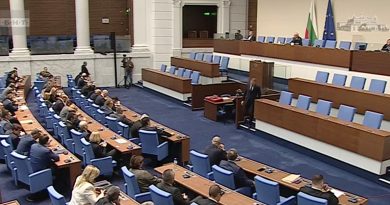
(Photo: parliament.bg)