
Poll: Support for Bulgaria’s ruling parties drops against background of protests that forced out government
Support for the four parties in Bulgaria’s de facto ruling majority has dropped against the background of the mass protests that prompted the resignation of the government, going by the results of a poll by the Alpha Research agency, the results of which were released on December 16.
The poll was done from December 5 to 12, while Prime Minister Rossen Zhelyazkov announced the resignation of the government on December 11.
Among those who would vote in a parliamentary election, support for Boiko Borissov’s GERB-UDF, current holder of the mandate to govern, is 21.4 per cent – a drop of just more than four points compared with the results of the Alpha Research poll the results of which were released on July 16.
The current Parliament’s second-largest group, opposition We Continue the Change – Democratic Bulgaria, is 17.8 per cent, compared with 13.9 per cent in July, making it the only group to see its support significantly increased.
In third place is opposition pro-Russian party Vuzrazhdane, at 11.6 per cent, just up from 11.5 per in July.
Fourth is the Movement for Rights and Freedoms – New Beginning, led by Magnitsky Act-sanctioned Delyan Peevski, at 9.4 per cent, down from 13.1 per cent in the previous poll. Peevski’s party has been crucial to the ruling majority, which formally not being part of it.
Fifth is the Bulgarian Socialist Party – United Left, a governing coalition member, with 4.9 per cent, down from 8.1 per cent in July.
Nationalist-populist party Mech is at 4.2 per cent, down from 6.3 per cent in July.
Populist party ITN, also part of the governing coalition, is at 3.8 per cent, down from 4.7 per cent in July.
Below the threshold for a four per cent share of valid votes to win seats in the National Assembly are nationalist-populist Velichie, at 2.1 per cent, down from four per cent in July, and the Ahmed Dogan loyalists of the Alliance for Rights and Freedoms, at 1.6 per cent, down from 2.87 per cent in July.
Alpha Research, commenting on the figure for Borissov’s GERB-UDF, said that in the coming months, it will become clear whether the rescue operation publicly announced by Borissov with the resignation of the Cabinet has a chance of softening the erosion of trust in the party or not.
The agency said that Borissov retained an approval rating of 21.6 per cent, but with a significant increase in his disapproval rating, which had risen to 58.8 per cent.
Among WCC-DB leaders, Assen Vassilev has an approval rating of 14.6 per cent and a disapproval rating of 63.2 per cent, Ivailo Mirchev 14.4 per cent approval and 57.1 per cent disapproval, Bozhidar Bozhanov 12.9 per cent approval and 56.3 per cent disapproval and Atanas Atanassov 8.2 per cent approval and 58.3 per cent disapproval.
Vuzrazhdane leader Kostadin Kostadinov has an approval rating of 10.8 per cent and a disapproval rating of 60 per cent.
The record holder is disapproval is Peevski – a key target in the mass protests – at 80.2 per cent, with an approval rating of 5.6 per cent.
BSP leader Atanas Zafirov has an approval rating of 8.4 per cent and a disapproval rating of 58.8 per cent, and cable television presenter Slavi Trifonov, leader of ITN, an approval rating of 7.6 per cent and a disapproval rating of 61 per cent.
Alpha Research said that several details in voter attitudes point to expectations of significant shifts in the event of possible early parliamentary elections in spring 2026.
One is voter turnout, the agency said.
It said that in the week of protests and the government resignation, the declared willingness to participate in early voting increased by five to seven points (that is, between 300 000 and 500 000 more people can be expected to go to the polls).
“Among the uncertainties in this regard is still what the behaviour of Generation Z, who actively participated in the protests, will be,” Alpha Research said.
Another factor was the potential of parties not in the current Parliament, the agency said.
Almost 10 per cent of those who said they wanted to vote declared that they would support other parties, and 13.3 per cent, that they had not yet made a choice.
“Shares that are not yet consolidated around specific political players, but are high enough to change the picture.”
The agency said that results on the key issue – public support for the protests – show very high, nationally in scope, approval.
Fifty-nine per cent express full solidarity with them, against 16 per cent of the opposite opinion.
Approval dominates in all social and electoral groups, with the exception of GERB-UDF supporters and the wavering position of BSP and ITN supporters.
Disapproval of 16 per cent is far below the sum of the electoral support of the ruling parties.
Between these two poles, there is an interesting trend that the survey registered – 25 per cent consider the protests to be fair and therefore partially support them, but they fear that they may lead to an unacceptable political alternative.
What kind of government, around which political forces is acceptable and/or desired by Bulgarians?
About 7.6 per cent are in favor of government around GERB and MRF – New Beginning; 16 per cent each, almost parity, for government around GERB, but without MRF – New Beginning and for government built around other of the current parties, without these two.
Forty per cent prefer government around a “new political force”.
“In the divided and fragmented Bulgarian society, however, there is no clear idea, let alone a consensus, of what it should be,” Alpha Research said.
Based on statistical analysis and with the understanding that the participants in the election race are not yet known, only a few approximate distributions of these 40 per cent can be derived. If Roumen Radev – currently President – personally comes up with his own political project, he can attract about half of these voters, the agency said.
The remaining 20 per cent are scattered among various other hypothetical projects – Eurosceptic and nationalist; right-wing; centrist, social democratic; pro-European.
The 51st National Assembly – which the agency said ” which has become a terrain of unceasing political confrontation and unpleasant scenes” – has an approval rating of only five per cent, a disapproval rating of 69 per cent and a neutral attitude from 26 per cent “with even supporters of the parties represented in it being highly critical”.
Radev retains leading positions in institutional ratings, but is also affected by the overall negative trend.
Trust in him fell by four points to 35 per cent, against 33 per cent distrust and 32 per cent neutral attitude.
He continues to attract the sympathies of voters of the BSP and nationalist parties, but his sharp attacks on the introduction of the euro and his positions on geopolitical issues alienate supporters of pro-European formations, the agency said.
The poll was done in the period December 5-12 2025 and is part of regular monitoring by Alpha Research. It is published on the agency’s website and was done using the agency’s its own funds. The poll was done among 1000 adult citizens from all over the country. A stratified two-stage sample with a quota according to the main socio-demographic characteristics was used. The information was collected through a direct standardised interview with tablets at the homes of the respondents.
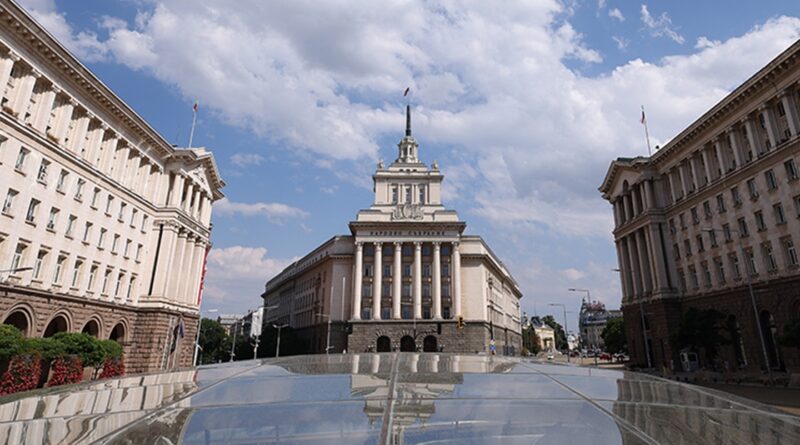
(Photo: parliament.bg)
Please support The Sofia Globe by signing up to become a subscriber to our page on Patreon: