Bulgaria’s government resigns after mass protests, while motion of no confidence defeated
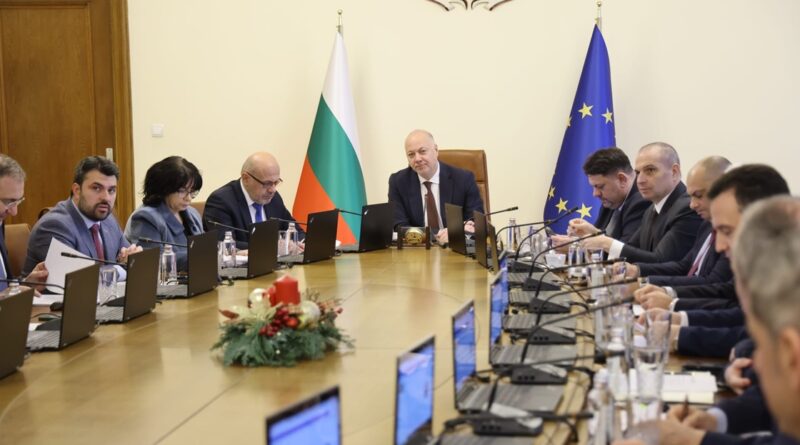
The Bulgarian government headed by Prime Minister Rossen Zhelyazkov resigned on December 11 against the backdrop of mass protests, while in Parliament, the latest vote of no confidence in it failed.
Zhelyazkov’s government took office in January 2025, with the votes of Boiko Borissov’s GERB-UDF – Parliament’s largest group – the Bulgarian Socialist Party-United Left coalition, populist ITN, and the Ahmed Dogan loyalists of the Alliance for Rights and Freedoms (ARF).
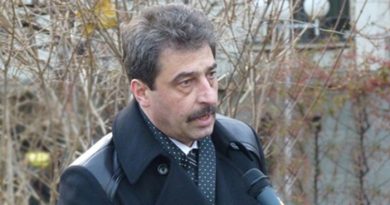
ARF subsequently withdrew its support after it became clear that the key influence over the government was held by its much more powerful rival, Magnitsky Act-sanctioned Delyan Peevski’s Movement for Rights and Freedoms – New Beginning. Peevski’s party did not have seats directly in the coalition government, but its support held it in place.
Recently, the de facto ruling majority – with Borissov and Peevski as its key figures – have been the target of mass protests in Bulgaria and abroad.
While initially the protests – called by opposition coalition We Continue the Change-Democratic Bulgaria – were called on the topic of controversial proposals in the now-scrapped initial version of the Budget package for 2026, they received mass support among Bulgarians indignant at corruption and abuse of power.
Zhelyazkov’s government survived six motions of no confidence in less than a year in office, but it was the enormous turnout for the protests against it that pushed matters over the edge.
The resignation comes 20 days ahead of Bulgaria adopting the euro as its currency, but the political developments do not stop that process.
“Power emanates from the sovereign,” Zhelyazkov said in a televised address on December 11, using a term that in Bulgaria commonly refers to the electorate.
“We hear the voice of the citizens. Their demands are the resignation of the government, this is the current moment. This civic energy must be supported and encouraged,” he said.
“The Cabinet came as a function of a complex coalition, of parties united around Bulgaria being part of the European countries for which evolution has proven that it can build the EU.
“We promised macroeconomic stability and achieved it, we promised and achieved unprecedented growth in budget revenues. We proposed a budget for social protection and the benefits that citizens should have and retain in 2026. All of this seemed to be unable to be fully explained,” Zhelyazkov said.
“This is not a reproach to the protesters, the protest was against arrogance, conceit.
“This is a protest for values, for behaviour, for attitude. From here on out, a great challenge lies ahead, unfortunately this will not allow the government to lead the country peacefully,” he said.
In Parliament, for the motion of no confidence to have been approved, it would have required 121 votes in the 240-seat House. It got 106 with none against.
Votes in favour came from WCC-DB, Vuzrazhdane, ARF, Mech and Velichie, with one from the BSP-United Left. Otherwise, the parties of the ruling coalition did not participate in the vote.
With the government having resigned, the procedure set out in the constitution must begin.
Head of state President Roumen Radev must hold consultations with all parliamentary groups. Following those consultations, he must offer to Parliament’s largest group, GERB-UDF, a mandate to seek to form a government. Should that first mandate prove fruitless, the President must offer a mandate to the second-largest group, WCC-DB. Should in turn no elected government result from that, Radev has a free hand in choosing to which parliamentary group to offer the third and final mandate. Failure at that final stage obliges Radev to appoint a caretaker Prime Minister and set a date for parliamentary elections, two months hence from this stage of the process.
The process of mandate-handing is familiar to Bulgaria, following the instability of recent years that saw numerous elections that mostly failed to result in Parliament electing a government.
For exclusive subscriber-only access to The Sofia Globe’s analysis and commentary on events in Bulgaria, please sign up to our page on Patreon: