
Opposition marks 100 days of Bulgaria’s Radev government by slamming it
After 100 days, Roumen Radev is no longer the alternative to power, Roumen Radev is the power and there is no longer an alibi, Boiko Borissov’s opposition party GERB said on August 16 on Facebook.
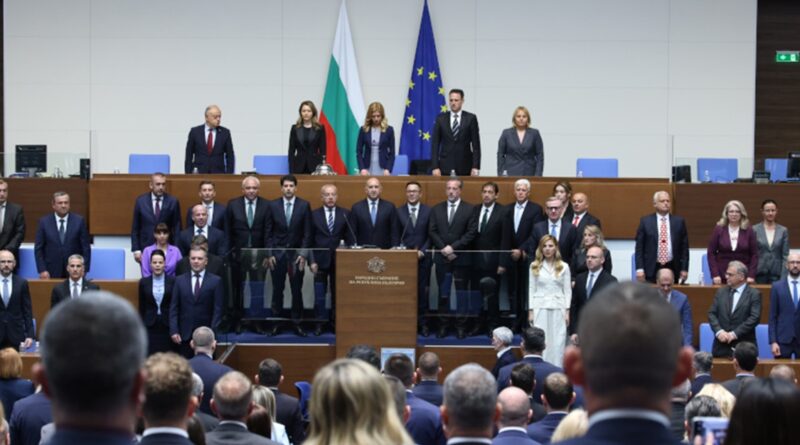
Bulgaria’s National Assembly voted Radev’s government into office on May 8 after his Progressive Bulgaria won a decisive victory in early parliamentary elections.
GERB said that for years, Radev had been “evaluating everyone else from the sidelines”, a reference to Radev’s years as head of state.
“Today, we will evaluate him. He has a majority. He has a government. He has a budget. He has power. Therefore, he also has responsibility. The first 100 days were a loan for time. From now on, contributions are paid with results,” GERB said.
The government started with a deficit of 5.7 per cent of the gross domestic product, with the explanation that it had “inherited” it, Borissov’s party said.
“But when you submit your own budget, you are no longer a commentator on another’s policy – you are responsible for your own. More spending, deficit and debt are a political choice, and the bill is paid by citizens and businesses,” it said.
GERB said that for years, Radev explained how Bulgaria should be governed.
“When he came to power, it turned out that he needed another 100 days to say what he would do with it. They promised us a 2.0 state. It turned out that it is run by two-faced people.”
“We have seen a drastic change of leadership in the administration and public structures. Every government has the right to its own team, but a personnel shake-up is not a reform,” GERB said.
GERB said that people have the right to an answer about what actually becomes cheaper.
“People do not live by the media statements from the Cabinet, but by the receipt from the shop.”
On foreign policy, GERB said that Bulgaria cannot say one thing in Sofia, leave an impression of another in Kyiv, and then explain a third to its allies.
On judicial reform, administration, healthcare, education and digitalisation, GERB said that they want deadlines, laws, responsible ministers and results.
Democratic Bulgaria described the first 100 days of the Radev cabinet as a period of mastering the failed governance model and creating new risks, instead of real change.
“One hundred days ago, Roumen Radev took sole power in our country, with an unprecedented majority and trust and a high intention – controlling prices and modernising the economy, dismantling the oligarchic model, returning statehood,” Democratic Bulgaria said.
“We also made our commitment according to the result that the citizens assigned to us – to be a constructive but firm right-wing opposition. To support real reforms, but also to expose imitations and to thwart attempts to go back. To offer solutions, to demand accountability and to defend the European course and the successful economic development of Bulgaria,” it said.
Democratic Bulgaria said that 100 days are not enough to solve all the problems, but they are enough to assess whether the ambitious goals of the Radev cabinet are being achieved, or whether the intentions of its government are far more modest – “subjugation and exploitation of the previous failed model”.
“Our assessment is highly critical,” it said.
“Debt and taxes instead of reforms and modernisation , personnel replacement instead of dismantling, a calendar with wishes instead of a bold and measurable government programme, an empty chair and isolation instead of influence in the European Union and protection of national security and priorities, division in society instead of leadership and national consensus for the future,” Democratic Bulgaria said.
It said that the Cabinet has not fulfilled its promise to control prices and dismantle the oligarchic model. Radev’s cabinet is also pursuing a policy of dividing society.
Democratic Bulgaria said that citizens did not vote for a new manager of the old system, but for it to be changed.
We Continue the Change (WCC) said that in 100 days, Radev said that he had “eliminated the oligarchy” in political power – by filling the government with bureaucrats from the old political model.
WCC went on to exhaustively list people with GERB, Movement for Rights and Freedoms and ITN backgrounds being returned to various positions in power since Radev took office.
“The old model has returned with even greater force,” WCC said.
“The same cadres, the same dependencies, and the same office-goers have once again lined up in ministries, agencies, and state-owned companies – only now under a new banner,” it said.


