
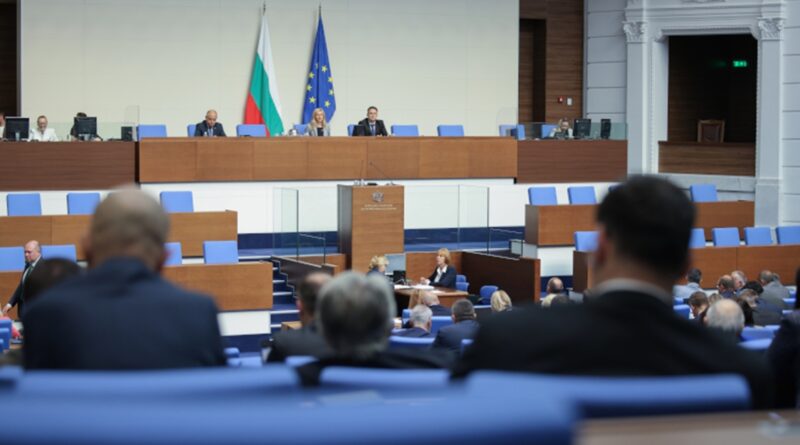
Bulgarian MPs vote unanimously to freeze their monthly salaries
Members of Bulgaria’s National Assembly voted unanimously on June 17 to approve changes to Parliament’s rules of procedure that freeze their monthly salaries.
In the 240-seat House, 193 voted in favour, with none against and no abstentions, and the amendments were approved without debate.
The amendments were tabled by Petar Vitanov, parliamentary leader of the National Assembly’s largest group, Progressive Bulgaria.
The current mechanism for automatically recalculating MPs’ salaries every three months was discontinued.
The basic monthly remuneration of members of Parliament will be fixed at the amount of three average monthly salaries of employees under employment and service relationships in the public sector, according to data from the National Statistical Institute from March 2026.
This means 4236 euro a month.
The pay will be received by bank transfer.
The freeze affects the basic salary of MPs, while additional allowances remain unchanged.
Deputy Speakers of Parliament continue to receive a 45 per cent higher salary, heads of standing committees 35 per cent above the basic salary, and MPs with academic degrees retain the additional bonuses provided for in the regulations.
In spite of the salary freeze, the amendments provide for the possibility of increasing the salaries of MPs in the future . This will be possible in accordance with the income policy in the budgetary sphere, set out in the state Budget Act for the relevant year.
While the automatic increase in MPs’ salaries is eliminated, room is left for increases through a political decision related to the adoption of the state budget.
In addition to the MPs themselves, the change also has implications for the remuneration of the executive branch .
The reason is that the salaries of ministers and the Prime Minister are directly tied to the amount of MPs’ remuneration.
Under current rules, Cabinet ministers receive a salary that is 30 per cent higher than that of MPs , while the Prime Minister’s salary is 55 per cent higher than that of an MP.
Business executive Maria Cappone, a former MP, said that the decision to freeze the salaries of MPs while leaving all their cash allowances and privileges, which add two-thirds to their basic salaries, was populist.
Cappone said that MPs who are elected from the regions where they live receive business and travel money to go home on weekends. Other additional sums include the 15 per cent supplement for those who have a doctor of science degree.
(Photo: parliament.bg)


