
Bulgarian Air Force commander: One squadron of fighter jets is not enough
Bulgarian Air Force commander Major General Nikolai Rusev told Bulgarian National Television on May 5 that he rejects claims that 16 F-16 fighter jets are completely sufficient “and too many for us”.
Rusev was speaking on the eve of Bulgaria’s May 6 Armed Forces Day, which will see flypasts over Sofia, Plovdiv and Yambol by Spartan transport aircraft, Su-25 fighter-bombers, MiG-29 fighters and – taking part in the day’s ceremonial flypast for the first time – F-16s.
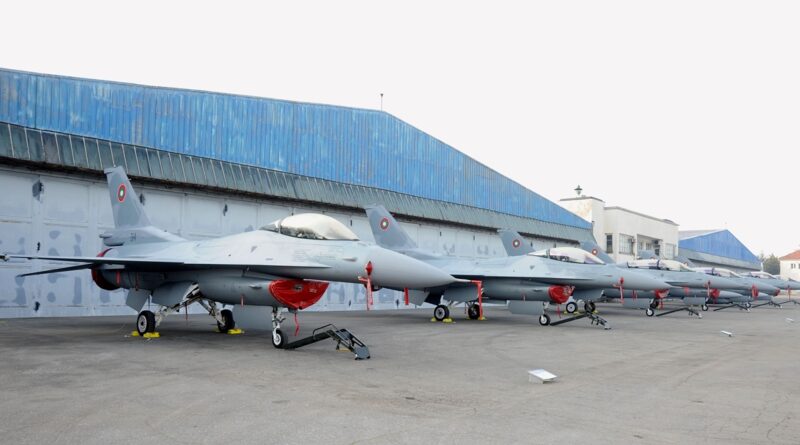
Bulgaria has taken delivery of eight US-manufactured F-16s and is to receive eight more.
“I will give an example of our neighbouring countries, how many fighter jets do they have and we ask ourselves why they have so many, and we will rely on only 16,” Rusev said.
“That is, I want to say that one fighter squadron is not enough to protect Bulgaria.”
Rusev said that, for example, Türkiye has 240 F-16s, 35 F-4 Phantoms and is expecting Eurofighters, meaning a total of 315 aircraft.
He said that Greece has not only Eurofighters but also Rafales, 242 aircraft.
Romania has 60 F-16s and is expecting 48 F-35s, Poland has 47 F-16s and is expecting F-35s, and has about 100 aircraft in total.
“Serbia too has more than us. So it’s obvious that one squadron is not enough,” Rusev said.
He said that Bulgaria currently has six pilots who have completed training on the F-16 and another one is expected to join them.
“Regarding F-16 pilots, we still have six pilots in Bulgaria. The process is slow. The (training) programmes are not ours. The programmes are American. The pilots go through the full programme in the United States,” Rusev said.
“But by November, these pilots will be 12. These six are no longer getting used to the aircraft, but are using it as a combat vehicle. The seventh returned yesterday, is expecting a baby, and after this nice event passes, she will also start flying on the new aircraft in Bulgaria.”
This year, F-16s will not go on combat duty, he said.
“And not because of the Bulgarian side. The F-16 must be completed and the first contract must be fulfilled 100 per cent,” Rusev said.
“When this happens, I will be the first to insist that the F-16 enter duty, because the men and women of the MIG-29 are exhausted at the moment. They perform a lot of duty, accumulate leave and compensation. The F-16 will really help, if it enters duty, to carry it together until the second F-16s arrive.”
Rusev said that out of the six anti-aircraft missile systems planned for purchase, there is only a contract for one, and the hope is that the rest will be acquired under the European SAFE mechanism.
There is also a project for seven radars, but there are still no contracts for them, and European funds are again being looked at with hope.
“I hope that within two years Bulgaria will have the first anti-aircraft missile complex and that this project for the purchase of the remaining complexes and radars will not be stopped, as it is very important to have them and replace our old equipment.”
A new video has been made to encourage young people to join the Air Force and the army.
“This has never been done before in Bulgaria. We put in a lot of effort. A very serious team came to Bulgaria,” Rusev said.
“John Depp, a world-famous aviation photographer with over 1000 hours of air time on fighter jets alone, to photograph them. Robert Churchill, a former F-16, F-22 pilot. He is currently flying a Boeing 777,” he said.
“And finally, there is the team of Steven Mott, producer of films such as James Bond, Mission Impossible, Jurassic Park, Dunkirk. With very serious equipment.
“Two cameras on gyroscopic platforms for at least $1 million. Very serious equipment. And it was interesting that they also brought a container that is expected on the wing of an aircraft with which Top Gun was filmed. We used that too for the filming. So it was very interesting,” he said.
(Photo: Bulgaria’s Ministry of Defence)


