
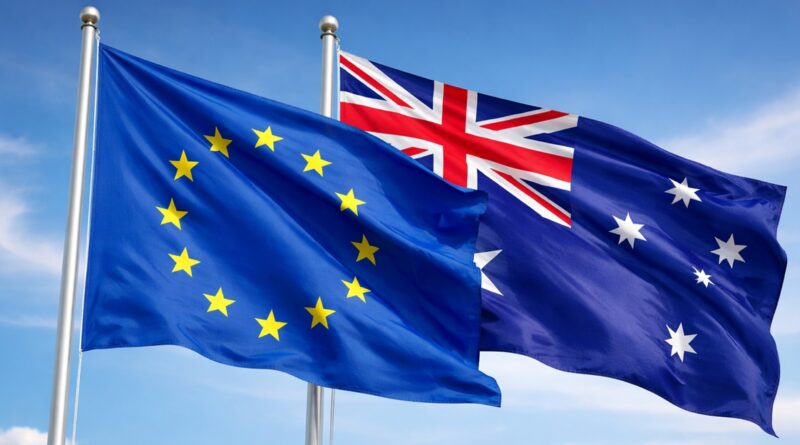
EU, Australia conclude negotiations on free trade agreement
With the conclusion of negotiations for an ambitious and balanced free trade agreement (FTA) between the European Union and Australia, the EU is opening the market to one of the world’s fastest-growing developed economies and thereby bringing significant economic opportunities to European companies, consumers and farmers, the European Commission (EC) said on March 24.
Negotiations on an EU – Australia FTA began in July 2018.
EU exports are expected to grow by up to 33 per cent over the next decade, with export value reaching up to 17.7 billion euro annually, the EC said.
Key sectors with strong growth potential include dairy (expected to increase by up to 48 per cent) motor vehicles (52 per cent), and chemicals (20 per cent), it said.
EU investment into Australia has the potential to grow by over 87 per cent, the EC statement said.
With this deal the EU also reinforces its strategic interests in the area of critical raw materials, making EU supply chains stronger and more resilient against geopolitical shocks, the EC said.
The statement said that the FTA also includes strong sustainability commitments, which will contribute to greener and fairer trade, and ensures that imports into the EU are more aligned with the EU’s own production standards on climate, environmental and animal welfare.
Following recently concluded deals with Indonesia and India, this agreement further diversifies the EU’s network of trade partners in the strategically important Indo-Pacific region and strengthens Europe’s position on the global stage.
The agreement will give EU exporters privileged access to the Australian market, the statement said.
The EC said that this includes removing over 99 per cent of tariffs on EU goods exports to Australia, thus cutting some €1 billion a year in duties for companies of all sizes; opening of the Australian services market in key sectors, including financial services and telecommunications; providing greater access for EU companies to Australian government procurement contracts; setting ambitious rules on data flows prohibiting data localisation requirements; and securing supply chains of critical raw materials (CRMs) by lowering tariffs on imports and opening investment opportunities.
In addition, to ensure that small businesses also benefit from the agreement, it contains a dedicated chapter on small and medium sized enterprises to help them increase their exports.
The agreement will also make it easier for EU professionals to work in Australia, while entry quotas for engineers and researchers will boost European and Australian innovation, the EC said.
The EU has a positive trade balance for agri-food products with Australia, worth 2.3 billion euro in 2024.
The agreement will eliminate tariffs on major EU exports such as cheeses, meat preparations, wine and sparkling wine, some fruits and vegetables including preparations, chocolate, and sugar confectionary.
The agreement takes into account the interests of EU agricultural producers. For sensitive agricultural sectors such as beef, sheep & goat meat, sugar, some dairy products and rice, the agreement will allow zero or lower tariff imports from Australia only in limited amounts, through carefully calibrated Tariff Rate Quotas.
In addition, the agreement includes a bilateral safeguard mechanism allowing the EU to take measures to protect sensitive European products and their producers in the unlikely event of a surge in imports from Australia causing injury to the EU market.
As an additional layer of protection for farmers, the bilateral safeguard mechanism will be operationalised in a self-standing EU regulation that will see swift and effective protections kick into gear, “in the unlikely event of an unforeseen and harmful surge in imports or an undue decrease in prices for EU producers”.
Moreover, the Agreement will protect 165 agricultural and food Geographical Indications (‘GIs’) and 231 spirit drink GIs including some of the most renowned ones such as Comté, Irish Whiskey, Queso Manchego, Salam de Sibiu, Istarski pršut ham, Lübecker Marzipan and Masticha Chiou.
The EU and Australia have also agreed on a modernised bilateral wine agreement, updating the full list of EU wine GIs and traditional terms protected in Australia. Building on the previous successful agreement, it will offer protection for all EU wine GIs (representing 1650 names), including the addition of 50 new wine GIs from 12 different member states.
Australia is a major producer of raw materials, including aluminium, lithium and manganese, which are vital for the EU’s overall economic security and competitiveness, the EC said.
he demand for critical raw materials (CRMs) is projected to increase substantially, and the EU remains heavily reliant on imports, the Commission said.
The deal facilitates EU access to Australian CRMs, with dedicated provisions making the market more predictable and reliable for EU businesses. In addition, special environmental and safety provisions will ensure that these CRMs are extracted sustainably.
Trade in CRMs is currently easily disrupted by sudden economic or geopolitical shocks, therefore trade agreements with reliable partners are essential for stabilising the EU’s supply.
The FTA fully integrates the EU’s high standards on trade and sustainable development (TSD), including ambitious commitments on workers’ rights, gender equality, environment and climate.
All TSD commitments in the deal will be enforceable via the agreement’s general dispute settlement mechanism. The deal includes binding commitments on core labour principles and the Paris Climate Agreement, as well as a dedicated sustainable food systems chapter.
The deal also liberalises trade in green goods and services, such as renewable energy and energy efficient products.
On the EU side, the negotiated draft texts will be published shortly. The texts will go through the necessary internal procedures before the Commission will put forward its proposal to the Council of the EU for the signature and conclusion of the agreement.
Once adopted by the Council of the EU, the EU and Australia can sign the agreement.
Following the signature, the agreement requires the European Parliament’s consent, and the Council’s decision on conclusion for it to enter into force. Once Australia also ratifies the Agreement, it can enter into force.
The EU and Australia have on March 24 also announced the adoption of a groundbreaking Security and Defence Partnership, the EC said.