
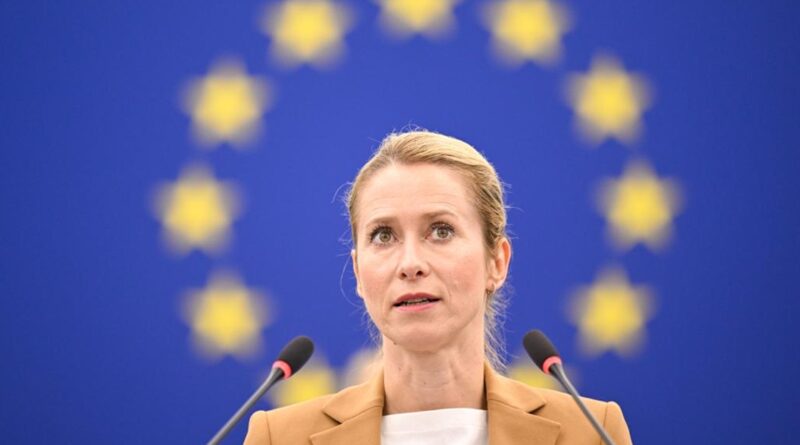
EU foreign policy chief: European naval assets sent to Gulf region
European naval assets have been sent to the Gulf region, because the security of the Strait of Hormuz and the trade routes are extremely important for the European Union, but also for the Gulf countries, EU foreign policy chief Kaja Kallas said on March 5.
Kallas was speaking as EU foreign ministers were meeting in video conference and there was a meeting of the EU-Gulf Cooperation Council to discuss the war in the Middle East.
She said that the EU has two naval missions in the region, Operation Atalanta and ASPIDES.
“But of course, right now, they are not in the Strait of Hormuz. European naval assets are really coordinating to have the protection of also the Strait of Hormuz, so that we have the trade routes,” Kallas said.
“Iran is exporting the war, trying to expand it to as many countries as they can, to sow chaos and we are calling for stability and seeing what we can do together,” she said.
“Of course, our first priority is also the safety of our citizens that are currently in the region,” she said.
We see actually the same drones that are attacking Kyiv every day now, attacking also the Middle East, Kallas said: “And there actually also Ukraine can help the Gulf countries, because they have developed drone interceptors and drone protection. So, we can see also how we can put these things together to help the countries to fight back the drone attacks”.
Asked whether she thought the regime in Iran would be toppled because of the United States and Israeli war efforts, Kallas said that usually regimes “are trembling from the inside, not from attacks from outside, but of course the regime has been considerably weakened, so it gives also, the opportunities for the Iranian people to actually decide their own future”
Kallas said that the European Commission had on March 2 discussed various aspects of the war and how it was influencing Europe, and one of those aspects was migration presure.
“We do not see it yet, but clearly, if the war drags on, the risks of migratory pressure on Europe will increase, and we have to be prepared. That is why we are also talking to other countries that we are cooperating with.”
Asked about the war’s impact on Ukraine, Kallas said that there was a clear impact on the war on Ukraine as well, because there are defence capabilities that are needed in Ukraine now moving also to the Middle East.
“There is also the issue of supply chains, of supplying the capabilities that Ukraine needs, now also the Middle East needs when it comes to air defence, for example,” she said.
“And there is also the issue of the oil price. The oil price, when it goes up, it actually benefits Russia to fund its war. And that is why we have to really push through the maritime services ban that we can really curtail the shadow fleet and the oil revenues that Russia has, to fund this war.”
Asked how concerned she was about US president Trump’s threats towards Spain – as the BBC reported, Trump threatened to impose a full trade embargo on Spain in response to its refusal to allow the US to use the jointly run bases at Morón – Kallas said: Trade is a European competence.
“We have a trade deal with United States that was signed in June. We hope that United States also respects this agreement that applies to all the (EU) member states,” she said.