
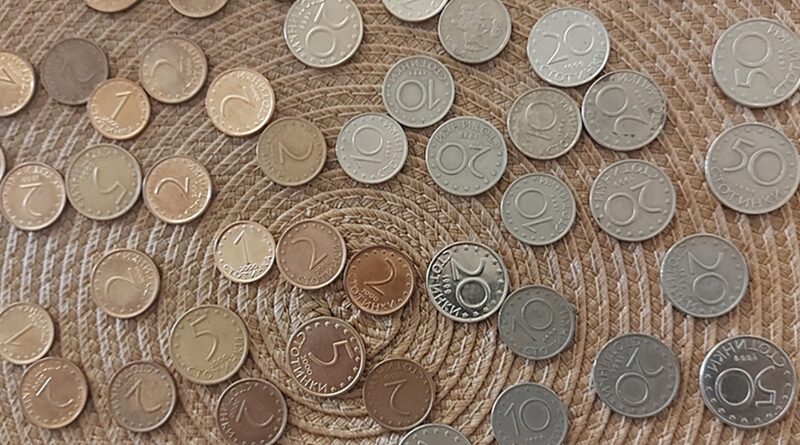
Bulgaria and the euro: ‘cashing in’ your coins
Those who stash away their lev-era stotinki – coppers and silvers – may be wondering what to do as Bulgaria adopts the euro as its currency as of January 1 2026.
For the first month of 2026, while the euro becomes legal tender, the lev also retains that status, but that ends at the beginning of February when the euro alone will be legal tender.
It does not make sense to rush to turn lev stotinki into banknotes before January 1 (to clarify, the Bulgarian-minted euro cent coins, like the lev-era coins, also are known in Bulgarian as stotinki. On the copper coins, the words “euro cent” appear on the front, and стотинки on the back).
By Bulgaria’s law on the adoption of the euro, from January 1 to June 30 2026, all commercial banks are required to exchange lev coins into euro free of charge. The same law says that you need not be a client of the bank to use this service.
Bulgarian Posts will also do the exchange in places which do not have commercial bank branches.
After June 30 next year, banks and post offices will be entitled to introduce fees for the exchange or gradually discontinue the service.
The safest option is central Bulgarian National Bank (BNB).
BNB will exchange lev-era coins for euro at the official exchange rate and, under current law, will do so indefinitely. (And while lev banknotes and coins will no longer be legal tender from February 1, BNB will continue to accept them for conversion into euro).
The coins are counted by machine at BNB and users of the service should arrive with their coins already sorted by denomination.
A little-known option is that some large retail chains have coin counting machines that accept large amounts of coins, and issue a receipt showing the precise amount that may be used as a voucher for shopping there. These machines do not issue banknotes in return for the coins.
Finally, for anyone thinking of getting rid of their lev stotinki by spending them, bear in mind that Bulgarian law permits traders to refuse payment if offered in more than 50 coins.
(Photo: Clive Leviev-Sawyer)
For reliable official information on Bulgaria’s transition to the euro, the Association of Banks in Bulgaria has a Q and A, in English.
The official evroto.bg website has an English-language version, while the European Commission made available on July 8 a Q and A on Bulgaria’s changeover to the euro.
For exclusive subscriber-only access to The Sofia Globe’s analysis and commentary on events in Bulgaria, please sign up to our page on Patreon: