Flash floods warnings for parts of Bulgaria on October 7
Bulgaria’s national meteorological bureau has issued warnings of possible flash floods in five districts for October 7, while eight districts are subject to the highest-level warning – Code Red – of very dangerous weather because of forecast heavy rain.
The districts subject to warnings of possible flash floods on October 7 are Dobrich, Varna, the northern part of Bourgas, Yambol and Haskovo.
The Code Red warning covers Dobrich, Varna, Bourgas, Silistra, Shoumen, Razgrad, Turgovishte and Yambol.
All other districts are variously subject to the Code Orange warning of dangerous weather or the Code Yellow warning of potentially dangerous weather, with the exception of five districts classified Code Green, meaning that no weather warning is in place.
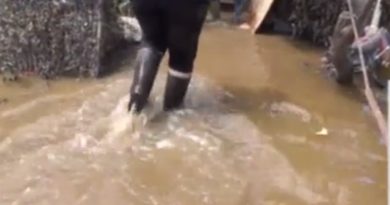
The warnings come after torrential rain on October 3 hit south-eastern Bulgaria particularly hard, leaving a reported four people dead and causing extensive damage.
The head of the directorate general for fire safety and population protection, Alexander Dzhartov, told a briefing on the afternoon of October 6 that “at the moment, the operational situation is relatively calm”.
Fire crews were working on 30 calls, including removal of fallen trees and drainage of various sites.
“Our teams are continuing to work on removing the debris from the flood in Elenite,” Dzhartov said, referring to the holiday village extensively damaged on October 3 and to which public access has been restricted until October 8, when a new decision will be made. Two hundred people have been evacuated from Elenite.
Dzhartov said that teams had been mobilised because of the Code Red warnings, and there would be patrols in those places “so that information can reach us in a timely manner and we can react”.
In Tsarevo, where there was damage similar in scale to that incurred in floods two years ago, the BG-ALERT system was activated on October 6 because of the forecast intense rainfall.
A team of scientists was examining Elenite on October 6 to establish what led to the tragedy.
Associate Professor Stylyan Dimitrov, director of the National Centre for Geospatial Research and Technologies at Sofia University, told Bulgarian National Radio: “The Elenite holiday village is an exhibition of human stupidity and greed”.
Dimitrov said that a 3D model would be created to examine what led to the disaster and “second, we document the damage and incompetent decisions that were made when developing this territory”.
“These small watersheds on the Southern Black Sea coast are extremely risky. We cannot prevent disasters, but we can limit them. Buildings limit the space in which water can spill and thus increase its impact power. There are also two risky areas in Sveti Vlas,” Dimitrov said.
Speaking to Bulgarian National Television on October 6, Environment Minister Manol Genov, could not answer who had given permission at the time to build on public state property, that is, the ravines in question.
“That is not my job,” he said.
He did not answer unequivocally whether illegal buildings should be demolished if violations are proven. And he transferred the responsibility to the National Directorate for Construction Control and local authorities, saying that they should make a decision.
“Nature has taken revenge for irresponsibility, carelessness and greed. The wide-eyed and greedy investors led to these human casualties,” Genov said. He promised to seek resignations, but said that everything happened “very far back in time”.
Former environment minister Yulian Popov said in a television interview on October 6 that construction on rivers and riverbeds was a widespread practice.
The resorts of Golden Sands and Sunny Beach are built on dunes, rivers are sealed, and there is also construction on rivers in Sofia, as well as in the Sv Konstantin i Elena resort, Popov said.
He said that the law is flawed and unclear regarding construction activities. The flood in Elenite was caused by unusually high amounts of rain and such precipitation should have been expected.
Popov said that in 2023, major floods occurred around Tsarevo and they prepared a report then.
“One of the factors is climate change, which will bring more and more extreme events. It is very important to conduct a serious investigation into all the factors that led to the disaster. There is often pressure on the cadastre not to include rivers and dunes – there is even an expression for such cases – ‘dune blindness’,” Popov said.
He said that there are two rivers in Elenite – Drashtela and Kozluka. Buildings have been built on them, which is absolutely unacceptable.
Natural disaster expert Atanas Krastanov told local media that there are several legal norms affecting riverbeds: the Water Act, the Territorial Planning Act, and the Ministry of Environment and Water.
“They explicitly state that any construction on riverbeds is prohibited,” Krastsanov said.
“In watershed areas and riverbeds, asphalting and concreting is absolutely not permitted. This is criminal construction, and the responsibility lies with the municipality, the state directorate for construction control, and Basin Directorate. These institutions must be sued. Since the construction is illegal, the buildings must be removed. Changing a riverbed is criminal,” he said.
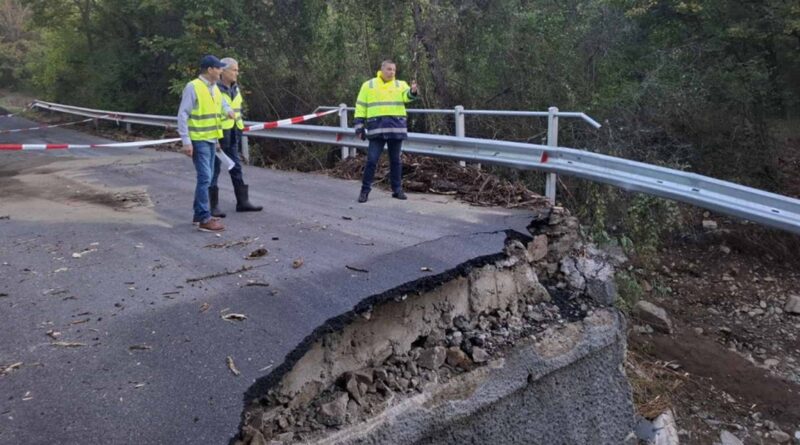
The Road Infrastructure Agency said on October 6 that it took urgent action to secure and restore the bridge over the Izgrevska River on road II-99 Tsarevo – Malko Turnovo, compromised during the floods of October 3 this year. Access to it was immediately restricted to ensure the safety of travellers, the agency said.
It said that the existing bridge was built in 1960, in accordance with the standards current at the time of its construction. Its abutments are filled with stone masonry, without pilot reinforcement, which is the main reason for the structure to be compromised due to the high water wave. No major repairs have been carried out on the facility to date. It was partially repaired in 2023 as an ongoing activity to improve its condition.
A statement by the Interior Ministry on October 6 said that Bulgaria would apply for assistance from the EU Solidarity Fund for the South-Eastern region. The Solidarity Fund is the EU’s main instrument for supporting recovery from natural disasters and is an expression of EU solidarity. It enables the Union to provide effective support to an EU member state (or candidate country) to help it cope with the consequences of a major natural disaster.
(Photo: Road Infrastructure Agency)