
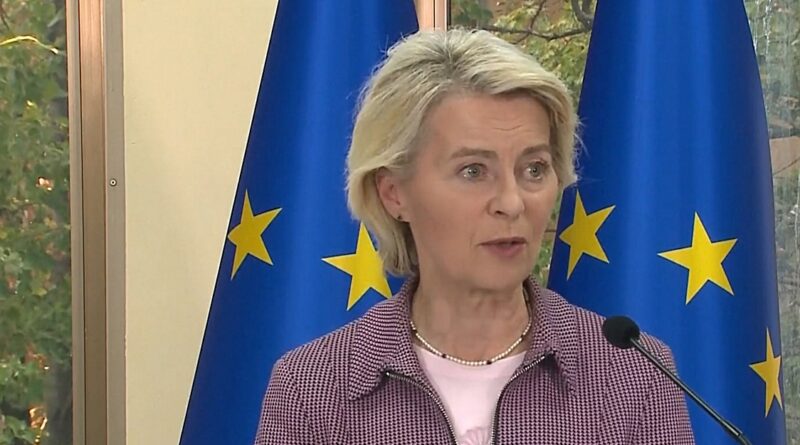
VDL visits Bulgaria on frontline states tour, praises support for Ukraine
European Commission (EC) President Ursula von der Leyen, visiting Bulgaria on August 31 as part of a tour of seven frontline states, praised the contribution of the country and its defence industry in support for Ukraine.
Announcing Von der Leyen’s tour earlier this week, the EC billed her visits to Latvia, Finland, Estonia, Poland, Lithuania, Bulgaria and Romania as underscoring the EU’s support for member states sharing borders with Russia or Belarus.
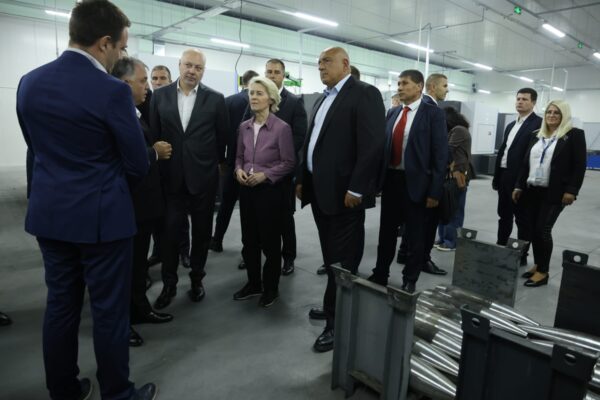
Von der Leyen, who visited Bulgaria’s VMZ Sopot arms plant with Prime Minister Rossen Zhelyakov and GERB-UDF leader Boiko Borissov as well as other officials, said: “Here, you are producing large quantities of ammunition. Much of which is supporting Ukraine in its fight for freedom”.
“At the beginning of war, one third of the weapons used in Ukraine was coming from Bulgaria. So, I want to thank you first and foremost for your ironclad support to our brave neighbour, partner and future member,” Von der Leyen said.
She said that Russia’s brutal war against Ukraine is in its fourth year: “It is obvious that Putin will not stop there. He has created full-scale yet old-fashioned war economy, precisely because of the biting sanctions that we imposed and he will continue to produce at large scale. So, as we strengthen Ukraine’s defence, we must also take greater responsibility for our own.”
“And in order to improve our readiness and defence posture, we have together worked at EU level. First and foremost for financial support. We have together created the SAFE instrument [a temporary financial instrument to bolster the European Defence Technological and Industrial Base (EDTIB) by providing up to 150 billion euro in loans to EU member states for common defence procurement] that is 150 billion euro for joint procurement. It was built and subscribed in record time.
“Thank you to Bulgaria, also for taking part in the subscription for the SAFE instrument. Now we have to invest these 150 billion euro in joint procurement,” she said.
Von der Leyen, referring to the plans for a joint venture between Bulgaria and German arms manufacturer Rheinmetall for a plant for the manufacture of gunpowder and artillery shells in line with Nato standards, said: “This is exactly the kind of project we want to see. It will bring good jobs to the region”.
“Up to 1000 new jobs will come here to Sopot thanks to these projects, but we increase also our ammunition production. We strengthen our collective security, as well as our cooperation with Nato,” Von der Leyen said.
“We support the brave Ukrainian armed forces; we create good jobs in the region. Everywhere in Europe, we are speeding up the production of ammunition. Because the times we live in call for it. Our production capacity should reach two million shells by the end of this year.”
“I can confirm that Bulgaria is actively contributing to both Ukraine and the European Union´s defence security. Bulgaria’s contribution and its defence industry are a reason not just for national but also for European pride. So, thank you very much for that,” Von der Leyen said.
Bulgaria will contribute to preserving future peace if the war between Russia and Ukraine ends, Zhelyazkov pledged: “This is to continue mine-clearing operations to guarantee freedom of navigation, as we are ready to do so with two mine-clearing ships and supporting ones, and in the field of the air domain – with the provision of airport infrastructure, as well as other opportunities, which, I repeat, will be relevant the moment a political solution and a ceasefire are reached.
“We are bound by the framework of the National Assembly’s decision, but we will be a loyal partner and ally so that the goals of the European Union for a stronger union, a more resilient union and a union that will deter any aggression can be fulfilled,” Zhelyazkov said.
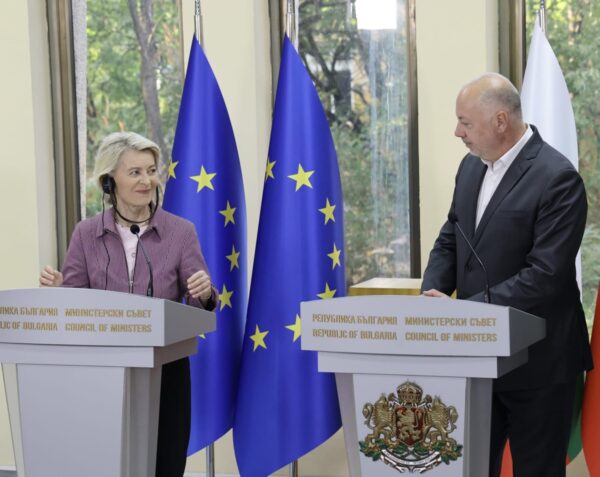
Borissov said that his party and the ruling coalition support the government so that the projects for new military factories can be implemented.
He addressed himself to supporters of two minority pro-Russian parties who on August 31 protested outside the VMZ Sopot plant against Von der Leyen’s visit: “The thousands of jobs that will be created, and the old ones will be preserved, are thanks to what is currently happening. We are all for peace, categorically, but you have to be strong, have a powerful defence so that they comply and do not attack you”.
The protests by the pro-Russian parties drew a large police presence and disproportionate attention from the Bulgarian-language media, as supporters of the pro-Kremlin movement screamed slogans against Nato, and, channelling a Kremlin disinformation propaganda campaign, against Bulgaria’s forthcoming adoption of the euro. Echoing the Russian embassy’s line, they made fatuous claims to reporters about Bulgaria being dragged into “war with Russia” and Von der Leyen “not being welcome” in Bulgaria.


