Bulgaria’s caretaker government announces 100M euro support package in face of Middle East crisis energy price shocks
Bulgaria’s caretaker government announced on the evening of March 27 a package of measures to overcome the consequences of the crisis in the Middle East and its impact on the public and the private sector, a package estimated to cost about 100 million euro.
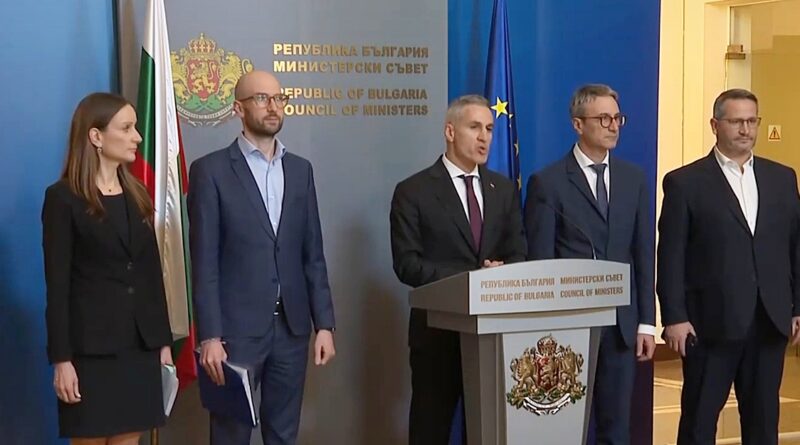
“When the crisis in the Middle East broke out, the government took measures for people with low incomes and those who use petroleum products,” caretaker Prime Minister Andrei Gyurov told a briefing, adding that over the past week the government had one main goal, to develop a package of measures.
“Since then, the crisis has been developing and we are of the opinion that this crisis will take time to return to normal, both for industry and for the people,” Gyurov said.
Gyurov said that the measures followed a series of recent meeting with representatives of various sectors of the economy, so as not to give what he called “helicopter money”.
He said that the measures covered fuels, transport, agriculture, electricity costs and access to liquidity for small and medium-sized enterprises.
At this stage, there is no shortage of certain products, he said. Support is entirely focused on where there is a need, Gyurov said.
The entire approach will be controlled by a headquarters at the caretaker government, he said.
“Any non-market behaviour will be closely monitored,” Gyurov said.
“So that at each stage it can determine the level of security and risk in the system, so that it can activate additional measures and not only that, but also control the process throughout the chain, so that we can see that there is no distortion and no non-market behavior in the supply chain.”
Measures have also been taken for medium and small enterprises, he said.
“We are proposing several ways in which these businesses will have direct access to liquidity so that there is more predictability and they can operate more calmly and not pass on every shock to their customers’ final prices.”
The measure to support the most needy individuals in the amount of 20 euro a month due to high fuel prices has already taken effect, as of March 26.
Caretaker Minister of Labour and Social Policy Hassan Ademov said on March 27 that more than 12 800 had been submitted by noon.
Ademov said that on average about 500 applications are submitted per hour.
The Social Assistance Agency, where the applications are received, was also reporting peak hours with over 1000 applications submitted per hour.
Caretaker Economy Minister Irina Shtonova said that Bulgaria’s transport sector had been hit very quickly, so there will be measures there as well. One of the measures is to delay the increase in toll fees from April to June.
“One of the wishes of the sector itself was to increase state aid, which is currently 25 million per year to 50 million, so we are sending a request to the European Commission on this topic,” Shtonova said.
Another requirement of the sector was in relation to liquidity and especially for leasing payments.
Therefore, a mechanism will be prepared for the rescheduling of leasing payments for transport companies.
In connection with the difficulties of companies that have leasing installments, a mechanism for deferring leasing installments will be prepared with the Bulgarian Export Insurance Agency, she said.
An additional subsidy will be allocated for public transport in remote areas.
The latter was reiterated by Gyurov, specifically emphasising that “the goal is not to make it more expensive for people to go to work instead of sitting at home.”
They will also offer insurance on loans and working capital for small and medium-sized enterprises for this sector and for food under relaxed conditions.
An additional subsidy will also be granted for urban transport in remote areas. “People should not feel that there is a war in the Middle East and continue their lives as before,” Shtonova said.
In the agriculture sector, it is planned to move all payments from the sector forward in time to meet the spring sowing season.
“We can be sure that we will eat good Bulgarian food in a few months,” Shtonova said.
Producers will be supported by reducing the excise duty on fuels. There is also a long list of other measures that will be further communicated by line ministries.
Caretaker Finance Minister Georgi Klisurski said that all measures have been costed.
“Some of them are at the expense of the state budget. Others are neutral, that is, for example, from electricity producers there would be a transfer to consumers. So far, all the measures that have been listed are within the budget. No more than about 100 million euros at this point,” Klisurski said.
He said it was important that all measures be targeted only at those in need. “The goal is to protect the most vulnerable citizens and nip inflation in the bud,” he said.
Caretaker Energy Minister Traycho Traykov said that for household customers “things are clear – prices are fixed”. Therefore, the goal was for businesses, goods and services to remain at prices that “do not fuel inflation”.
Traykov issued a reminder about the currently existing measure for assistance in “industrial electricity” – at prices above 120 euro. It remains the same, but measures are being taken to make it much more operational – with subsidization month by month.
“Currently, the support is if the price for six months exceeds the limit. We will do the calculation month by month. So if there is a sharp increase – and this is one of the main characteristics of the current situation – if the weighted free market price exceeds 122 euro, all companies will have access to this financing,” Traykov said.
“Bulgaria is the first country in the EU that will launch a scheme to support energy-intensive industries within two to three weeks. They will receive support of up to 50 per cent of the energy they use at prices above 63 euro per Mwh,” Traykov said.