Government security council on Middle East escalation: No direct military threat to Bulgaria
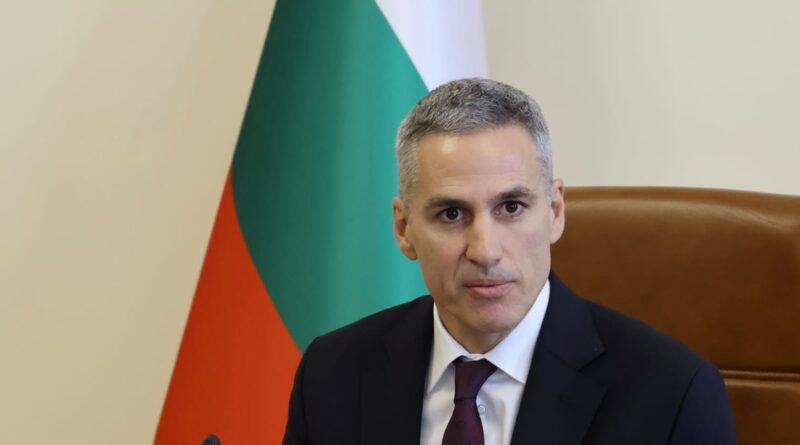
Bulgaria’s caretaker Prime Minister Andrei Gyurov, speaking on February 28 after a three-hour meeting of the government security council that he convened in response to the escalation in the Middle East, said that the council’s main conclusions included that there is no direct military threat to Bulgaria.
On February 28, a US-Israeli attack on Iran was followed by retaliatory firing of missiles at Israel. Iran also was reported to be targeting US bases in Kuwait, UAE, Qatar, Bahrain and Jordan.
The government security council had agreed that Bulgaria was not a party to the conflict, Gyurov said: “Our country is not part of and does not participate in any way in the conduct of the military operation”.
“The provision of Bulgarian territory for combat operations has not been required and there is no change in the level of combat readiness of our armed forces,” he said.
“There are no risks to the life, health and peace of citizens in the country. The Interior Ministry and the security services have taken preventive measures to guarantee public order and there is no reason for concern in the everyday life of Bulgarian society.”
Gyurov said that a 24-hour crisis headquarters was already operating at the Ministry of Foreign Affairs, “all our diplomatic missions in the region are in constant contact with the Bulgarian community, specific evacuation plans have been discussed, in case the situation requires it.”
GERB-UDF and minority pro-Russian party Vuzrazhdane complained that parliamentary groups had not been invited to the meeting of the government security council, to which the government information service responded that parliamentary group representatives were not permanent members of the council and the government did not want the meeting to be used for electioneering.
Caretaker Defence Minister Atanas Zapryanov told bTV on February 28: “I want to reassure Bulgarian citizens that this operation, which is currently underway, does not involve the participation of the Bulgarian state in any way. There is no immediate danger to the Bulgarian state from what is happening there”.
“Our country’s reaction has always been for a peaceful resolution of this issue, we appeal for a de-escalation of tensions,” Zapryanov said.
He said that the 10 US military aircraft at Vassil Levski Sofia Airport were still there and no flights were planned for them.
“This is, as we have announced, and at the request and note of the US, a deployment on our territory for the purpose of training on the enhanced forward presence on the eastern flank of the alliance,” he said, adding that the purpose of their presence, for training, remained unchanged.
Bulgaria’s Foreign Ministry said on February 28 that on the orders of caretaker minister Nadezhda Neynski, a crisis headquarters had been set up in connection with the military escalation between Israel and Iran.
The ministry was maintaining constant contact with all Bulgarian diplomatic missions in the region, as well as with its partners and allies, the statement said.
“We call on Bulgarian citizens in the region to remain calm and vigilant, to stay at home and strictly adhere to the instructions of local authorities, as well as to monitor the messages on the websites of Bulgarian embassies and the Ministry of Foreign Affairs,” the ministry said.
The Foreign Ministry called on Bulgarian citizens in Israel to strictly follow the instructions of local authorities in case of alarm and in case of calls to use shelters in case of possible retaliatory strikes against the country.
In accordance with the instructions of the Foreign Ministry, employees of Bulgarian diplomatic missions in the region and their families were observing all necessary safety measures, it said.
In a separate statement on February 28, the Foreign Ministry said that Bulgaria had repeatedly expressed its position of concern about Iran’s nuclear programme, as well as Tehran’s missile programme, the reach of which would reach Europe.
“We have also repeatedly expressed concern about Iran’s destructive role in the region,” the Foreign Ministry said.
“It is in this context that we are deeply concerned about the military escalation in the region.
“Our main priority is the security of Bulgarian citizens. In coordination with our partners, we have started an exchange of opinions and information about the risks for European citizens, with priority given to those of the Republic of Bulgaria,” the ministry said.
Israeli air space has been closed for arrivals and departures.
Bulgaria Air said on its website on February 28 that because of the emergency situation in the Middle East and an official announcement received from the airport authorities in Israel, all flights of Bulgaria Air to and from Tel Aviv have been cancelled until March 2 2026 inclusive.
Numerous airlines have cancelled flights to and from Israel and other destinations in the Middle East.
Bulgaria’s Foreign Ministry said that as of 3pm on February 28, the airports in Oman, Egypt, Pakistan, Turkmenistan, Armenia, Azerbaijan, Türkiye and Cyprus were still functioning.
“We urge Bulgarian citizens to use civil flights from the designated airports to immediately leave the conflict region,” the ministry said.
According to the BBC, civilian flights all over the Gulf region were being rerouted. Qatar, Kuwait and the UAE have closed their air space.
As The Sofia Globe reported earlier, European Union foreign policy chief Kaja Kallas said in a message on X on February 28: “The latest developments across the Middle East are perilous”.
(Photo of Gyurov: government.bg)