Bulgarian PM Radev tries to blame opposition, euro, for high prices
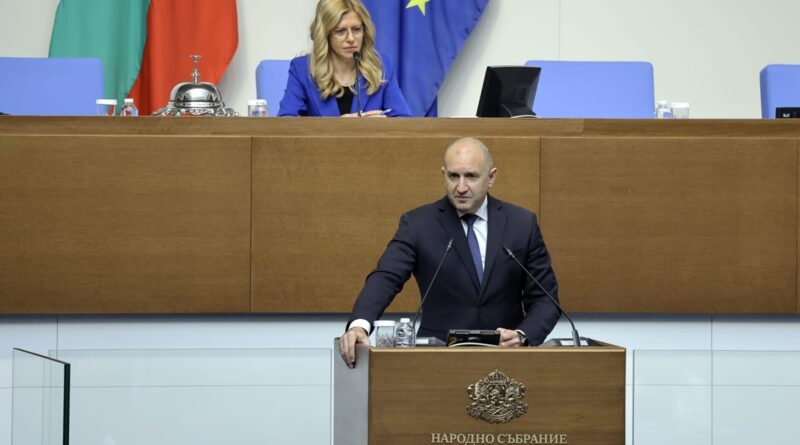
During Question Time in Parliament on October 2, Bulgarian Prime Minister Roumen Radev sought to blame the parties formerly in government and now in opposition for the country’s high prices.
Radev also tried to pin the blame on Bulgaria’s adoption of the euro, in contrast to his Finance Minister Gulub Donev having said on September 25 that the rise in inflation in Bulgaria coincided with its adoption of the euro but the euro cannot be blamed for the inflation
Radev turned his appearance for Question Time into a demonstration of contempt for the opposition.
He described his opponents as stupid, naive and placed all responsibility for rising prices on them.
This followed Venko Sabrutev, an MP for opposition We Continue the Change, criticising the government’s move to decrease the minimum wage and the government’s “Basket with care” initiative which Sabrutev described as “a basket with lies and no care”.
“Is this your fight with the oligarchy?” Sabrutev asked, referring to Radev’s promise ahead of Bulgaria’s April 2026 early parliamentary elections.
Radev said: “We are fighting the battle with the oligarchy and will fight it. But it will be very difficult to fight the battle with your stupidity and naivety”.
He accused the opposition of having lied to Bulgarians that prices would fall with Bulgaria’s entry into the euro zone.
“I wonder how people who can claim intellectual superiority do not have elementary logical thought and do not know what is happening in other countries in Europe, Croatia for example. You ask why prices are high. Well, they are high because of you,” Radev said.
In the past few years before Radev’s government took office, it was preceded by a few elected governments and several that he, when he was president, appointed.
Sabrutev countered by issuing a reminder that Deputy Prime Ministers Gulub Donev and Atanas Pekanov have denied that the euro zone is responsible for inflation.
“Is Mr. Radev lying or is Mr. Gulub Donev an inadequate finance minister?” Sabrutev asked. And he warned that “the citizens will speak out on the streets.”
Radev said that he had promised to control the rise in prices, not that he would reduce them by a certain percentage, and that the battle with the oligarchy should be waged with its proxies.
“Not directly like you, arresting political leaders and then laundering them,” Radev said, referring to how a WCC-led government had had former prime minister Boiko Borissov arrested, while WCC-Democratic Bulgaria had been in the informal “assemblage” coalition with Borissov’s GERB-UDF and Delyan Peevski’s Movement for Rights and Freedoms.
During Question Time, Radev boasted to Parliament about the praise he receives for his policies from Russia. He most recently received such praise a few days ago from Kremlin spokesman Dmitry Peskov.
“The fact is that in the interview I gave a few days ago to Euronews, you saw the reaction of the Russian side – that this is welcomed, the return of dialogue,” Radev said.
“They welcome the Bulgarian Prime Minister there, not Tsoncho Ganev,” Radev said, responding to Ganev, an MP from pro-Russian party Vuzrazhdane, who said that Radev is not fulfilling his election promises to normalise relations with Russia.
A few days ago, the Kremlin welcomed Radev’s call to restore dialogue with Russia. Peskov described his political will as “undoubtedly a very positive phenomenon”.
Radev made his appeal in an interview with Euronews in Brussels, saying that diplomatic means to end the war in Ukraine have not been exhausted and calling for the opening of channels of communication with Moscow.
According to Radev, support for Ukraine must continue, but in parallel with it, conditions for peace must be created.
He also spoke of the risk of nuclear escalation and said that European countries should take into account Russia’s nuclear potential when assessing the risk of further escalation of the conflict.
Radev said that in his opinion there is a limit to the supply of weapons, as the final steps towards ending the war will have to be taken through diplomacy.
I never said that I would suspend the agreement that caretaker Prime Minister Andrei Gyurov concluded with Ukraine, I said that it was an irrational and bad decision, Radev in response to a question from Ganev about the 17 million euro set aside in the budget to support Ukraine and the deepening of the Varna port for military purposes.
“There is not a single lie or unfulfilled promise on our part,” Radev said. He said that these 17 million euro for Ukraine were voted and given by Radev’s caretaker government. “This money has already been transferred there,” Radev said..
Radev said that the agreement with Ukraine is filled with formulations – “to check the possibility of whether something like this can be done, to explore the options and whether it can be done”.
“I said it very clearly: It cannot be done”.
“While we are in power, none of these things will be implemented, because there is a given probability there and it depends on our political will whether we will take something or not,” he said.
Our political will is very clear in this case, but as a civilised country, we will not suspend agreements, how we will implement them, this is a matter of our right, Radev said.
Regarding the deepening of the port, Radev said that over a billion leva has already been paid for the two new multifunctional patrol ships.
“If we do not deepen the port, they cannot enter there, they cannot be used, all the equipment that needs to be integrated on board cannot be integrated,” he said.