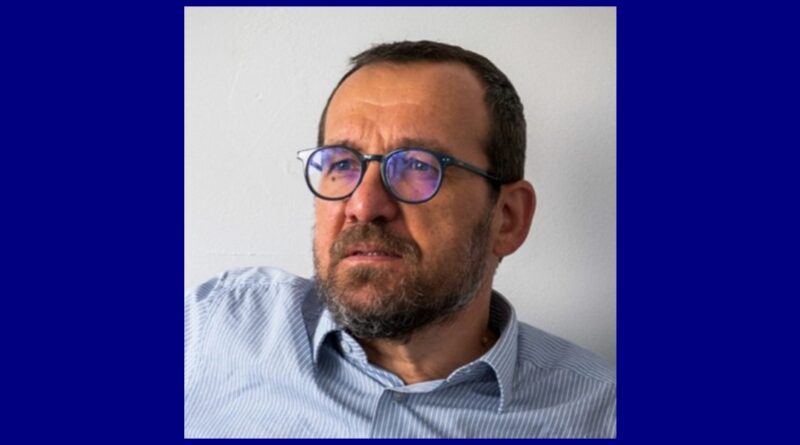
Dr Stefano Cozzini: Considering the costs of AI
Dr Stefano Cozzini admits to being a bit sceptical about AI, to sometimes feeling scared and “sometimes I’m actually an enthusiast”.
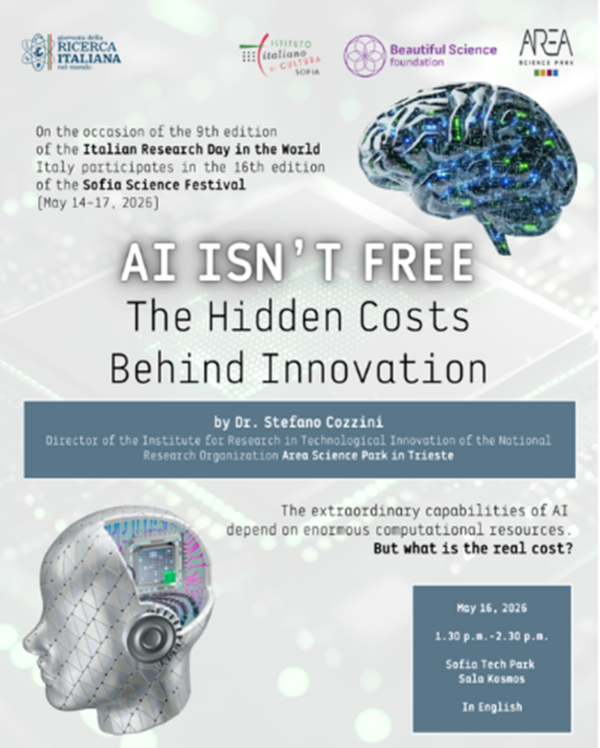
Dr Cozzini, director of the Technological Innovation Research Institute at Area Science Park in Italy, will be speaking at the 2026 Sofia Science Festival at Sofia Tech Park in Bulgaria’s capital city on May 16 on the topic “AI isn’t free: The hidden costs behind innovation”.
He tells The Sofia Globe: “There are three kinds of hidden cost that I would like to point out”.
The first is energy consumption, devoured by the training of AI and its use. This cost, he says, is well known by those involved in the development of the AI algorithm “but not so known or considered by the users”.
The second cost is actually quite related to the energy, is actually the environmental cost: “The fact that they are building such large data centres, such large data computational infrastructure to cope with the never-ending demanding for computing power that this AI algorithm requires”.
“And so the hidden cost is actually the environmental cost,” he says. “It costs a lot of water, it costs a lot of CO2 footprint, and so on.”
This is a hidden cost in the sense that there is no real bill, unlike energy, where there is a clear bill.
“But the environmental cost is actually a little bit more complex to compute. Indeed, there is a lot of research how to compute it, because how to evaluate how much CO2 the system is producing. So it’s a little bit complex and still very important.”
The third cost, he says, is the social impact and the social cost.
This, again, is very difficult to evaluate, Cozzini says.
“I think that a lot of people really miss the point that is actually these techniques and these algorithms and whatever makes life easier, because actually it’s very nice to use them, because they solve a lot of problems, but sometimes we use it without too much consciousness. That’s the point,” he says.
“I mean, using these kind of tools requires a little bit of care – requires a little bit of care in the sense that you can’t trust them blindly. And I see a lot of people that they are actually using them blindly.”
Cozzini adds that there are a lot of free tools, but actually nothing is free: “I mean, nobody is actually giving you things for free”.
“So, if things are free, it means they are taking something from you and they are taking from you all the information that you blindly put on the screen, put on the prompt of this AI system.”
This, he says, is “a little bit dangerous, in my opinion. And the danger is not so well understood…and this is actually the most important (point).”
Cozzini says that he sees a lot of people “not just young people, actually people of my age” are using AI “in a very stupid way” – putting in information that is private and that should be considered private, but this point is not yet fully understood.
He warns of using AI as a “shortcut”. You park your brain “and so you say, okay, it’s a little bit too difficult to think by myself”.
He likens the syndrome to the appearance of washing machines many decades ago, when the idea was that as labour-saving devices, they would save people physical fatigue and free them up for other things.
But using AI in this way, he says “you are avoiding brain, or let’s say intellectual fatigue, intellectual thinking. And that’s actually quite dangerous, especially for young people.”
He says that he sees young people “using this kind of stuff in a blind way, in a stupid way…but I see bright students, that they are using them in the right way.”
“But it shouldn’t be a tool to avoid you thinking. That’s actually the problem”.
Asked how to make changes so that AI becomes more cost-effective and has less of the negative impacts, he says that it is possible to optimise, but that opens the way for the German balancing paradox, that lower costs could stimulate usage.
“And then the other point is actually that there is a lot of energy just wasted in very stupid things. And this may come back with the social impact that we discussed before. I mean, why do we need, why do we have to, why do I have to ask my artificial intelligence stupid things? And we are wasting a lot of energy in this.”
He adds: “To reduce this is actually you have to be a little bit conscious that any kind of action that you’re doing is actually have a small footprint in energy, in carbon, and so on. And so maybe we can avoid this kind of stuff”.
Asked what policymakers in the EU should be doing about the issues raised by AI, Cozzini says: “I’m a little bit puzzled and let’s say disappointed by what is actually happening in Europe. What I’m seeing is actually that the great players are actually all Americans and Chinese”.
“There are these great players, you know, Anthropic, OpenAI, Meta and all these guys that are building such large data centres and doing such large models. In Europe, we have just Mistral.”
He underlines that Mistral, a French company, is doing well. Of what is happening at EU level, he notes the bloc’s AI Factories initiative: “A very good initiative. Very nice initiative. If you put together all the money that the European Union is spending, it is actually something like the budget of OpenAI”.
Cozzini says that he is happy that the EU is thinking about these issues: “And they are taking care about data, data sovereignty at a European level. But for the fact that we need to be on the global competition with Americans and Chinese, I don’t think that is the right way to split in many different data centres and different initiatives”.
“I would rather prefer to see one single large initiative called EU initiative placed in a country that could be Italy, could be Germany, can be whatever. We don’t really have to care about the country where the system is. We have to care about to have one large initiative that is all together, working all together.”
More broadly, he says that what is happening is not a matter purely for scientists “it’s actually a social problem with a profound impact”.
“I’m a little bit worried of the fact that maybe the genie of the bottle is gone, and we don’t really understand what’s going on, what are the implications on the society, you know? You know, technology is always this way,” he says.
“Because there are some disruptive technologies that change the world. This is actually for sure changing the world, in which way we don’t understand, because we still don’t understand how it works correctly.”
This, he reiterates, is not something for the scientific community to discuss alone: “We need a lot of help to discuss this. We need other people, we need other competencies, sociological competencies, philosophical competencies, and so on.”
Cozzini adds his disappointment that AI is being harnessed as a tool of war.
“I’m really very much sceptical and I will say disappointed in the sense that, again, we have great tools in our hands and we are using it for very bad things and there is no way to change it.”
He says that the AI business is not ruled by government but “a handful of people that have in their hands a lot of power that probably sometimes they don’t even realise”.
“And this is actually, again, a little bit of scary part of it because, I mean, I trust better a government than a company sometimes. I don’t know.”
The Sofia Globe is a media partner of The Sofia Science Festival. Dr Cozzini’s participation is in partnership with the Istituto Italiano di Cultura di Sofia.