
Alpha Research poll: Radev’s Progressive Bulgaria 30.8%, GERB-UDF 21.2%
Were Bulgaria to hold parliamentary elections now, ex-president Roumen Radev’s Progressive Bulgaria would get 30.8 per cent among those who would vote, with Boiko Borissov’s GERB-UDF coalition in a distant second place at 21.2 per cent, according to a poll by the Alpha Research agency, the results of which were released on March 29.
The poll results were released with three weeks to go to Bulgaria’s early parliamentary elections that are to be held on April 19.
In third place is We Continue the Change – Democratic Bulgaria (WCC-DB), 11.1 per cent, followed by the Movement for Rights and Freedoms – New Beginning, which is led by Magnitsky Act-sanctioned Delyan Peevski, 9.8 per cent, and pro-Russian party Vuzrazhdane, 6.9 per cent.
Just below the threshold of a minimum four per cent of valid votes to win seats in the National Assembly is the Bulgarian Socialist Party – United Left, at 3.9 per cent.
Nationalist-populist Mech has three per cent, the Siyana coalition 2.8 per cent, nationalist-populist Velichie 2.7 per cent, right-wing Blue Bulgaria 1.6 per cent, populist ITN 1.4 per cent and the Ahmed Dogan loyalists of the Alliance for Rights and Freedoms 1.2 per cent
As The Sofia Globe reported on March 24, an Alpha Research poll then showed Radev’s Progressive Bulgaria at 29.4 per cent, GERB-UDF 20.7 per cent, WCC-DB 11.5 per cent, MRF – New Beginning 9.8 per cent, Vuzrazhdane 6.8 per cent, the BSP – United Left 3.8 per cent, Mech 3.3 per cent and Siyana 2.4 per cent.
Previously, an Alpha Research poll, the results of which were released on March 5, showed Radev’s coalition at 32.6 per cent, GERB-UDF 19.7 per cent, WCC-DB 12.6 per cent, MRF-New Beginning 9.6 per cent, Vuzrazhdane 6.4 per cent and the BSP – United Left 3.6 per cent.
Speaking to Bulgarian National Radio on March 29, Alpha Research’s Boryana Dimitrova said that the coalition around Radev was showing a slight mobilisation, probably because Radev’s campaign events have begun.
GERB-UDF is also strengthening its position, but there was a difference of between eight and nine points between first and second place, Dimitrova said.
WCC-DB is not at the level of mobilisation that it achieved at the time of the late 2025 street protests, according to Dimitrova
“WCC-DB failed to show a more energetic and distinct face during the first week of the campaign. The two parts of the coalition seem to be running parallel campaigns,” she said, referring to WCC and DB, respectively.
There was an interesting development regarding the BSP, she said, describing it as “creeping up slightly, step by step”.
More than half of those polled – 55.8 per cent – said that they intended voting on April 19.
“A slight mobilisation is observed compared to our previous survey. However, it does not meet expectations from the end of January, when President Radev announced that he was leaving his post and entering politics.”
The overwhelming majority of respondents expect to see a regular government after the elections , Dimitrova said.
“Forty-three per cent say: ‘I expect a coalition government’, 30 per cent have a rather shaky belief that a regular cabinet will be formed.”
She said that so far, none of the political parties has given a clear statement about who they would govern with, as well as what the priorities are that they would work on.
“It’s time to start talking. The voter is pragmatic and has a clear idea that there are alliances that are possible. He expects principled behaviour after the elections. When there are no answers, this creates serious concerns and hesitation among voters.”
Forty-seven per cent of those polled named income and inflation as the first problem that a future regular government should address, for 33 per cent it is the fight against corruption and reform of the judicial system, 11.3 per cent Bulgaria’s economic development, for seven per cent of Bulgarians it is healthcare, and 1.2 per cent point to roads and infrastructure.
“The spectre of inflation has not been there since 1997-98,” Dimitrova said, referring to the financial and economic crisis into which a socialist government plunged Bulgaria 29 years ago.
The new Alpha Research poll found that more than half of Bulgarians – 56.3 per cent, would choose the European Union as the country’s strategic partner, for 19.5 per cent it is Russia, for 7.8 per cent the United States, 6.4 per cent China, and Türkiye 1.8 per cent.
“Years ago, the US had a much higher percentage,” Dimitrova said.
The poll was conducted by the Alpha Research agency, under contract to and with funding from Bulgarian National Radio. Sample size: 1000 people. A stratified two-stage sample with a quota based on the main socio-demographic characteristics was used. The information was collected through a direct standardised interview done with tablets at the homes of the respondents. The poll was done from March 19 to 26 2026.
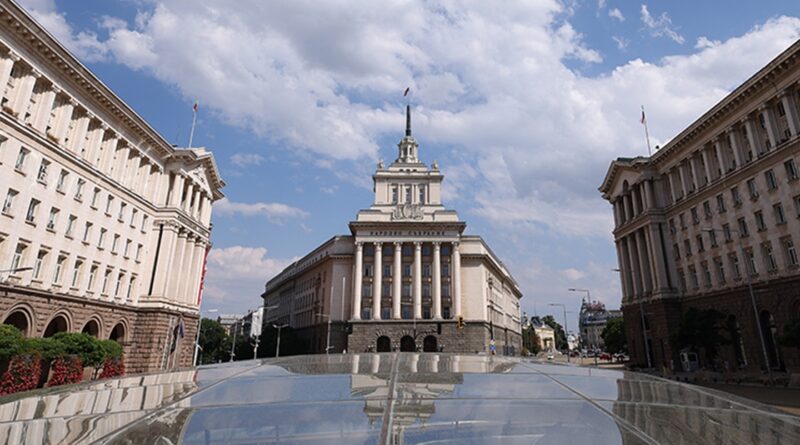
(Photo: parliament.bg)
Bulgaria’s April 2026 parliamentary elections: The Sofia Globe’s factfile


