Caretaker PM: Bulgaria is not directly threatened by military actions in the Middle East
The situation has not yet reached a critical point, but if this happens, we can defend ourselves and we have a clear strategy about how this will happen, caretaker Prime Minister Andrei Gyurov said on March 5 after a meeting of the government security council, called because of the war in the Middle East.
This was the second meeting of the government security council after the United States and Israel launched attacks on Iran on February 28, and was called because of Iran’s launch of a missile against Türkiye on March 4.
That missile launch prompted the Defence Ministry to reassess the risks and threats to Bulgaria from the situation in the Middle East.
However, the message from March 5 meeting was largely the same as that from its February 28 emergency meeting.
Gyurov emphasised that at this moment Bulgaria is not threatened and is not participating in the military actions.
“Both within Nato and at the national level, we have the capabilities to protect our country and – I emphasise – the situation has not yet reached a critical point, but if this happens, we can protect ourselves and we have a clear strategy on how to do this,” Gyurov said.
“Nato’s missile defence is designed to reflect a missile attack from Iran and, as we saw in the case of Türkiye, it worked flawlessly, and therefore we can be calm and rely on this collective defence.”
Gyurov said that he had instructed the ministers responsible for security to speak clearly and openly with the public.
“There is no hidden information. Bulgarian citizens and their peace of mind are our priority,” he said.
Gyurov appealed to the public to get information from official bodies, and not from the words of political parties, which, he said, are in an election campaign. “Disinformation only aims to confuse and scare Bulgarians,” Gyurov said.
“People should be calm and confident that when they go to the polls on April 19, they will be guided by wisdom, not panic. I have instructed the services to monitor everything carefully and not allow a repetition of the Romanian scenario,” he said.
In the late 2024 elections, the presidential candidate with fascist and pro-Putin messages, Calin Georgescu , reached a runoff and even had a chance to win. However, the vote was annulled by the Constitutional Court on the grounds that there was convincing evidence of foreign interference in the electoral process.
Romania is investigating reports that the candidacy of Georgescu, an extreme nationalist with anti-European and anti-Nato messages, was supported by Russian interference and a hybrid influence campaign on TikTok.
Gyurov said: “We listened carefully to the reports [from the security services], we held a second security council meeting in a timely manner, precisely because the situation is dynamically changing and we must always have the most up-to-date information.
“At the same time, it was very important that we expanded the permanent members of the security council and invited representatives of the National Assembly, precisely to avoid any speculation that there was hidden information. I think this was appreciated on its merits, both by the Speaker of the National Assembly and by the representatives of the political parties present,” he said.
Caretaker Defence Minister Atanas Zapryanov said that the decision to allow US military aircraft to be parked at Vassil Levski Sofia Airport was made on February 17 and 18 during the term of Prime Minister Rossen Zhelyazkov, when Boiko Borissov’s GERB was the holder of the mandate to govern.
“I signed this decision and notified the political force and the prime minister at the time,” said Zhelyazkov, who met Borissov on March 5 for discussions ahead of the government security council meeting.
“It is very important to me that GERB’s support for this decision continues to be implemented within the framework of the caretaker Cabinet. We must have a Euro-Atlantic majority and support in the Bulgarian Parliament on this issue, because it is about the security and defence of the country,” Zapryanov told the briefing.
Gyurov, however, in a clear rebuke said that caretaker ministers had no place at political party headquarters.
Regarding the measures taken to ensure the security in Bulgaria, Zapryanov said that the country’s air defence has been strengthened by activating forces and resources. He said that they are in constant contact with Nato.
“Tomorrow, March 6, there will be a Nato Council that will consider this topic, the readiness of Nato’s missile defence system will be increased, and we will request additional reinforcements if the high command believes that there is a need for such reinforcement for missile and air defence,” Zapryanov said.
Caretaker Foreign Minister Nadezhda Neynski said that she was in contact with the Turkish Foreign Minister, discussing possible assistance from Türkiye in the event of a migrant flow.
“At this stage, there is no danger of a migrant flow, but we want to be prepared for bad scenarios. God willing, better things will happen, but it is a war and no one can give a guarantee,” Neynski said.
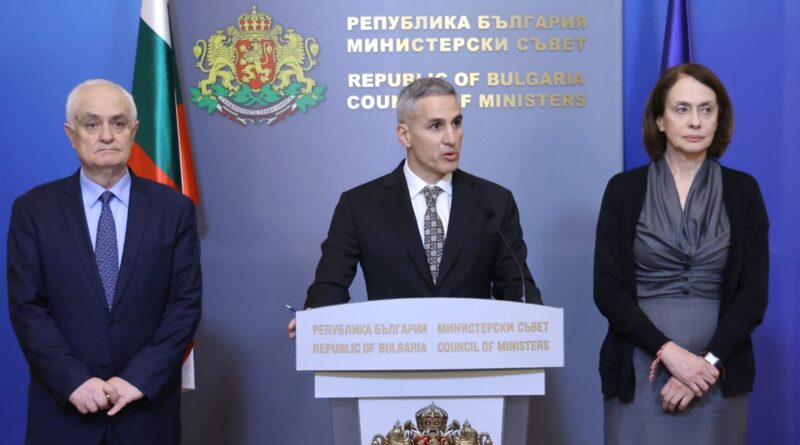
(Photo of, from left, Zapryanov, Gyurov and Neynsk: government.bg)