
Bulgaria’s caretaker Foreign Minister has reservations about Trump’s ‘Board of Peace’
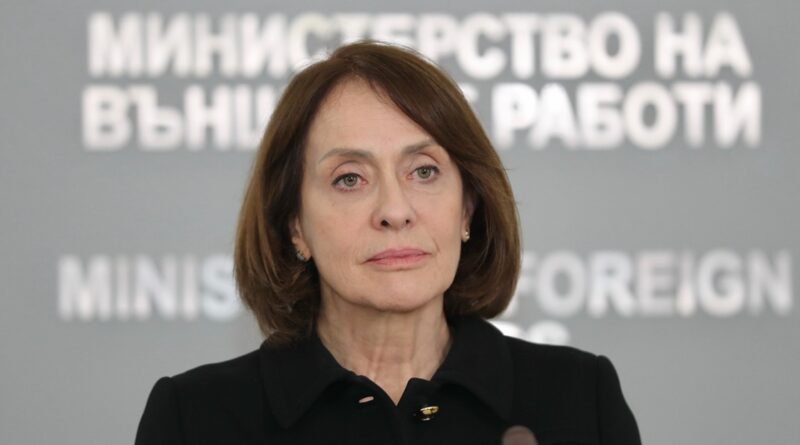
Taking office on February 19 as Bulgaria’s caretaker Foreign Minister, Nadezhda Neynski said that she and her colleagues from the European Union “still have many reservations and question marks” about the legal status of US president Donald Trump’s “Board of Peace”.
Neynski’s statement came a few hours before the first meeting of the “Board of Peace”, to which Bulgaria signed up on January 22 and to which the now-former Bulgarian government decided on February 17 to send a delegation of Foreign Ministry officials.
The Zhelyazkov government agreed at its final meeting to send a delegation headed by Foreign Ministry permanent secretary Ivan Naidenov, the ministry’s director general for political affairs Konstantin Dimitrov and Bulgarian embassy charge d’affaires Stefka Yovcheva.
The former government’s decision was that Bulgaria would take part in the February 19 meeting as a non-voting member, as provided for in the “Board of Peace” charter.
The February 17 decision was made even though it was widely expected that the Zhelyazkov government would leave office on February 19, with a caretaker government taking office as Bulgaria heads to early parliamentary elections on April 19.
Bulgaria was only of only two European Union countries to sign the “Board of Peace” charter, and few EU countries were expected to attend the February 19 meeting in Washington, and then mainly only as observers.
Neynski said that Trump’s initiative about Gaza, of which Bulgaria is a part, is still unclear.
“With its support, Bulgaria has given a political signal, but it is not yet clear whether the document has the character of an international treaty,” Neynski said.
She said that the topic would probably be discussed with Nikolai Mladenov, whose appointment as special representative for Gaza was announced on January 17, and was one of the successors as foreign minister, January 2010 to March 2013, of Neynski, who held the portfolio from 1997 to 2001.
Neynski said that she expected to discuss the topic on February 20 with her immediate predecessor, Georg Georgiev.
“One of the issues I will address during my meeting with Mr. Georgiev is what exactly was signed, to see in the documents themselves, because up to this point I am not sure that there is publicity for all the commitments that this signature implies,” she said.
Ratification of the document has not been put to the current National Assembly and Georgiev previously has said that it would be put to the next.
“At this stage, the idea of ratification is being held back, because without knowing the legal basis of what has been signed, absolutely no further steps can be taken,” Neynski said.
She said that issues related to financial dimensions must also be considered, as well as the fact that “it is managed by a single person”, a reference to Trump.
Neynski said that the comprehensive peace plan, which received the support of UN Security Council Resolution 2803, only aims at peace in Gaza.
Trump’s expansion of the initiative opens up questions that have not yet been answered, she said.
In a step reported to have caused controversy among EU member states, the February 19 meeting in Washington is to be attended by European Commissioner for the Mediterranean Dubravka Šuica. The controversy stems mainly from the European Commission (EC) deciding to send a representative in spite of the absence of a policy decision by the EU member states.
The EC said on February 18 that Šuica’s participation, on its behalf, “is in line with the EU’s commitment to the implementation of the ceasefire in Gaza, as well as to international efforts for its recovery and reconstruction”.
The Commission said that the EU “is a strong advocate for a two-State solution with a secure Israel and a viable Palestinian State”.
“The EU has an important role to play in this context as the biggest provider of external assistance to the Palestinians (1.6 billion euro multiannual programme to Palestine recovery and resilience for 2025-2027 and over 550 million euroin humanitarian assistance since October 2023),” the EC said.
In November 2025, the EU set up the Palestine Donor Group, to gather international support for the implementation of the reform agenda of the Palestinian Authority, also in line with point 19 of the Gaza Peace Plan, the Commission said.
“In Washington, Commissioner Šuica will take part in the talks to facilitate coordination and complementarity of our actions with international efforts for the post-war recovery and reconstruction of Gaza,” it said.
(Photo of Neynski: Ministry of Foreign Affairs)