
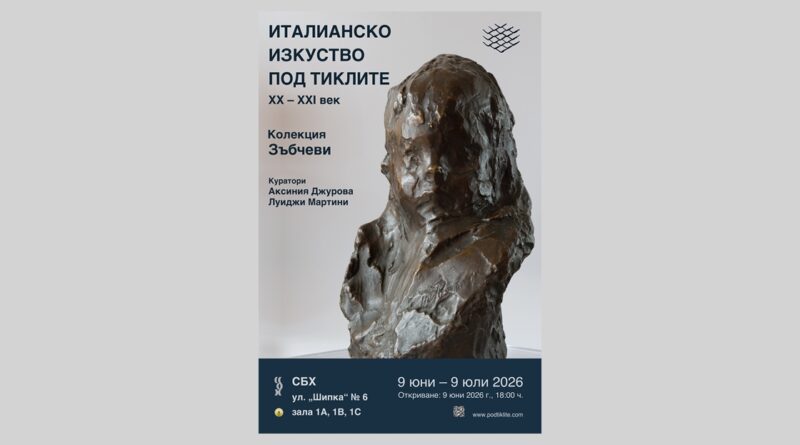
Exhibition ‘Italian art under the stone slates XX – XXI century. The Zabchevi Collection’ opens on June 9
An exhibition entitled “Italian art under the stone slates XX – XXI century. The Zabchevi Collection” opens at the Union of Bulgarian Artists gallery at 6 Shipka Street in Sofia on June 9.
The exhibition pulls back the curtain on a rich collection born from the meeting of two collectors from Italy and Bulgaria – Luigi Martini and Georgi Zabchev, the gallery said.
“One was born in Ravenna – the city that still preserves the memory of Justinian’s Byzantium and the splendor of its mosaics in the churches of the V – VII centuries; the other – under the tikli, the stone slabs of the old houses in Kovachevitsa, which have preserved the functional aesthetics and traditions of our ancestors.”
Composed of numerous works by painters and sculptors of European and Bulgarian art, the core of Georgi and Vanya Zabchev’s foreign collection was laid by that of Luigi Martini and his daughter Monnalisa, subsequently significantly enriched.
Over 200 works by 40 Italian and Bulgarian artists from the Zabchevi Collection have been selected and displayed in three gallery halls, each designed with a extraordinary space concept created specifically for the venue.
Among the prominent Bulgarian and Italian artists featured in the first gallery are Medardo Rosso, Giorgio de Chirico, Franco Ferrari, Jaber Alwan, Nunzio Bibbò, Ennio Calabria, Renato Guttuso, Assen Peykov, and Boris Georgiev.
In the second hall, there is a figurative art section: artists from the 1940s to the beginning of the XXI century, namely Pietro Cascella, Emilio Greco, Piero Guccione, Giacomo Manzù, Edolo Masci, Maddalena Mauri, Saro Mirabella, Zoran Mušič, among others.
In the third hall—Hall 1C—is the abstract art section, which includes works by Enrico Accatino, Vasco Bendini, Eugenio Carmi, Nicola Carrino, Piero Dorazio, Giorgina Lattes, Umberto Mastroianni, Gastone Novelli, Giò Pomodoro, Emilio Scanavino, Guido Strazza, and Emilio Vedova.
In Italy, artists working in the field of abstract art are numerous, and those included in this exhibition should be seen only as an initial stage of presenting this movement, which will expand in the coming years.
In general terms, abstract art in Italy is defined by a continuous dialogue between European influence and local specificities – from the surrealist approach in the 1930s to the freer forms after the Second World War, starting with Informel.
The exhibition is curated by Aksinia Dzhurova—a professor, holds a Ph.D. in art history, specializing in medieval and contemporary art, and Luigi Martini—a cultural advocate for Arci—the Italian Association for Leisure and Culture.
Luigi Martini and Axinia Džurova are the authors of a three-volume publication dedicated to the Zabchevi Collection (2023, 2025, and 2026).
The exhibition in 1A Hall will be open until July 23; the exhibitions in 1B and 1C Halls will be on display until July 9.
___
The exhibition is organized by the Zabchevi Collection in partnership with the Union of Bulgarian Artists and the Union of Collectors in Bulgaria.