

Eurostat: Residence permits issued in EU to non-EU citizens reached record high in 2024
A total of 4 607 257 single residence permits were issued by European Union countries to non-EU citizens in 2024, an increase of 13.6 per cent compared with 2023 and the highest number recorded, the bloc’s statistics agency said on December 18.
The figure is 28 per cent higher than in 2022, Eurostat said.
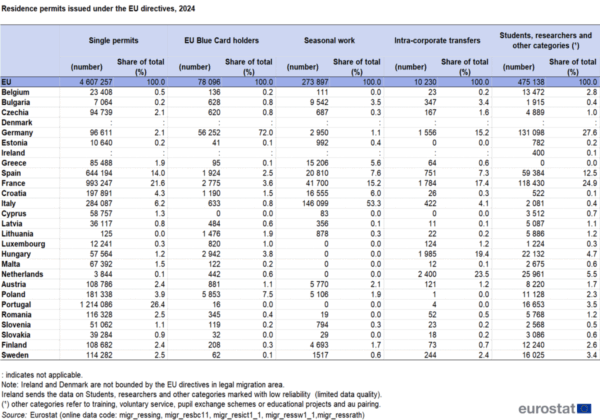
In 2024, more than two-thirds of single permits issued in the EU were extensions of residence permits (67.6 per cent or 3 113 809), which can be broken down to either renewals (61.9 per cent) or change of status (5.7 per cent) of existing residence permits.
The remaining 32.4 per cent (1 493 448) of single permits were issued for the first time i.e. an inflow in the reporting EU country.
Nearly two thirds of the total number of single permits (61.9 per cent) issued in the EU were issued by three countries in 2024: Portugal (1 214 086, 26.4 per cent of the total), France (993 247 permits, 21.6 per cent), and Spain (644 194, 14.0 per cent)
The overall trend of EU Blue Cards issued in the EU shows a positive trend since 2016, except for 2020 when a decrease of 3.6 per cent was recorded due to the Covid-19 pandemic and a decrease of 12.3 per cent in 2024, probably due to the revision of the EU Blue Cards Directive, Eurostat said.
A total of 78 096 EU Blue Cards were granted to non-EU citizens in 2024 after a record number of 89 055 in 2023, when an increase of 8.8 per cent was recorded compared with the 81 846 EU Blue Cards granted in 2022.
In 2024, the majority of EU Blue Cards in the EU (89.5 per cent) were issued in five countries: Germany (56 252, 72.0 per cent of the total), Poland (5 853, 7.5 per cent), Hungary (2942, 3.8 per cent), France (2 775, 3.6 per cent) and Spain (1 924 or 2.5 per cent).
Conversely, 6 EU countries issued less than 100 EU Blue Cards in 2024: Greece (95 EU Blue Cards), Sweden (62), Estonia (41), Slovakia (32), Portugal (16) and Cyprus issued no EU Blue Cards.
The top 10 countries whose citizens were granted EU Blue Cards in 2024 accounted for nearly two-thirds (63.3 per cent) of the total 78 096 cards issued in the EU in 2024.
Of these, 16 268 EU Blue Cards were granted to citizens of India, representing 20.8 per cent of all EU Blue Cards issued in the EU.
The next largest numbers were for citizens of Russia (6 657 EU Blue Cards, 8.5 per cent of the total), Türkiye (5 645, 7.2 per cent), China (4 550, 5.8 per cent), Belarus (3 533, 4.5 per cent), Ukraine (3 524, 4.5 per cent) and Iran (3503, 4.5 per cent).
In this top 10 countries list, three countries recorded less than 2000 EU Blue Cards issued to the citizens of Syria (1 955), Tunisia (1 889), and United States (1 884).
The total number of authorisations for seasonal work granted to non-EU citizens in the EU rose by 42.8 per cent, from 191 840 residence permits issued in 2023 to 273 897 in 2024. This follows the trend from the previous year, when 20.5 per cent more authorisations for seasonal work were granted compared with 2022, Eurostat said.
In 2024, most authorisations for seasonal work in the EU were issued in five countries: Italy (146 099, 53.3 per cent of the total), France (41 700, 15.2 per cent), Spain (20 810, 7.6 per cent), Croatia (16 555, 6.0 per cent) and Greece (15 206, 5.6 per cent).
On the opposite side of the ranking, eight EU countries issued less than 100 authorisations for seasonal work in 2024: Cyprus (83), Slovakia (29) and Romania (19), and no authorisations to reside for seasonal work were issued in Hungary, Luxembourg, Malta, Portugal and the Netherlands.
The top five countries whose citizens were granted authorisations for seasonal work in 2024 accounted for more than two-thirds (69.4 per cent) of the total 273 897 authorisations for seasonal work issued in the EU in 2024.
Of these, 76 579 authorisations were granted to citizens of Morocco, which represented 28.0 per cent of all authorisations for seasonal work issued in the EU. The next largest numbers and shares were for citizens of Bangladesh (53 567 authorisations for seasonal work, 19.6 per cent), India (39 137, 14.3 per cent), Tunisia (12 675, 4.6 per cent) and Pakistan (8 240, 3.0 per cent).
The total number of authorisations for study, research and other related activities (authorisations issued to trainees, volunteers, school pupils and au pairs) granted to non-EU citizens in the EU increased between 2022 and 2024.
In 2022, 421 974 authorisations for students and researchers and other related categories were issued in the EU, followed by an increase in the following two years: 6.8 per cent increase in 2023 (450 848 authorisations issued) and 5.4 per cent increase in 2024 (475 138).
In 2024, about three quarters of total authorisations for study, research and other activities in the EU were issued in fivecountries (75.1 per cent): Germany (131 098, 27.6 per cent of the total), France (118 430, 24.9 per cent), Spain (59 384, 12.5 per cent), the Netherlands (25 961, 5.5 per cent) and Hungary (22 132, 4.7 per cent).
On the other side of the ranking, four countries issued less than 1000 authorisations: Estonia (782 authorisations), Croatia (522), and Ireland (400) while no authorisations to reside for study, research and other activities were issued in Greece.
The top 10 countries whose citizens were granted authorisations for study, research and other activities in 2024 accounted for nearly half of the total authorisations (47.4 per cent).
Of these, 52 890 authorisations were granted to citizens of India, which represented 11.1 per cent of all such authorisations in the EU.
The next largest numbers were for citizens of China (43 985 authorisations, 9.3 per cent), Morocco (22 918, 4.8 per cent), US (21 694, 4.6 per cent), Türkiye (18 711, 3.9 per cent), Iran (16 146, 3.4 per cent), Pakistan (13 421, 2.8 per cent), Brazil (12 049, 2.5 per cent), Algeria (11 916, 2.5 per cent), and Colombia (11 680 2.5 per cent).
All these 10 countries excepting China and Algeria recorded an increase in the past two years (2023 and 2024). The greatest increase in 2024 in absolute numbers in comparison with 2023 was recorded by citizens of Iran (+9 181), Pakistan (+4 304) and Brazil (+4 075. A decrease was recorded by China (-3 009) and Algeria (-1 405), Eurostat said.
(Photo: Council of the EU)