Bulgaria’s PM on Lukoil sanctions derogations: ‘We did the best we could for the refinery’
Bulgarian Prime Minister Rossen Zhelyazkov, reacting on November 15 to temporary derogations by the United States and United Kingdom on sanctions on Lukoil in Bulgaria, said: “We did our best for the refinery”.
The derogations were announced on November 14, the same day that the Bulgarian government appointed National Revenue Agency head Roumen Spetsov as special administrator of Lukoil assets in Bulgaria, including the country’s sole refinery.
As quoted by the government information service, Zhelyazkov said that intensive daily talks had been taking place with partners from the UK and US since the first day of the sanctions.
“The goal is to ensure that no funds from the companies will flow in an unwanted direction,” Zhelyazkov said.
“At the same time, it is important that the refinery continues to operate smoothly, that its workers are calm about their work and that the Bulgarian market does not experience any difficulties,” he said.
There are many challenging days, weeks and months ahead for the refinery, Zhelyazkov said, noting that the derogation lasts for six months.
He said that it is important to ensure the timely delivery of oil, to have unhindered processes of processing and distribution.
“I count on the special manager and the team that he will select, through the prerequisites provided for in the law, to bring the necessary reassurance,” Zhelyazkov said.
He expressed hope that Russia will listen to the voice of reason and will cease fire. While the war continues in Ukraine, the sanctions from the European Union and the United States will continue to tighten the noose, he said.
Former Prime Minister Boiko Borissov, whose GERB-UDF coalition is Parliament’s largest group and holds the mandate to govern, thanked the entire government team that prepared the decisions that led to Bulgaria receiving a derogation.
On his Facebook profile, Borissov expressed thanks for the support in Parliament from Delyan Peevski’s Movement for Rights and Freedoms – New Beginning, the Bulgarian Socialist Party – United Left, and ITN.
Nadezhda Yordanova, co-leader of the opposition We Continue the Change – Democratic Bulgaria parliamentary group, said in a statement on November 15 that the appointment of Spetsov as special administrator of Lukoil in Bulgaria raises serious concerns and challenges.
Yordanova referred to legislative amendments approved by Parliament in 2023 that explicitly require that the special administrator must have at least five years of experience in managing economic activities related to oil.
“We introduced this requirement for a special commercial manager precisely to ensure that a person who knows what he is talking about will come in. How exactly will Roumen Spetsov cope with the management of the refinery and the complex complex of economic activities?” Yordanova said.
“What experience does he have in managing economic activities related to oil? His appointment creates the impression of a straw man with no experience, appointed to head the Bourgas refinery,” she said.
“Tomorrow they may appoint a tax inspector to manage the nuclear power plant, but our society does not need such experiments.”
Yordanova said that from now on, the processes at the Bourgas refinery must be reorganised very quickly so that its activities are reliably ensured and all financial flows to Russia are stopped.
“We see the Belene nuclear power station scenario repeating itself before us. It is not in the interest of Bulgarian citizens to pay billions for the incompetent work of the current administration.
“The government could have appointed a special administrator from day one, but instead they insisted on hastily pushing through scandalous amendments to our law. These changes carry risks for the future, which we will all pay for,” Yordanova said, adding that the new texts do not actually correspond to the so-called German model.
“The amendments contain many deviations and risks that do not meet the high standards of legal certainty adopted by Germany to protect its interests and citizens from future claims by Russia.
“There, there is judicial control at every stage. In Bulgaria, the appointment of a special manager has not been confirmed by the court. In Germany, the rights of shareholders are exercised by a person other than the special manager,” she said.
“If, God forbid, it comes to expropriation and nationalisation, in Germany there is again judicial control. We do not have it here. This violates both the constitution of Bulgaria and many bilateral and multilateral treaties that we have signed,” Yordanova said.
President Roumen Radev, speaking to reporters on November 15, said that the appointment of Spetsov as special administrator of Lukoil was illegal.
“Because according to their law, he must develop a detailed six-month activity plan and present it to the Cabinet security council, where it will be approved.
“When did Mr. Spetsov develop such a detailed six-month plan, when did the members of this council meet, when did they approve it, and he was not even present at the council,” Radev said.
He said that it was clear that all European countries would receive a reprieve from the US sanctions, since Washington is a strategic ally of Europe.
“All attempts at heroic poses, at demonstrations of some super achievements in diplomacy sound slightly ridiculous against this background, but it is indicative of the way in which the mentors of the ruling party tried to use this case,” Radev said.
“Of the way in which a law was passed and the essence of the law, which betrays their true intentions, which lead to situations like Bulgartabac and Corpbank,” he said.
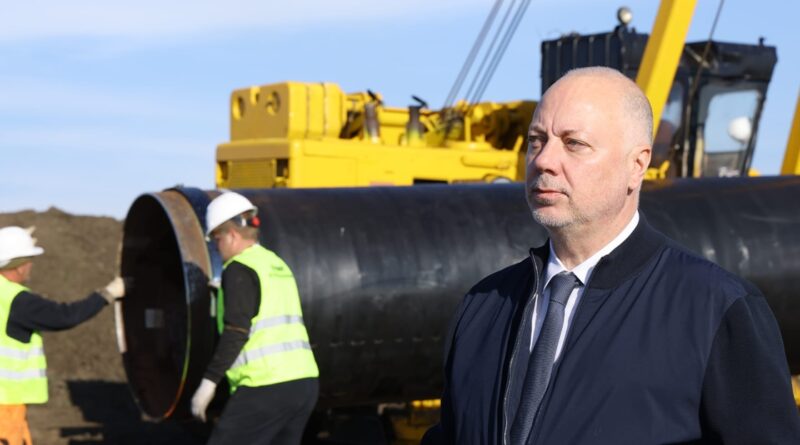
(Photo of Zhelyazkov: government.bg)
For exclusive subscriber-only access to The Sofia Globe’s analysis and commentary on events in Bulgaria, please sign up to our page on Patreon:
Become a Patron!