
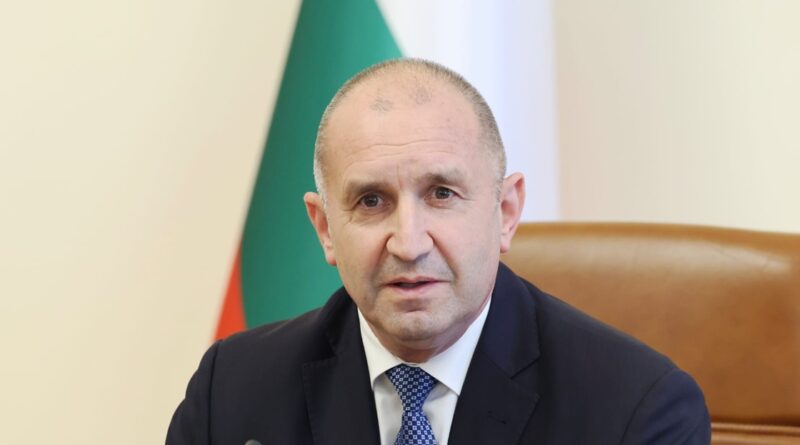
Bulgarian PM Radev: No price ceiling but ‘all tools of market economy’ to lighten prices
Newly-elected Bulgarian Prime Minister Roumen Radev said on May 8 that his government will not introduce price ceilings but will use “all the tools of the market economy” to lighten prices and lead to shorter retail chains.
Measures to break the trend of rising prices will be among the first priorities of the new government, Radev told reporters shortly after Parliament voted his government into office.
Legislative changes are already being prepared to clarify the pricing process and counteract unfair competition, he said.
Radev emphasised the need to strengthen the impact on those who violate normal competition.
“We will propose much higher sanctions and much more comprehensive control mechanisms, ” he said.
He also emphasised the possibility of cooperation between Bulgarian producers so that they have faster and easier access to the market.
Radev said that there was a need to protect Bulgarian producers from “arm-twisting” practices that force them to sell almost at cost. He said that this is detrimental to dairy production and livestock farming and everything possible must be done to stop this trend.
Radev convened the first meeting of his Cabinet on the afternoon of May 8, opening the meeting by stating what he said were the leading goals and tasks of the new government.
Along with judicial reform and the fight against corruption, he spoke of saving the funds under the Recovery and Resilience Plan and priorities in healthcare, education, transport infrastructure and improving the business environment in Bulgaria.
In order to implement these priorities, however, it is necessary to have a complete picture of the state of the country, he said.
Radev ordered the ministers to carry out a detailed analysis in each department in a short time with an emphasis on the financial situation, checking for the presence of problematic contracts, bloated administration and public procurement.
Based on the results of the analysis, the government will decide how to draft the state Budget – it will be a function of what is already in place in the relevant ministries.
“I draw attention to the hidden deficit, the hidden expenses, the unpaid invoices that are in the drawers – all of this must be taken out as a priority so that the Minister of Finance can finally know how to structure the Budget,” Radev said.
“We are committed to our programme to dismantle the oligarchic model – this means an energetic and decisive government that can be a driving force in the fight against corruption,” he said.
He emphasised the importance of having an independent Prosecutor’s Office, as well as a new Supreme Judicial Council.
The government, for its part, will focus on cracking down on corruption crimes and violations of the law, according to Radev.
“This will go hand in hand with our efforts and together with the National Assembly to elect a new, independent, legitimate Prosecutor General,” he said.
He said that judicial reform does not end with the replacement of the Prosecutor General. In this context, the Cabinet is about to submit to Parliament its proposals for a comprehensive judicial reform, so that there is more justice, faster, more accessible and fairer administration of justice in Bulgaria, he said.
“We are committed to working to change the business environment in Bulgaria – to attract more investments, to increase digitalisation and a greater number of electronic services, to reduce regulations, ” Radev said.
He emphasised the need to accelerate the modernisation of the Bulgarian military.
Regarding the Interior Ministry, Radev highlighted the fight against crime and against the war on the roads. Drug trafficking among young people is a threat to our national security, he added.
On Bulgarian foreign policy, Radev emphasised “the need to guarantee more constructiveness and to uphold Bulgarian interests in the alliances of which our country is a member”.
On education, Radev highlighted as a priority the improvement of the functional literacy of the young generation in the interest of their future professional growth.
The accelerated construction of the National Children’s Hospital will be among the priorities in the field of healthcare, he said.
Radev pointed to the elimination of abuses in the healthcare system. “There can no longer be this shameful trade in medicines on the backs of ill people and their loved ones,” he said.
He highlighted the guarantee of social payments for the most vulnerable social groups as a top priority. Without solidarity, the fabric of a society disintegrates very quickly, Radev said.
Transport and infrastructure are also among the government’s top priorities, Radev said. The Cabinet will work towards greater connectivity, including through opportunities for public-private partnerships, he said.
In the energy sector, “we will work to ensure maximum utilization of domestic resources, to have more autonomy, more security, reliability and affordability of electricity bills for both businesses and Bulgarian citizens”.
Radev also highlighted the importance of food security and Bulgarian products on the table. A process of expanding Bulgarian production and protecting domestic producers will begin, he said.
“I expect us to find a balance between business, production and the environment, to solve the issues with the refuse that litters Bulgarian nature more quickly,” Radev said.
He also highlighted the importance of developing Bulgarian culture, cultural and historical heritage and tourism. In the field of sports, among the priorities will be mass sports for Bulgarian children, Radev said.
(Photo: government.bg)