
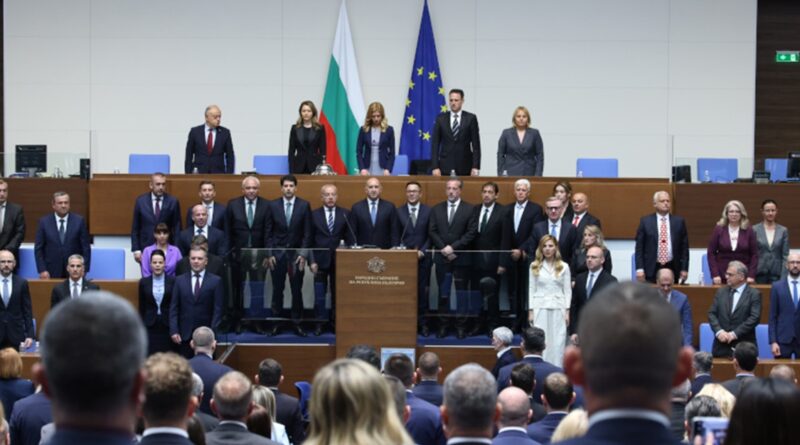
Bulgaria’s Parliament votes Radev government into office
Bulgaria’s Parliament voted on May 8 to elect a government headed by Prime Minister Roumen Radev into office.
There were, as prescribed by the constitution, three successive votes – first to elect Radev as Prime Minister, then to approve the structure of the Cabinet, and then its line-up.
The votes in favour came from Radev’s Progressive Bulgaria, which in Bulgaria’s April 19 early parliamentary elections won a decisive majority in Parliament.
The votes against came from Delyan Peevski’s Movement for Rights and Freedoms, Democratic Bulgaria, We Continue the Change, and Vuzrazhdane.
Boiko Borissov’s GERB-UDF abstained.
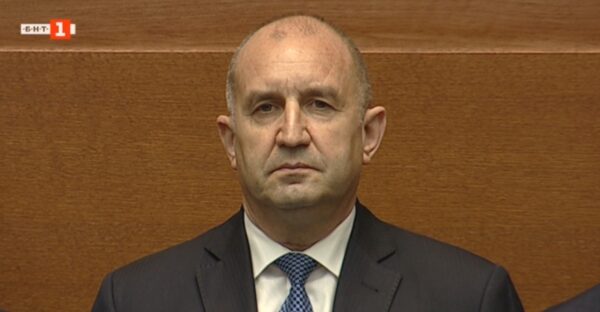
Radev, who was Bulgaria’s president for nine years before resigning to enter parliamentary politics, said at the opening of the sitting: “We have no illusions about the crises and trials facing the government, which will soon be seeking your support – galloping prices, budget, missing reforms, a severe global energy crisis and escalating conflicts”.
He said that on May 11, they will submit proposals on galloping prices and for changes to the Judiciary Act.
Speaking in the House ahead of the election of the government, GERB-UDF MP Toma Bikov said that out of respect for the vote by Bulgarian citizens, the group would not vote against the Radev Cabinet, but would abstain.
“We recognise that in these elections the Bulgarian citizens gave a very clear signal for an end to the political crisis, we hope that this will happen,” Bikov said.
Bozhidar Bozhanov of Democratic Bulgaria said that Bulgarian citizens had given a mandate to a political party to dismantle the model of the conquered state.
Unfortunately, based on the composition of the Cabinet, “we have every reason to be skeptical whether this mandate from Bulgarian citizens will be fulfilled,” Bozhanov said.
“We are obliged to wish the government success, because if it succeeds, it will be a success for Bulgaria,” he said.
Velislav Velichkov of We Continue the Change, addressing himself to Radev, said: “People placed very high hopes on you proposing a government that would reflect all the diversity, with authority, honesty and integrity of the candidates. I do not see such people on the list”.
“I see a strange mish-mash of unknown people, with unknown expertise and tied to previous administrations,” Velichkov said.
“Regarding the judicial reform – we expected to see an authoritative name, known and proven, with an opinion and position.
“Yesterday, colleagues asked me who the Minister of Justice Nikolay Naydenov is – he was the Secretary General of the Supreme Judicial Council during the time of (then-Prosecutor-General Sotir) Tsatsarov, – a person without an opinion and position, whom we expect to carry out judicial reform.”
“Naydenov has had no contact with the judicial system, how will he fight the oligarchy that stands behind and inside the judicial system?” Velichkov said.
Kostadin Kostadinov, leader of pro-Russian party Vuzrazhdane – the smallest group in the 52nd National Assembly, with just 12 MPs – also spoke in the debate.
(Main photo: parliament.bg)