
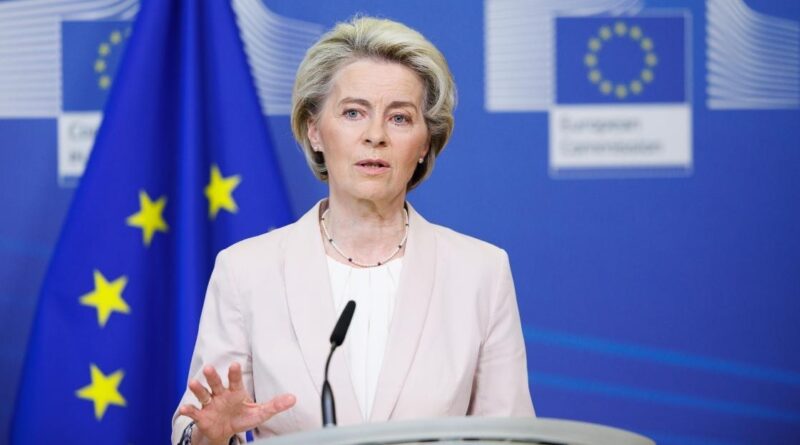
VDL sets out details of proposed 20th package of sanctions on Russia
European Commission (EC) President Ursula von der Leyen has announced details of a proposed new package of sanctions on Russia, the 20th since the start of that country’s war of aggression against Ukraine.
The new package of sanctions, Von der Leyen said on February 6, covers energy, financial services and trade.
On energy, the sanctions introduce a full maritime services ban for Russian crude oil.
Von der Leyen said that this would slash further Russia’s energy revenues and make it more difficult to find buyers for its oil. As shipping is a global business, the EC is proposing to enact this full ban in coordination with like-minded partners after a decision of the G7, she said.
“We are listing 43 more vessels part of the shadow fleet – reaching 640 in total,” Von der Leyen said.
“We also make it more difficult for Russia to acquire tankers to be used for the shadow fleet and add sweeping bans on provision of maintenance and other services for LNG tankers and icebreakers to further dent gas export projects,” she said.
“This complements our ban on LNG imports agreed with the 19th package and the RepowerEU Regulation.”
The EC is proposing a second block of measures to further constrain Russia’s banking system and its ability to create alternative payment channels to fund economic activity.
“This is Russia’s weak point, and we are pressing hard on it,” Von der Leyen said.
The EC is listing 20 more Russian regional banks, “and we will take measures against crypto currencies, companies trading them and platforms enabling crypto trade, to close an avenue for circumvention”.
Von der Leyen said that the EC is also targeting several banks in third countries involved in facilitating illegal trade in sanctioned goods.
“With the third block of measures, we tighten export restrictions to Russia with new bans on goods and services – from rubber to tractors and cybersecurity services, worth over 360 million euro,” Von der Leyen said.
The EC is also introducing new import bans on metals, chemicals and critical minerals, not yet under sanctions, worth over 570 million euro.
“And we introduce further export restrictions on items and technologies used for Russia’s battlefield effort, such as materials used to produce explosives,” Von der Leyen said.
The EC is proposing a quota on ammonia to cap existing imports.
“To show our determination to cut sanction evasion, we will activate for the first time the Anti-circumvention tool, by prohibiting the export of any computer numerical control machines and radios to jurisdictions where there is a high risk that these products are re-exported to Russia,” Von der Leyen said
“Finally, we propose stronger legal safeguards for EU companies to protect them from violations of their IP rights or from unfair expropriation in Russia due to abusive court rulings in connection with sanctions.”
Von der Leyen said that Russia’s fiscal revenues from oil and gas dropped by 24 per cent in 2025 compared to the previous year, the lowest level since 2020, widening its fiscal deficit.
Oil and gas revenues in January will be the lowest since the war began. Interest rates stand at 16 per cent, inflation remains high, she said.
“This confirms what we already knew; our sanctions work, and we will continue to use them until Russia engages in serious negotiations with Ukraine for a just and lasting peace.”
Von der Leyen called on the EU member states to swiftly endorse these new sanctions.
“Doing so would send a powerful signal ahead of the grim fourth anniversary of this war: our commitment to a free and sovereign Ukraine is unwavering. And if anything, it grows stronger day by day, month by month, year by year.”
(Photo: EC Audiovisual Service)


