
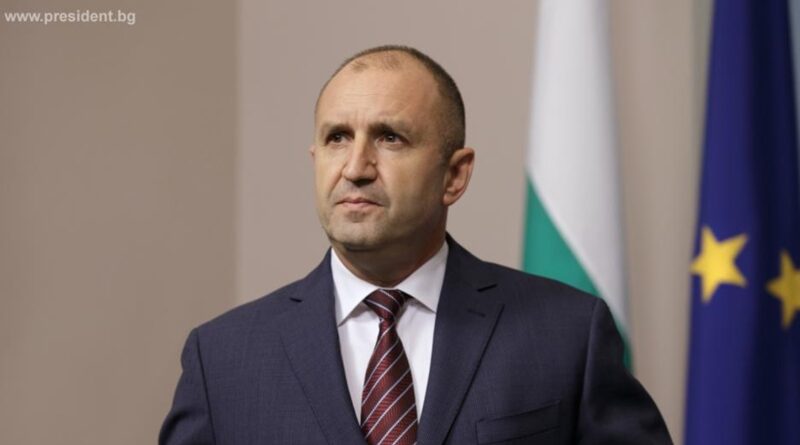
Bulgarian President to hand over first mandate to seek to form government after New Year
Bulgarian head of state President Roumen Radev is to wait until after January 1 to hand over the first mandate to seek to form a government, according to a December 19 statement by the President’s office.
Radev made the statement after concluding consultations with representatives of all nine parliamentary groups, held between December 15 and 19.
The consultations followed the December 11 resignation of the Rossen Zhelyazkov Cabinet – which quit against a background of mass street protests – and are a step mandated by the constitution following the resignation of a government and which precedes the next step, the offering of mandates to seek to form a new one.
In the series of consultations, it became clear that no parliamentary group believes it possible for the current Parliament to elect a new government, and Bulgaria is headed to its next early parliamentary elections, in the first months of 2026.
According to the constitution, the first mandate must go to the largest parliamentary group, Boiko Borissov’s GERB-UDF, and in the event of that proving fruitless, it must go to the second-largest, We Continue the Change – Democratic Bulgaria.
Should, as is widely expected, that produce nothing, the head of state has a free hand to choose to which parliamentary group to offer the third and final mandate. Failure at that stage means that the President must appoint a caretaker government and decree a date for parliamentary elections.
Some participants in the talks with Radev have claimed, citing their talks, that he is looking at an election date at the end of March or early April, soon before Bulgaria’s Orthodox Easter holidays.
Radev said on December 19: “The general opinion is that trust in the 51st National Assembly has been exhausted, the dialogue has been destroyed, and early parliamentary elections are already on the horizon”.
He said that urgent actions are needed to increase trust in the electoral process, and backed conducting the election will 100 per cent machine voting with electronic reporting of the result and control counting of ballots.
WCC-DB, the largest opposition group in the current Parliament, has said that it is tabling amendments to the Electoral Code so that voting is done solely using machines, eliminating paper ballots. It sees the latter as enabling abuse of the electoral process.
The night of December 18 again saw mass street protests, in Sofia and several other cities, organised by WCC-DB.
WCC-DB’s Ivailo Mirchev said that protests had many demands.
“The general demand is for Peevski to be swept out of Bulgarian political life,” he said, referring to the Delyan Peevski, the Magnitsky Act-sanctioned leader of the Movement for Rights and Freedoms – New Beginning, who is seen a holding sway over the ruling coalition, while not formally part of it.
“Machine voting so that there can be fair elections…and we count on all parties that say they are for fair elections to now confirm this,” Mirchev said.
(Photo: president.bg)