
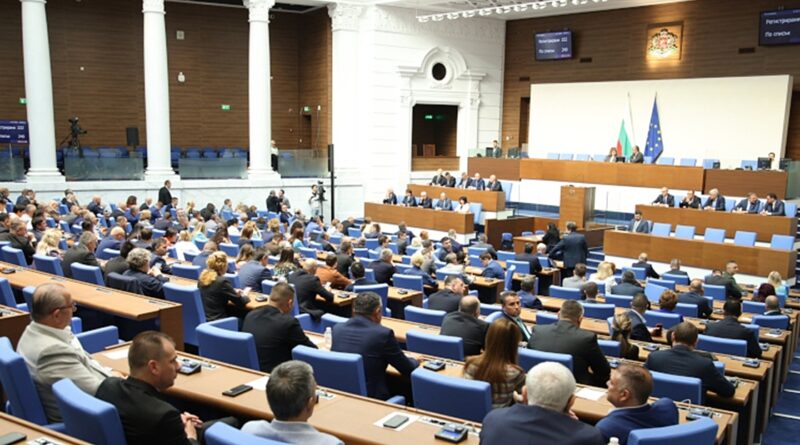
Bulgaria’s Parliament rejects President Radev’s euro referendum proposal
Bulgaria’s National Assembly voted by a large majority on December 3 to reject a proposal tabled in May by President Roumen Radev to hold a national referendum on whether the country should adopt the euro as its currency as of January 1 2026.
This is the fourth time that Bulgaria’s Parliament has rejected holding a referendum on accession to the euro zone. Parliament voted down a similar proposal in July 2023, again in September 2024 and on September 3 2025.
In the case of the December 3 vote, it was held less than a month before Bulgaria adopts the euro, as the relevant European institutions agreed to in July.
In the 240-seat National Assembly, 219 MPs voted – 135 against, 81 for, with three abstentions.
The votes against came from Boiko Borissov’s GERB-UDF coalition, 33 opposition We Continue the Change – Democratic Bulgaria coalition MPs, Delyan Peevski’s Movement for Rights and Freedoms – New Beginning, 16 Bulgarian Socialist Party – United Left MPs, one MP from the Ahmed Dogan loyalists of the Alliance for Rights and Freedoms (ARF).
Votes in favour came from opposition pro-Russian party Vuzrazhdane, one BSP – United Left MP, populist party ITN, 13 ARF MPs, and populist-nationalist minority parties Mech and Velichie.
Of the three abstentions, one each came from GERB-UDF, WCC-DB and the BSP – United Left.
The December 3 debate started after a lengthy delay, as Parliament sought a representative of the Presidency to come to the House to present the reasons for the proposal. Speaker Raya Nazaryan told Parliament that no one from the Presidency had been reachable.
The debate was less about the element of the question as to whether Bulgaria should use the euro from January 1 next year but more about the merits or otherwise of the common currency, with opponents of the referendum emphasising – correctly – that the constitution forbids holding a referendum on an international treaty that already has been ratified.
The reason that the matter was on the Order Paper was that Bulgarian parliamentary practice allows minority parties to shape the agenda of the first sitting of the month, and Vuzrazhdane used this to put the referendum item there.
Earlier in the saga of Radev’s referendum bid, then-Speaker of the National Assembly Natalia Kiselova refused to put the matter to Parliament on the grounds of the unconstitutionality of the proposed question. However, the Constitutional Court ruled that Kiselova had erred in doing so, saying that she had taken on herself a prerogative belonging properly to the whole House.
Radev’s move in May to once again request a referendum on this topic was surprising because it was a complete change in his own position. In 2022, Radev told Vuzrazhdane that a referendum on Bulgaria’s entry into the euro zone was impossible because, by law, referendums cannot be held on issues regulated in already adopted and ratified international treaties.
For reliable official information on Bulgaria’s transition to the euro, the Association of Banks in Bulgaria has a Q and A, in English.
The official evroto.bg website has an English-language version, while the European Commission made available on July 8 a Q and A on Bulgaria’s changeover to the euro.
For exclusive subscriber-only access to The Sofia Globe’s analysis and commentary on events in Bulgaria, please sign up to our page on Patreon:


