
European Parliament adopts 2026 EU budget
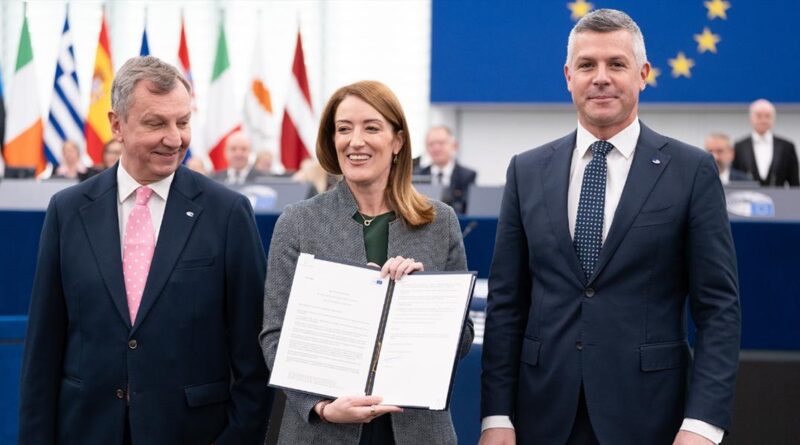
The European Parliament voted on November 26 to adopt the 2026 European Union budget, which was then signed into law by EP President Roberta Metsola.
The 2026 budget was adopted by 419 votes to 185, with 53 abstentions.
The Council of the EU endorsed the deal on November 24.
The total budget for 2026 is 192.8 billion euro in commitments, and 190.1 billion euro for payments, leaving a margin of 715.7 million euro below the 2026 multi-annual financial framework ceilings in commitments for unforeseen events.
In a deal with EU member states, reached on November 15, the European Parliament obtained an additional 372.7 million euro for its priorities on top of what the European Commission had initially proposed in its draft budget.
The European Parliament focused on increasing funding for programmes and policies aimed at improving people’s lives, boosting competitiveness, and addressing defence challenges.
To boost competitiveness and improve cross-border infrastructure, MEPs increased funding for Horizon Europe by 20 million euro and for transport and energy networks by 23.5 million euro.
The European Parliament secured an additional 10 million euro for the Civil Protection Mechanism and RescEU to improve coordination and disaster response.
Playing an essential role in the EU’s defence preparedness, military mobility will get an additional 10 million euro. MEPs also ensured that border management will be reinforced with an added 10 million euro.
The EU’s environment and climate action instrument, the LIFE programme, will receive an additional 10 million euro in funding, while the EU4Health and Erasmus+ programmes will benefit from a further three million euro each.
The European Parliament pushed for an additional 35 million euro for the EU’s Southern Neighbourhood, and a 25 million euro increase for the Eastern Neighbourhood. It also secured a 35 million euro increase in humanitarian aid, in response to growing geopolitical instability, accelerating global humanitarian crises, and climate change-induced emergencies.
To create new opportunities, particularly for young farmers, funding for measures promoting European agricultural products under the European Agricultural Guarantee Fund has been increased by 105 million euro in line with Parliament’s position.
The EU is facing an unexpected 4.2 billion euro increase in borrowing costs for NextGenerationEU in 2026, which is twice the amount initially projected by the European Commission.
MEPs ensured that this extra cost will not lead to reductions in key programmes such as Erasmus+ or EU4Health. As previously agreed, the additional costs are being handled through the “cascade mechanism”, which is intended to manage rising NextGenerationEU repayment expenses while safeguarding flagship programmes.
(Photo: EP President Roberta Metsola signed the 2026 EU budget into law, following its adoption in the Strasbourg hemicycle © European Union, 2025)