

Eurostat: EU countries granted citizenship to almost 1.2 million people in 2024
In 2024, nearly 1.2 million people acquired the citizenship of the EU country where they lived, an increase of 11.6 per cent (+122 700 people) compared with 2023. The number of citizenships granted jumped by 54.5 per cent compared with 2014, when a total of 762 100 were attributed.
The majority of these new citizenships were granted by Germany (288 700; 24.5 per cent of the EU total), Spain (252 500; 21.4 per cent) and Italy (217 400; 18.5 per cent).
Most recipients (88.0 per cent) were from non-EU countries, while citizens from other EU countries accounted for 10.6 per cent.
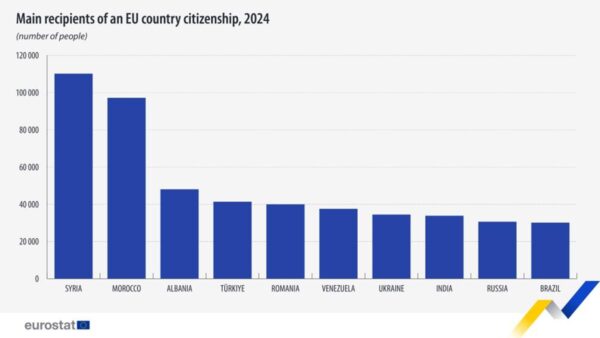
In 2024, as in the year before, Syrian nationals were the largest group of new EU citizens, with 110 100 new citizenships granted. Moroccan nationals were the second largest group, with 97 100 granted citizenships, followed by Albanians (48 000).
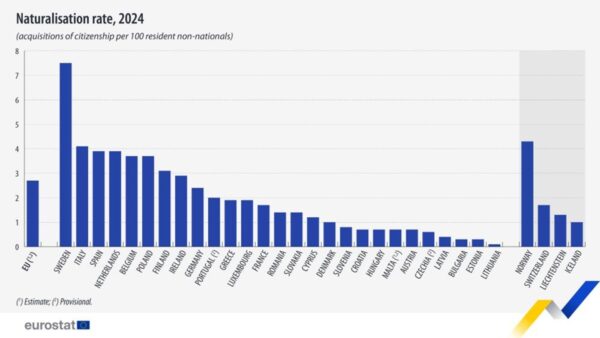
The naturalisation rate indicates the number of persons acquiring citizenship in a country during a year, relative to the total number of non-national residents at the beginning of the year.
In 2024, Sweden recorded the highest naturalisation rate among EU countries, with 7.5 citizenships granted per 100 non-national residents, followed by Italy (4.1) and Spain and the Netherlands (each 3.9). At the other end of the scale, the lowest naturalisation rates per 100 non-national residents were recorded in Lithuania (0.1), Bulgaria and Estonia (each 0.3).
As The Sofia Globe reported previously, in 2023, 1 050 100 people obtained citizenship of the EU country of their usual residence, an increase of 6.1 per cent compared with 2022.
In 2022, a total of 989 000 people acquired the citizenship of the EU country where they lived, an increase of about 20 per cent (163 100 people) compared with 2021.
(Photo: Bulgaria’s Interior Ministry)


