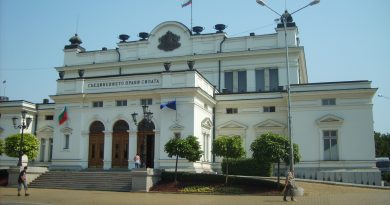

Bulgaria’s National Assembly instructs government to ‘take measures against price shock from oil and gas prices’
Bulgaria’s National Assembly voted on March 13 a resolution instructing the caretaker the caretaker government to take “measures against the price shock from high oil and natural gas prices”.
The resolution, tabled even though the Gyurov interim government already set up an interdepartmental commission on the issue on March 10 and on March 12 announced proposals, was tabled by MPs from the Movement for Rights and Freedoms – New Beginning, which is led by Magnitsky Act-sanctioned Delyan Peevski.
The parliamentary vote comes as Bulgaria heads to early parliamentary elections in April, with the legislature expected to be adjourned at the end of next week when the official campaign period begins, although parties long since have been chasing votes, some through populism.
In the 240-seat House, 136 MPs voted – 97 in favour, 20 against, with 19 abstentions. Vuzrazhdane voted against and We Continue the Change abstained.
WCC – DB pointed out that there is already a government interdepartmental commission that is developing similar measures, and it was appropriate to hold joint consultations.
The resolution requires the caretaker government to come up with an assistance programme within a week and notify the European Commission about it.
It envisages the creation of a fund at the Ministry of Finance with contributions from increased VAT revenues from the increased cost of fuels.
The funds from the fund will be used to compensate vulnerable groups of the population, agricultural producers, transport companies, schools, kindergartens, hospitals, among others.
According to MRF – New Beginning the war in Iran is not expected to end soon and will deepen the crisis for the world economy, so the state must respond with rapid anti-crisis measures aimed at the transport sector and urban transport based on the amount of fuel consumed for the respective month, as well as state guarantees for the deferral of leasing payments until the end of the year.
Hospitals, schools and kindergartens must be supported for their increased energy costs, as well as farmers.
How this will be done is left up to the caretaker cabinet, as well as what compensation to give to people with incomes below the poverty line.
The resolution’s new “Energy Support for Enterprises and Households” fund, which is to be created at the Ministry of Finance, is planned to be filled from several sources, including through additional revenue in the state budget from value added tax from raised prices of motor fuels and liquefied natural gas (LNG).
In addition, however, the decision states that contributions may also come from the state-owned Bulgarian Development Bank and other sources, without specifying which ones.
The fund will be financed through additional revenues in the state budget from value added tax, generated as a result of the increase in the prices of Brent crude oil and liquefied natural gas. The government can also finance the fund through the Bulgarian Development Bank.
Caretaker Prime Minister Andrei Gyurov, speaking on March 13 before the vote in Parliament, said that the government is analyzing all data on availability and purchased quantities, fuel storage options and the processing process.
“We have reviewed all the information and the specific measures we proposed were exclusively targeted precisely at the people who are most vulnerable to the increase in fuel prices, ” Gyurov said.
He said that this concerns about about one million Bulgarian citizens, for whom the Ministry of Finance is doing calculations based on data from the National Revenue Agency.
When the measure is implemented, it will be on a monthly basis and people will not have to submit special applications.
“The Bulgarian government is preparing for the worst-case scenarios for the conflict in the Middle East. Naturally, we hope that the developments will not be so bad – both for Bulgarian citizens and for security in the region as a whole,” Gyurov said.
According to the fuelo.net website, the average price of a litre of A95 petrol has risen from 1.25 euro on February 27 – the day before the US-Israeli attack on Iran began – to 1.36 euro on March 13.
The average price of a litre of diesel has risen from 1.29 euro on February 27 to 1.48 euro on March 13.
(Photo: Kiril Havezov/ sxc.hu)