
Bulgaria’s 2026 presidential elections: Yotova on the defensive over close first-round contest with Gyurov
Opinion polls after voting ended in the first round of Bulgaria’s 2026 regular presidential elections have left incumbent President Iliana Yotova on the defensive, after the gap between her and reformist-backed, pro-Western candidate Andrei Gyurov was shown to have narrowed considerably compared with earlier opinion polls.
Most election night polls showed Yotova – backed by Prime Minister and former president Roumen Radev – as marginally ahead of Gyurov, but one, by Market Links based on a parallel count – showed Gyurov slightly ahead.
Because Bulgarian electoral law requires that a first-round victory must see a candidate get more than 50 per cent of the vote with voter turnout of at least 50 per cent, and neither of these conditions have been met, Yotova and Gyurov will meet in a second-round contest on November 1.
Going by the exit polls and parallel counts by opinion polling agencies, Yotova’s October 25 electoral performance does not come close to the decisive victory won by Radev, her predecessor as president before in January 2026 he entered parliamentary politics, in Bulgaria’s April early parliamentary elections.
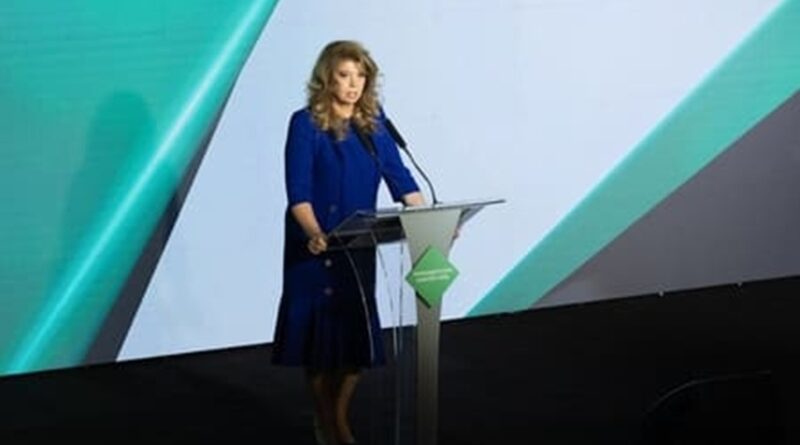
“I want to share some concern and tell Bulgarian citizens that it is an illusion to think that if they do not vote, we can change something in the country,” Yotova said in a brief statement on the October 25 election night.
“And we have to change a lot in the coming years. So that we do not return our country to the years of inertia, in which we missed so many benefits – with division, with confrontations. In the coming years, Bulgaria will have its prosperity and we hold a golden card and here in Southeast Europe we will make sure that Bulgaria is a guarantor of security for the entire continent,” Yotova said.
“War is raging in Europe. I have been talking all along about the fact that I am a Bulgarian president who will be a president of peace, because without peace there is no security and no prosperity,” said Yotova, who along with Radev has been reluctant to blame Russia for the attacks on merchant vessels in the Black Sea off the coasts of Bulgaria and Romania.
“And we are obliged to leave Bulgarian citizens an opportunity for a future and for development. Our message of peace must be heard and we will do this for the next week. We will speak even more categorically with our voters, with all Bulgarian citizens, because I believe that Bulgaria has its strong position. Bulgaria has its sovereign policy, of course, with our partners… I do not want foreign flags to fly in the squares, I want Bulgarian flags,” Yotova said.
Yotova deflected questions about whether she would talk to Boiko Borissov’s GERB and minority opposition pro-Russian party Vuzrazhdane to attract greater support before the runoff on November 1, saying “I don’t want Bulgaria to be ruled by assemblages”. The assemblage was an informal coalition of diverse political formations, billed as at daggers-drawn with each other, in a previous government.
“I think that the non-participation of the second political force (GERB) also affected the voter turnout,” Yotova said, referring to the fact that Borissov had neither nominated nor endorsed a candidate in the 2026 presidential elections.
“That’s why I say again: we will turn to everyone again, we will continue to lead this election campaign, because I think that it is truly an illusion if there is no vote that we can really make a change in the country,” she said.
Meanwhile, as The Sofia Globe reported earlier, Gyurov repeated his challenge to Yotova to meet in debate on public broadcaster Bulgarian National Television ahead of the November 1 runoff vote.
A key point in Bulgaria’s autumn 2026 elections has been the continued attacks, widely blamed on Russia, on merchant shipping in the Black Sea off the coasts of Bulgaria and Romania. The Radev – Yotova axis has chosen not to blame Russia, claiming a lack of proof.
The camp behind Gyurov has been clear on blaming Russia, and has criticised Yotova for her tardiness and vagueness in response, with Yotova preferring to speak about a “coalition of peace” to end the war between Putin’s Russia and Ukraine, with the latter wanting to retain its sovereign territory in line with international law.
Bulgaria’s 2026 presidential elections: The Sofia Globe’s factfile


