EU leaders reaffirm ‘firm and unwavering’ support for Ukraine
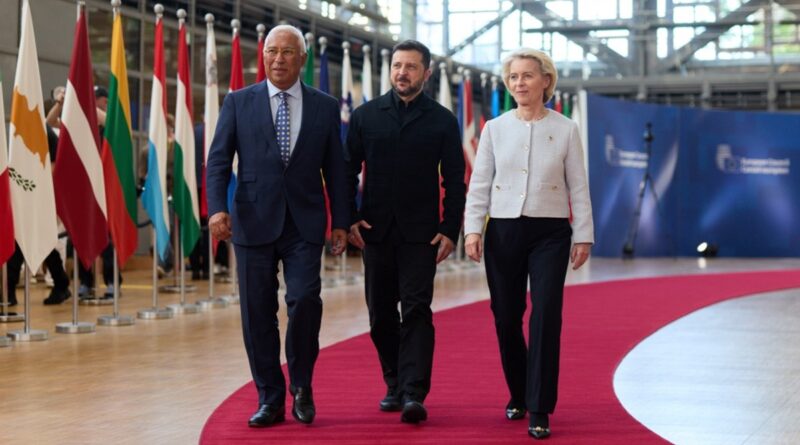
EU leaders exchanged views with President Volodymyr Zelenskyy on the latest developments on the ground and reaffirmed the EU’s firm and unwavering support for Ukraine and its people, according to a statement after the June 18 first day of the two-day European Council meeting in Brussels.
They also welcomed the second accession conference with Ukraine, held on June 15 2026, and the opening of the fundamentals cluster, the statement said.
They expressed their support for opening other clusters, in line with the merit-based approach.
The statement said that EU leaders reaffirmed the EU’s long-term commitment to supporting Ukraine’s defence and security, including through the EU missions and support for ceasefire monitoring through the EU Satellite Centre.
They underlined the importance of sustaining military support for Ukraine, including through the Ukraine support loan. They also called for faster delivery of air defence systems, ammunition, drones and missiles, as well as closer cooperation between the EU and Ukrainian defence industries.
They also expressed their support for the first disbursement of the loan under the Ukraine Facility loan for 2026–2027 before the end of June 2026 and encouraged further international support to help meet Ukraine’s remaining financing needs.
EU leaders reaffirmed their commitment to a comprehensive, just and lasting peace in Ukraine, supported by robust security guarantees that ensure the country’s long-term security and stability.
They underlined the EU’s readiness to contribute to such guarantees, including through the Coalition of the Willing and in cooperation with the United States.
EU leaders called on Russia to agree to a ceasefire and engage in meaningful peace negotiations. They also stressed that, as long as there is no just and lasting peace in Ukraine, there should be no normalisation of Russia’s participation in international sports and cultural events.
EU leaders condemned Russia’s intensified missile and drone attacks against Ukrainian cities and energy infrastructure and called for an immediate halt to all military activities near Ukraine’s nuclear facilities.
They reiterated the need to support Ukraine in repairing and strengthening its critical infrastructure and energy systems ahead of the next winter, including the rapid rehabilitation of the Chornobyl containment arch, and encouraged enhanced cross-border electricity interconnections.
They also strongly condemned Russia’s increasingly aggressive and irresponsible actions, including the strikes against the UNESCO World Heritage site of Kyiv-Pechersk Lavra, foreign information manipulation and interference activities, threats against the EU’s diplomatic presence in Ukraine and incidents affecting the security of EU member states.
They noted that other recent incidents, including a drone strike on a residential building in Romania, threaten the security of EU citizens and regional stability. EU leaders stressed that Russia bears full responsibility for these actions and the continued escalation.
They also highlighted the potential risks that former Russian combatants may pose to the EU’s internal security and called for further technical work to address this issue.
EU leaders reaffirmed their commitment to increasing pressure on Russia. In this context, they welcomed recently adopted measures targeting the shadow fleet, following the adoption of the 20th sanctions package.
They also called for the swift adoption of the 21st sanctions package, and stressed the importance of
further efforts to reduce Russia’s energy revenues, stronger action against Russia’s shadow fleet,
additional measures targeting Russia’s banking sector, a common approach to addressing the environmental, security and maritime safety risks posed by the shadow fleet, and they welcomed close coordination with G7 partners on sanctions.
They also strongly condemned the deployment of North Korea’s military forces against Ukraine and the military support provided to Russia by Iran, Belarus, North Korea and other countries.
Following repeated violations of member states’ airspace, the importance of ensuring the defence of all EU land, air and maritime borders, including on the Eastern flank, was stressed.
In this context, EU leaders strongly condemned the incident in which a Russian drone carrying explosives crashed into a residential building in Romania, as well as other hybrid attacks against the EU and its member states by hostile actors, including Russia and Belarus.
They called for increased and urgent efforts to strengthen protection against such threats, safeguard critical infrastructure, and improve the EU’s ability to prevent, deter and respond to hybrid attacks. They welcomed ongoing work on the Eastern flank watch project and the EU action plan on drone and counter-drone security.
Europe’s defence readiness must be ramped up by 2030. EU leaders welcomed increased national defence spending and progress across priority capability areas, particularly drone and counter-drone systems, early warning, air defence and long-range precision strike capabilities.
(Photo: European Council)