
Bulgaria’s supermarkets body: First days of the euro passing with no significant shocks
The first days of the introduction of the euro in Bulgaria are passing without any significant shocks in the supermarket sector, Nikolay Valkanov, executive director of the Association for Modern Trade – which represents most of the country’s major retailers – told Nova Televizia on January 3.
In spite of the sanctions imposed by the National Revenue Agency on 69 traders totaling 45 000 leva, Valkanov said that the large chains have gone through the process with excellent preliminary preparation.
One of the main measures to avoid currency conversion errors in large stores is the implementation of special software.
“The cash registers display the change that the customer should receive in both leva and euro. This helps the consumer to be calm, and the cashier to avoid unnecessary arithmetic calculations,” Valkanov said.
He acknowledged that smaller neighbourhood shops are still experiencing a shortage of euro coins, but expects the situation to normalise after banks open on January 5 and 6.
Valkanov issued a reminder that by law, cashiers have the right to refuse payments that include more than 50 coins at a time.
Regarding concerns about price increases, Valkanov said that this was not seen in large chains.
He said that the price changes in early 2026 are due to objective economic reasons: “Retailers profit from turnover, not from price differences.
“Image is much more important and no one would risk customer trust for a quick profit,” he said, adding that some goods, such as butter and pork, were even selling at lower prices.
Iliya Lingorski, a member of the management board of central Bulgarian National Bank (BNB), told Bulgarian National Television on January 3 that the transitional period, in which the lev and the euro will be in circulation simultaneously, will last one month and this is completely sufficient.
“I think this period, which is one month, is completely sufficient. It is neither too little nor too much,” he said.
Lingorski said that the pace of withdrawal of the lev from circulation already shows that people are quickly getting used to the change.
BNB is seeing how the public are deliberately paying in shops with leva in order to use them before the January 31 end of the transition period, he said.
“Currently, people are paying en masse with leva to spend what they have – that is the point of dual circulation,” Lingorski said.
He said that there is no need for queues at banks and exchange offices, because the exchange of leva into euro is practically unlimited.
“The exchange of leva into euro is unlimited – people will be able to exchange peacefully even after this period,” he said, referring to the provision in law that BNB will change leva into euro for an unlimited period.
The collected leva are being collected from shops and banks and are being prepared for destruction.
The coins will be melted down, and the banknotes destroyed using special technology, Lingorski said.
“With banknotes, the process is different – we won’t burn them like regular paper,” he said.
Lingorski said that the machines and money printing capacity will not be stopped.
“Bulgaria has long been printing euro for other central banks,” he said, adding that the country participates in the ECB’s common system for producing euro banknotes.
Borica, a technology company providing the national payment infrastructure, said on its website on January 3 that Bulgarians welcomed the first 48 hours of the country’s membership of the euro zone with a high level of activity in card payments and ATM operations.
In the period January 1-2 2026, a total of more than 933 000 POS and ATM transactions were done through the national card and payment infrastructure, worth a total of nearly 42 million euro, Borica said.
Non-cash payments dominate in number (over 86 per cent), and ATM operations (withdrawals and deposits) dominate in value (over 52 per cent).
In the first 48 hours, the system processed more than 804 000 POS transactions worth more than 20 million euro, with an average amount of nearly 25 euro per payment.
ATM withdrawals added up to more than 125 000 transactions worth more than 18 million euro, with an average amount of 144 euro per withdrawal.
ATM deposits added up to close to 3500 transactions worth nearly 3.8 million euro, with an average amount of nearly 1100 euro per deposit.
Borica said that there were close to 19 446 transactions per hour (about 324 transactions per minute), or 5.4 transactions per second, that is, over five card transactions were made every second.
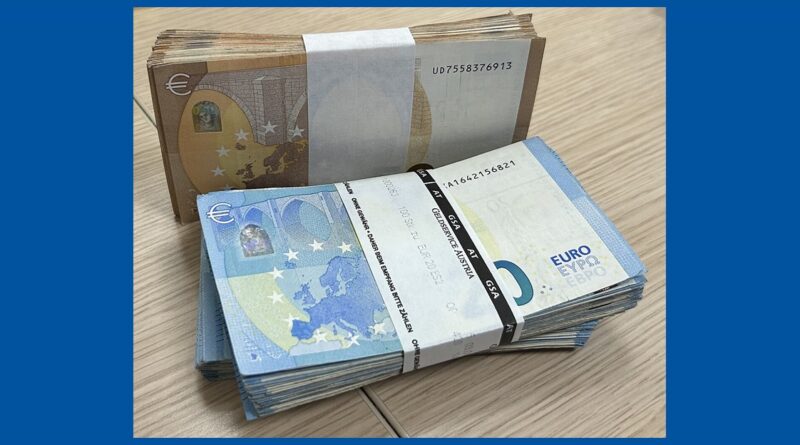
(Photo: BrayLockBoy, via Wikimedia Commons)