European Council President holds talks in Sofia with Bulgarian PM as part of ‘Tour des capitales’
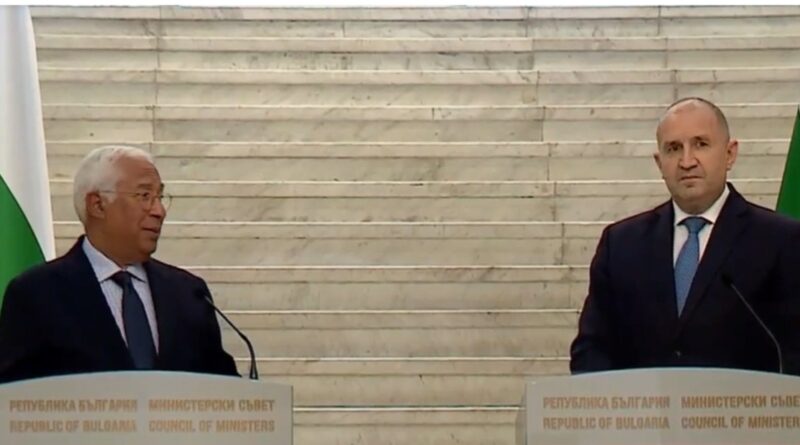
European Council President António Costa visited Sofia on September 3 as part of Costa’s “Tour des capitales”, holding talks with Bulgarian Prime Minister Roumen Radev.
The concept of the “Tour des capitales” is for the European Council President to hear directly from EU leaders about their priorities and concerns and to strengthen cooperation across the EU.
Costa said that 2026 is a decisive year for the European Union: “by the end of it, we must have approved our Union’s long-term budget for the period 2028-2034”.
He said that this is fundamental to make sure the investments keep flowing in 2028 to those who build Europe’s prosperity: “our farmers, our companies, our researchers, our innovators”.
“We need a European budget that matches our ambitions and provides the means to deliver on our common priorities — namely key areas such as defence and security, competitiveness, innovation, and strategic resilience,” Costa said.
“At the same time, it must continue to support our agricultural and cohesion policies, as they remain key pillars for the prosperity, resilience, and the balanced development of every European region, including Bulgaria’s.”
To build a more resilient, competitive and secure Europe, affordable energy prices are needed, Costa said.
“This is key, both for our citizens and for our industry. Therefore, we need to accelerate our work to reduce energy costs, in particular by strengthening market integration and interconnections between European Union countries. This will help us solidify our energy security. Bulgaria can play a decisive and strategic role in this regard,” he said.
Costa said that Europe’s security is also about enlargement.
“Ukraine, Moldova and the Western Balkans belong inside our Union: each moving forward on its own merits, and each of them treated equally. It is the most important geopolitical investment the European Union can and should make.”
Candidate countries must carry out the necessary reforms and respect previous commitments; at the same time, it is important that we also play our part, Costa said: “By engaging in a constructive dialogue with them and by recognising progress when it is made”.
“We also need to continue working together on Ukraine,” he said.
“Our determination in supporting Ukraine as it defends itself and works towards a just and lasting peace has never wavered. And as you know,
Russia’s hostile behaviour goes beyond Ukraine,” Costa said.
“We see it on the European Union territory: drones at our borders,
cyber-attacks, disruption of critical infrastructure, attempts to undermine our democracies. It is time for Russia to stop this war and not to escalate it.”
Russia’s threats and intimidation will not diminish our resolve to support Ukraine for as long as it takes, until a just and long-lasting peace is reached, Costa said.
“Russia must understand that Europe will not relent. On the contrary, we will intensify the pressure on Russia until it ends the killing and shows a genuine commitment to peace. It’s time to stop the war. It’s time to cease fire and open real peace negotiations,” he said.
Radev said: “As you know, Europe is nowadays facing many various crises and this affects all of us, the member states. And it makes us be persistent to have a very strong will and to seek working and rational solutions to overcome these crises”.
“Speaking of the multi-annual financial framework, we must admit that this is a great challenge for the Union because we have the high ambitions of achieving several goals, many goals, but the resources are limited, however,” Radev said.
“And we fully understand and support the vision of the Union to have a very strong focus on competitiveness and security in the EU and especially in a difficult-to-predict world,” he said.
This, however, should not happen at the expense of financing important policies such as the enlargement policy, the cohesion policy and the agricultural policy that all guarantee the unity in the Union and that are of crucial significance as tools to have a single, prosperous Union to overcome all challenges together, united, Radev said.
He said that he had proposed to Costa to think about a new term “industrial cohesion”.
“To not only speak about cohesion as has been the traditional, so far classic, cohesion on social programmes and infrastructure, but to speak about cohesion that gives an opportunity to all member states to take part equally, in principle, on an equal footing in the technological and industrial development of Europe,” Radev said.
“Because if we do not succeed in this, if we do not achieve this, the fragmentation process, especially in high-tech fields, in high-added-value industries, will continue deepening.”
“Speaking about defence, I must emphasise that all the challenges that we are facing today in the field of security demand from us to unite our efforts in scientific, industrial and technological fields,” Radev said.
Bulgaria is very actively contributing to the main vision of the European Union for deepening and strengthening its common security, which is based on new programmes, new initiatives, he said.
“The initiative for our common anti-drone defence, the European Air Shield, the European Space Shield, and Bulgaria is actively working for strengthening its industrial base, for developing its defence science in order to have a really active contribution for a more secure and stronger Europe,” Radev said.
Bulgaria is playing a crucial role in the change of European connectivity within Europe and with neighbouring regions, he said.
“Because the Trans-Caspian Corridor goes through Bulgaria. The future corridors in the Gulf countries, too, in order to mitigate and minimise the risk of sea and water transport through the Strait of Hormuz, also go through Bulgaria.”
Radev said that Costa knows perfectly that “Bulgaria is a main engine, a strong driver for the integration of countries neighbouring the EU, especially in the Western Balkans, and coming as an element of the enlargement of the space of peace and prosperity.
“But he also knows that we firmly stand for this enlargement to not be related only on political processes, but on the principle of own work that has been achieved,” Radev said.