EU foreign policy chief: No agreement yet on 21st package of sanctions on Russia but ‘quite close’
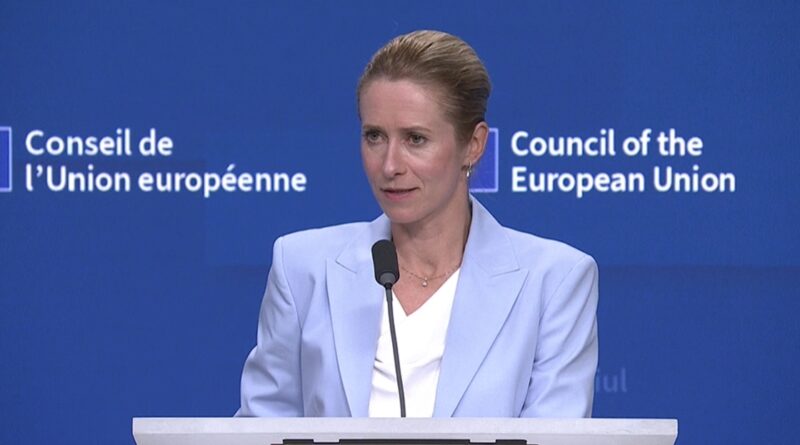
European Union foreign policy chief Kaja Kallas said on July 13 that EU countries did not yet have agreement on the 21st package of sanctions on Russia “although I must say that we are quite close”.
Kallas was speaking after a scheduled meeting of EU foreign ministers.
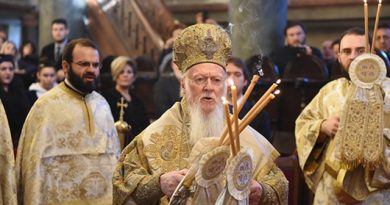
Bulgarian Foreign Minister Velislava Petrova, whose country objected to the inclusion of Russian Orthodox Church head Patriarch Kirill and Lukoil owner Vagit Alekperov in the proposed sanctions, told reporters on July 13 that “within the framework of the negotiation process on the 21st sanctions package, the three individuals on whom Bulgaria had reservations and was ready to block were removed from the package”
The arguments presented by the Bulgarian government were accepted by the European Commission and the Irish Presidency of the Council of the EU, Petrova said.
Petrova said that this result shows that the consistent protection of the national interest does not lead to isolation, but confirms Bulgaria’s “equal place among its partners in the European Union, when it is based on consistency, predictability and clear argumentation”.
Kallas told the news conference that “focussing on the positive, we had 250 listings, which are also very important under different regimes”.
She was referring to the EU adding 250 individuals and entities to the Russian sanctions regime in response to Russia’s attacks on civilians in Ukraine.
This is the EU’s biggest round of individual designations since Moscow’s 2022 full-scale invasion, and includes also the EU’s largest-ever cyber sanctions package.
“This war has been going on for four years and more. And of course, it has effect on all. But the best effect on our economy, all the member states in all the member states would be if this war would end,” Kallas said.
“And that’s why we would have to we have to make the necessary efforts in the short term that we wouldn’t have this war. So so today, also, we had this intense discussions. And the call was to really focus on on this ending this war that we are trying to do with putting more pressure on on Russia,” she said.
“But yes, there are different things put forward by different member states that have to be removed from the package.”
Kallas said work was still being done on barring Russian ex-combatants from entering the EU.
“Because clearly, this is a risk to our own security,” she said.
“And we should not let these people come to Europe. In Ukraine, we have programmes where we help with the veterans. I mean, psychological support, also the support that they are reintegrated into the society,” Kallas said.
“Russia does not have anything like this. These are dangerous people. We have to see and work how we really live in post-war area.”
“But again, I want to stress that for our economy, whether it’s a member state from the east, west or south or north, it is best when this war ends to all of us,” Kallas said.
“So we need to increase the pressure still to stop it and help Ukraine at the same time. So that really Russia would see that they come to the negotiation table.”
Kallas declined to comment on which issues had been agreed and which had not: “I can’t also say what is taken out and what is left behind, because until everything is agreed, nothing is agreed. So I can’t really put anything forward. What is my wish is that this package is strong, because really the continued attacks on civilians, really targeting the most populated areas”
Kallas said that the EU foreign ministers had been “very angry” at the decision by the International Olympic Committee to invite Russian athletes back to international competition.
She said that the IOC decision was “blind to reality”.
“Ministers strongly condemn such a decision, as it coincides with Russia killing a record number of Ukrainian civilians. So it looks like the International Olympic Committee is rewarding such attacks. The Commission is ending the funding to Venice Biennale,” she said.
A July 13 statement by the Council of the EU said that on July 13, EU foreign ministers decided to impose restrictive measures on four individuals and five entities responsible for serious human rights violations in Russia, notably the repression of civil society and democratic opposition, and for undermining democracy and the rule of law.
The July 13 listings focus in particular on Russia’s continued use of new technologies to restrict freedom of expression, access to information and freedom of association.
The listings agreed on July 13 include VK Company – also known as VKontakte – and its daughter company Communication Platform, responsible for developing and managing the phone application Max App, under supervision by the FSB.
The app comes pre-installed on all mobile devices sold in Russia and includes extensive surveillance features, later used for repressive actions against users criticising Russia’s war of aggression against Ukraine or posting other content banned by authorities.
The EU is also imposing restrictive measures on Citadel, VAS Experts and Norsi-Trans, companies which manufacture, develop, and sell hardware and software related to so called System of Operative Investigative Measures (SORM) – a surveillance system used to control Internet and mobile communications in Russia, namely to monitor phone calls, emails, text messages, and social networks, and to target journalists, opposition figures, minority groups and ordinary citizens.
The four sanctioned individuals hold leadership positions in these companies and are therefore responsible for supporting serious abuses of human rights and for repression of civil society and democratic opposition in Russia, the statement said.
There are now total 98 individuals and seven entities listed under this regime. All listed persons are subject to an asset freeze and EU citizens and companies are forbidden from making funds available to them. Individuals are also subject to a travel ban, which prevents them from entering or transiting through EU territories.
A statement by the Council of the EU said that “today we expose the 16th Centre of Russia’s Federal Security Service (FSB) as controlling a variety of cyber threat groups including TURLA”.
For years, the FSB has conducted a wide range of malicious cyber activities with growing severity affecting the EU, its member states, as well as international partners, notably Ukraine, the statement said.
These activities have included infiltration of governmental networks and sabotage of critical infrastructure. Among others, France, Germany, Poland, Cyprus, the Netherlands, Austria, Slovakia, Romania and Finland have been targeted.
In France, the 16th Centre has conducted cyber espionage against strategic governmental entities since 2010 and defence industry in 2025.
In Germany, it has targeted governmental entities. Recently in Poland, the 16th Centre has carried out disruptive sabotage operations against critical infrastructure, including combined heating and power plants.
In response to malicious activities, the EU is also imposing restrictive measures on nine individuals and four entities, the statement said.
These EU sanctions include GRU intelligence officers, as well as cybercriminals, self-proclaimed hacktivists and private companies that contribute to Russia’s efforts to destabilise the EU, its member states and international partners.