
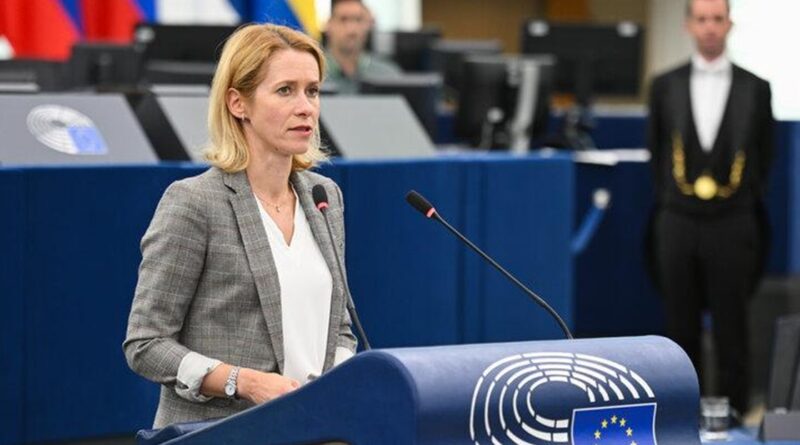
EU foreign policy chief: US easing of sanctions on oil from Russia is a dangerous precedent
The United States easing of sanctions against oil from Russia is a dangerous precedent because “we need them to have less money for waging the war than more,” European Union foreign policy chief Kaja Kallas said on March 16.
Kallas was speaking on arrival for a meeting of EU foreign ministers.
As the BBC reported, the US has loosened sanctions preventing other countries buying Russian oil and petroleum already loaded on vessels at sea to try to ease the energy supply crunch sparked by the US-Israel war with Iran.
Kallas told reporters that it is important that the attention on the Middle East does not take away the attention from Ukraine.
She said that the Strait of Hormuz being closed is also to the benefit of Russia to fund this war: “We need to do definitely more on this”.
What is happening in the Middle East is also affecting Ukraine.
“It is affecting other partners. And there, the main topic will be how to keep the Strait of Hormuz open,” Kallas said.
She said that during the weekend, she had had talks with UN Secretary General Antonio Guterres
about whether it was possible to also have the same kind of initiative “like we had the Black Sea initiative, how to get the grain from Ukraine out, because the closure of Strait of Hormuz is really dangerous for the oil supplies, energy supplies to Asia”.
Kallas said that there would be discussions with EU member states about whether it is possible to change the mandate of the Aspides mission.
Operation Aspides, also known as European Union Naval Force Aspides, is an EU military operation in response to the Houthi terrorist group’s attacks international shipping in the Red Sea
The point is that whether the member states are willing to actually use this mission, Kallas said.
“If we want to have security in this region, then it would be easiest to actually already use the operation that we have in the region, and maybe a change a bit,” she said.
There is also talk of Coalition of the Willing in this regard, Kallas said: “But we also need to see what could be the fastest to provide this opening for the Strait of Hormuz”.
Asked to comment on Trump’s comments in an interview with the Financial Times that it would be “very bad for the future of Nato” if allies do not help secure the Strait of Hormuz, Kallas said: “Clearly, all these security theatres are very much interlinked when it comes to the capabilities that are needed in Ukraine or in the Middle East, when it comes to also our attention”.
“That is very, very clear. And the actors or our adversaries are also using this. So, this is very, very clear,” she said.
“Now, it is in our interest to keep the Strait of Hormuz open and that is why we are also discussing what we can do in this regard, from the European side,” Kallas said.
(Archive photo: European Parliament)