
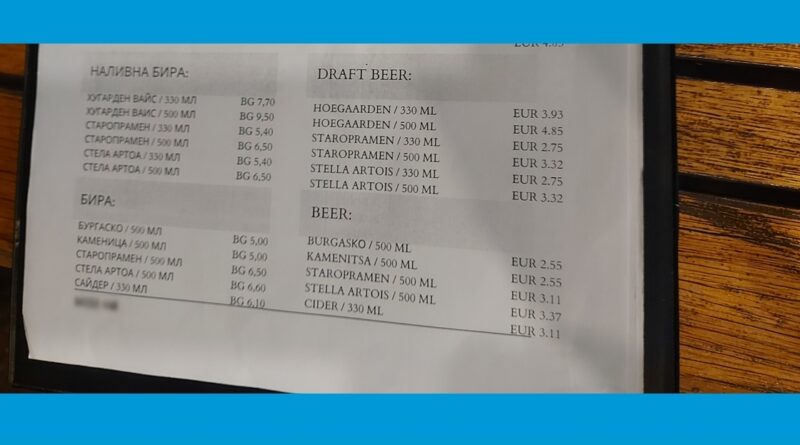
Bulgaria and the euro: Fining of traders who break dual pricing rules begins
As of October 8, the grace period provided for in Bulgaria’s Euro Adoption Act has ended and traders who break the rules on displaying dual pricing of goods and services in leva and euro will now face fines.
The prices must be written in the same font, size and colour so as not to mislead consumers.
Cash receipts must also show double denomination – in leva and euro. Checks are being conducted by the Consumer Protection Commission and National Revenue Agency.
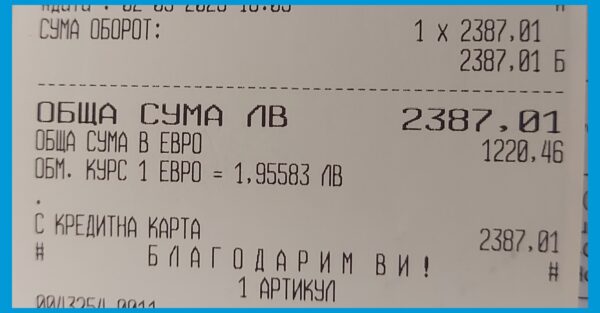
Alexander Kolyachev, acting head of the Consumer Protection Commission, told bTV on October 8: “After today we begin to impose sanctions on dishonest traders who do not provide information and on traders who incorrectly declare prices on their labels”.
“We have issued quite a few warnings. We are checking the sites very massively and issuing the appropriate warnings,” Kolyachev said.
“We rely on 65 inspectors, we are trying to digitally acquire the information we need. We use the on-site inspections as confirmation of the information from the companies. When we have signals and complaints about small sites, we go to the site,” he said.
The most common violation is with the labeling in leva and euro – lack of price in one currency, incorrect currency conversion, difference in font between the two currencies.
The fine is determined according to the company’s turnover.
On the topic of unregulated and unjustified price increases, Kolyachev said that it was too early to answer.
An unreasonably high price is a price that does not depend on economic criteria. “We have a formula with which we calculate using many criteria,” he said.
On October 6, speaking at an information meeting on Bulgaria’s changeover to the euro – which will happen on January 1 2026 – Bulgarian National Bank (BNB) issue department chief director Georgi Chanev said that BNB’s priority now is to supply commercial banks with euro banknotes and coins, and they in turn must distribute them among traders and businesses so that the new currency can be available from the first day of 2026.
BNB called on the public who have free and available funds in leva to deposit them in a bank now, so that they can be automatically converted into euros from January 1.
Fraud and unfair exploitation of the process are likely to occur, so the BNB reminded that the exchange of leva into euro should be done only in official places – the BNB, commercial banks and branches of Bulgarian Posts, a report on the meeting on the evroto.bg website said.
For reliable official information on Bulgaria’s transition to the euro, the Association of Banks in Bulgaria has a Q and A, in English.
The official evroto.bg website has an English-language version, while the European Commission made available on July 8 a Q and A on Bulgaria’s changeover to the euro.
(Photos: Clive Leviev-Sawyer)


