
Alpha Research poll finds rise in support among Bulgarians for euro
A poll by the Alpha Research agency has found an increase in support among Bulgarians for the country’s forthcoming euro accession.
Bulgaria is to use the euro as its currency as of January 1 2026.
In July, support was 49.2 per cent, with 45.8 per cent against and five per cent undecided – a change from the equivalent May 2025 poll by Alpha Research which saw 46.5 per cent in favour, 46.8 per cent against and 6.7 per cent undecided; and in turn from the April 2025 poll, which saw 45.2 per cent in favour, 49 per cent against and 5.8 per cent undecided.
The poll found that Bulgaria’s private sector was maintaining a consistently high positive attitude – 69 per cent in favour and 30 per cent against.
“The overall assessment of both target groups is that if Bulgaria adopts the euro from January 1 2026, this will be a success for our country in its overall European integration,” Alpha Research said.
“Forty-three per cent of the general public and 62 per cent of business representatives share this assessment,” the agency said.
The main concerns among Bulgarian citizens continue to be focused on the short-term effects, immediately after (and now – even before) the introduction of the euro.
Although some of the concerns have decreased in the last month, the assessment of the consequences in the near future continues to be with a minus sign (47 per cent negative versus 39 per cent positive opinions).
As for the long-term effects, both citizens and businesses have optimistic expectations, and they are especially strongly expressed among entrepreneurs (65 per cent : 22 per cent).
In terms of specific expected positives, pragmatic and rational views prevail – convenience in travelling and paying abroad (59 per cent), facilitated trade with other European countries, increased financial security and stability of the country, strengthening European affiliation and preventing the transition to another sphere of influence (all between 25-30 percent).
“These more rational assessments, devoid of excessive expectations and populism, are largely due to the social profile of the supporters of the euro – people with higher education, employed in modern industries, professionals, from large cities, well informed about real economic processes,” Alpha Research said.
The agency said that the most worrying trend that the survey registered is the significant increase in people who fear speculation and artificial price increases – 71 per cent, which is a significantly higher share of people with a negative attitude towards the euro.
That is, the concern has covered broad social groups, the agency said.
“In this light, there is a risk of erosion of public attitudes in the event of price increases by the end of the year and in the first six months of the next.”
Although the dual display of prices in leva and euro has been introduced on a large scale relatively recently, most Bulgarians have already encountered it: 90 per cent have seen the dual display in grocery stores, 38-40 per cent in bank statements and mobile operators, 36 per cent – in clothing and shoe stores.
“The first encounters logically cause contradictory assessments, since getting used to the new currency takes time.”
In this sense, it is very important that the dual display starts earlier, the agency commented, though it was on August 8 that mandatory dual pricing took effect, after the poll was done.
“At the moment, people’s self-assessments are divided into two almost equal parts – 34 per cent claim that it makes it easier for them, they are starting to get used to it,” the agency said.
Thirty-six per cent admit that the dual display rather confuses them – most often they report that they are misled by the lower price, which is in euro, the poll found.
The preferred way for both citizens and businesses to exchange the leva they have is in bank branches.
The share of citizens choosing this method has increased to 71 per cent and is almost equal to that of businesses (76 per cent).
“Obviously, the banks’ campaign to deposit leva without a fee has yielded results,” Alpha Research said.
Post offices are mentioned by about six per cent of respondents, mainly living in small settlements.
A significant decline is observed in exchange offices (from 12 per cent in May to five per cent in July), but for people with higher balances (including for some businesses) they remain the second preference.
In total, over a quarter of the company management are of the opinion that in the coming months, or immediately after the introduction of the euro, they will have to increase the salaries of their employees: seven per cent – in the next one or two months, and a further 20 per cent – immediately after the introduction of the euro.
If they come true, these predictions will also affect prices and inflation, the agency said.
Asked to estimate what percentage of payments to company employees are made by bank transfer and what percentage is made in cash , companies logically indicate different ratios, but the summarized average result is: 68.5 per cent by bank transfer; 31.5 per cent in cash.
Business assessments of the abilities of Bulgarian state and private institutions to cope with the preparations for the introduction of the euro are a positive exception to the permanent crisis of institutional trust in Bulgaria, the agency said.
Central Bulgarian National Bank continues to be the institution with the highest trust among businesses and is recognised for leading this process. Ninety-one per cent are confident that it will succeed.
The 88 percent positive opinions about commercial banks are a very important prerequisite for a smooth transition, given the close interaction of businesses with them.
High levels of trust are also registered in relation to the Ministry of Finance (70 per cent are confident that it will cope, 22 per cent are doubtful) and the National Revenue Agency (66 per cent versus 22 per cent).
The opinion on the readiness of municipalities is more polarized (43 per cent : 37 per cent) and reflects the assessment of the capacity and expertise in municipalities of different sizes, the agency said.
The only two institutions with negative assessments from businesses are the Competition Protection Commission (30 per cent believe in their ability to cope, 54 per cent – not) and the Consumer Protection Commission (34 per cent : 56 per cent).
Considering the increased powers and obligations of these two commissions, “these assessments are a serious signal to them,” the pollsters said.
The survey was done from July 8 to 22, the third consecutive such poll in a series on public attitudes in connection with Bulgaria’s accession to the euro zone. The client was the Ministry of Finance. A total of 1200 citizens over 16 years of age were surveyed in their homes through a direct standardized interview with tablets. Separately, 500 owners or representatives at the management level of businesses, responsible for making decisions for the development of the company, were surveyed.
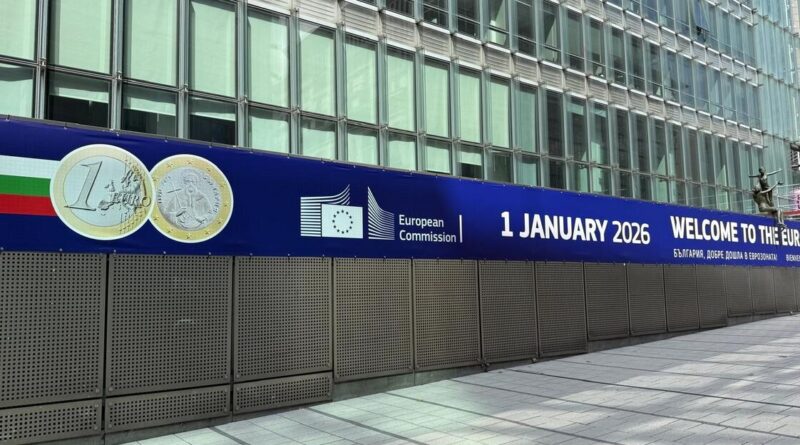
(Photo via the evroto.bg official information website)
For exclusive subscriber-only access to The Sofia Globe’s analysis and commentary on events in Bulgaria, please sign up to our page on Patreon:


