
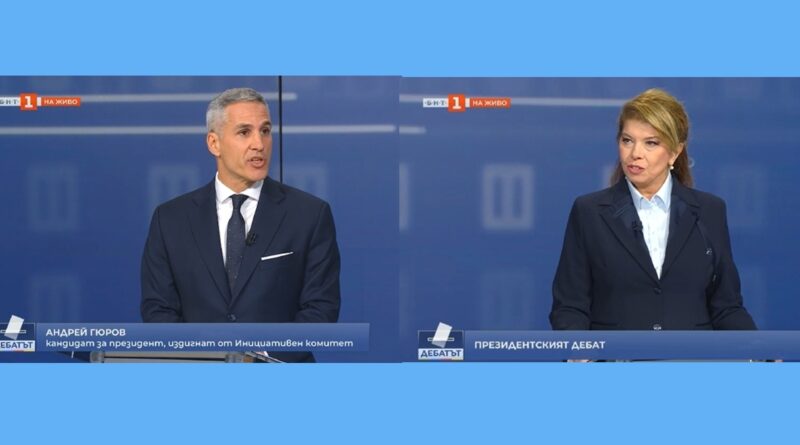
Bulgaria’s 2026 presidential elections: Notes from the Gyurov – Yotova debate
The rival candidates in the second and final round of Bulgaria’s 2026 presidential elections – incumbent head of state Iliana Yotova and former caretaker prime minister Andrei Gyurov – met in a live television debate on the night of October 29, and hereafter, that might serve as a final statement of fact.
The debate, on Bulgarian National Television (BNT), was the one and only face-to-face public confrontation in these elections between the two, since the official campaign period began and before the November 1 finale.
Billed on BNT’s official website as having been intended to last from 9pm to 10.30pm, an hour and a half, it lasted for close to two.
Whether it changed any minds among those who will go to the polling stations on November 1 remains to be seen. Its significance is of and of itself – as the one and only confrontation in which the two rivals, in the course of this election, stood in front of the viewing public to punt their competing views.
The close to two hours passed, in a subjective view, with neither a killer blow nor a gaffe of any significance.
It was, by the standards of rivalry in Bulgarian politics, conducted with some degree of decorum. Each, by these standards, seldom accused the other of lying.
Questions of style.
Yotova, vice president before being elevated to her chair by Roumen Radev’s departure for parliamentary politics, for him to win a decisive victory in Bulgaria’s April 2026 early parliamentary elections, chose for her appearance to emerge with pinned-back hair and a serious business suit, in contrast to her customary cornucopia of a coiffure.
Gyurov was costumed in dark suit and dark tie, that subtly murmured statesmanship. He declined, as is his prerogative, to address or refer to his opponent as anyone but “Mrs Yotova”. Not “Mrs President”. No need to concede to her the benefits of incumbency.
But any such debate is not merely about sartorial style. It is about delivery. Yotova, decades ago, was a presenter on host broadcaster BNT. In the course of the close to two hours, she answered the questions – in the parameters of the old radio show – without hesitation, repetition or deviation. She came across as unquestionably well-prepared and well-rehearsed with regard to the questions from host Poli Zlatarova with which she was presented.
Gyurov has experience as a university lecturer but less so as a debater. On a number of times in the course of proceedings, he seemed to lose his train of thought. In an election well to the west of here, those moments of empty air would cost him.
But this television event featured not only Yotova, who has the backing of the governing party of Roumen Radev, and Gyurov, who has the backing of reformist, pro-Western, pro-EU and pro-Nato and anti-Putin parties from the parliamentary opposition.
Always with us, these troubled autumn days, as Putin’s regime sinks ships off the Bulgarian coast, leaving sailors dead and cargoes lost in the depths of the ever-colder Black Sea, are the drones. Moreover, the unwillingness of the Radev-Yotova axis to pin the blame on Russia. Yotova and Gyurov were on the stage, but the drones of the day, and Radev, were present as key characters in this drama. The spectres at the barren banquet.
The debate on BNT took place at the close of a day in which it was confirmed, on the same television station, that the latest vessel to fall victim to an attack by drones, the Costship Jet, had receded beneath the waves.
Cue the same narratives that we have heard throughout the campaign, and before it. From Yotova’s podium, in that BNT studio, the insistence on “peace”. The characterisation of Gyurov, in his guise as a former caretaker PM whose administration signed a security guarantee with Ukraine, as complicit – with neither the consent of nor consultation with Parliament, nor the Presidency where Yotova sat – in about to send Bulgaria’s youth to war, in the battlefields in Ukraine. That such an allegation cannot stand, given that Parliament – holder of the prerogative on the deployment of military personnel abroad – has twice voted against this happening, including at the instance of political forces backing Gyurov, is neither here nor there. At least not for the camp opposing him.
Gyurov countered, as well he might, that the guarantee contained no such undertaking. He sought to portray it as an opportunity for Bulgaria’s defence manufacturing industry. Yotova countered that it contained no such undertaking.
Gyurov had his opportunity, and took it, to underline that the Radev-Yotova axis had left this country’s allies uncertain about where it stood in the contest between European democracy, on the one hand, and Putin, on the other.
These exchanges were typical of the battle lines drawn throughout the election campaign, and its backdrop, the Bulgarian politics of the day.
Gyurov offered how unprofitable the Botas deal with Turkey, signed by a caretaker government appointed by Radev, was for Bulgaria. He raised, when the opportunity arose, the controversial pardons granted by then-vice president Yotova to drug dealers, at least leaving Yotova on the defensive about how it all had been done on documents presented to her by experts.
The close to two hours dwelt less than it should have, from the point of view of the camp of Gyurov, a lecturer in economics and finance, on cost of living. He had little chance to pin on Radev, and by extension Yotova, the current rulers’ questionable handling of the economy.
It was when we were on to numbers that Gyurov was more confident.
But it was when we got on to decisions about shifting money to the state coffers from Bulgarian Development Bank that one could sense that the electorate might wonder what on earth these two were dipping each other’s pigtails into the inkwell about. It was a wee bit arcane. It was no – in the legend of US presidential elections – “where’s the beef?” moment. Gyurov, if he had wanted to attack Radev, and by extension Yotova, about the price at the pump, appeared to have brought a hairpin to a gunfight.
In the October 25 first round, Yotova ended a mere 2.81 percentage points ahead of Gyurov, a margin vastly narrower than the eve-of-vote polls had predicted. In the BNT show on October 29, Yotova played to her existing backers (notably, the pro-Putin, pro-Russian, pro “peace” ones) and Gyurov, to the electorate that he has, and will, perhaps, have – if they turn out on Sunday.
It all passed with no killer blow. Those happen out on the Black Sea, the ones that some can with confidence ascribe to Putin’s Russia and others can insist lack any evidence to ascribe guilt for the killing of civilian sailors.
No significant gaffe or weakness? With neither, Yotova and Gyurov, playing to anyone but their own electorates, all that may be said is that a blunder is in the eye of the beholder.
Please support independent journalism by clicking on the button below. For as little as three euro a month or the equivalent in other currencies, you can support The Sofia Globe via patreon.com and get access to exclusive subscriber-only content:


