
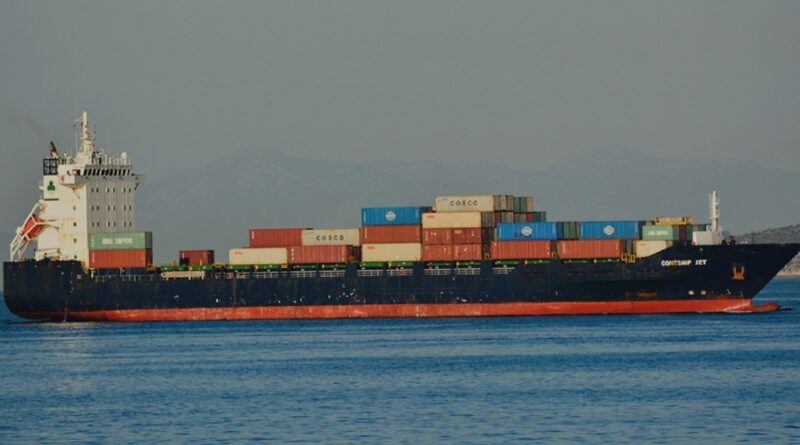
Bulgaria’s Black Sea being checked for pollution where ship was sunk by drones
Laboratory tests are being done at five points along the Black Sea coast where container ship Contship Jet was sunk in a drone attack on October 28, Bulgaria’s Environment Ministry said.
The vessel was attacked by three drones on October 28. While all hands were rescued by the Navy and Border Police, containers fell into the water and hours after the attack, the ship sank.
The Environment Ministry said that during an inspection on October 28, in the area of Shabla and Bolata Bay at Cape Kaliakra, no oil slicks, visible changes in the water surface or other visible traces of pollution were found.
These are initial observations that will be supplemented with laboratory analysis, the ministry said.
According to the ship’s manifest, the cargo included lithium-ion batteries, corrosive liquids and acids, flammable liquids, including ethanol solutions, household chemicals and plastics, along with food, construction materials, wood, equipment and industrial components.
“I have no hesitation – the drones that hit the merchant ship near Cape Kaliakra are Russian,” Captain Todor Georgiev, owner of a shipping agency, told Nova Televizia on October 29.
Georgiev said that artificial intelligence was also used in yesterday’s attack. He was adamant that Bulgaria must take more serious measures to protect shipping in the Black Sea.
The captain also warned of the dangers posed by the stricken ship. According to him, the vessel and the containers on board pose a risk to other ships, especially in the event of a collision.
The drones that hit the container ship yesterday came from the east, outgoing Defence Chief Admiral Emil Eftimov told bTV on October 29.
He declined to name the country from which the drones came, but indicated that Bulgaria has enough information that will be analysed.
“The drones came from the east. We have enough information regarding the drones. The information we have has been shared with the relevant competent authorities both nationally and at the European Union level,” Eftimov said.
“Analysis and accurate information, if any, about the origin of the drones are pending, but we have enough material to work with,” he said.
Eftimov told bTV that a new system will be deployed on October 30, which will be upgradeable, including capabilities for aerial surveillance and, later, for strikes. It will have a radius of 150 kilometres, he said.
Maritime Administration teams have inspected the vessel and after assessing its condition, said that no significant negative consequences for the marine environment and the coast are currently expected, a statement on October 29 said.
(Photo via the website of Bulgaria’s Transport Ministry)


